
Reviewed · HIKING & TREKKING
The Urban Hike of Marseille
Marseille reveals itself best on foot, and this 10-kilometer urban hike gets far beyond the usual Old Port circuit. With Olivier leading the way, you move from fisherman villages and sea coves to quiet lanes, wooded parks, grand Second Empire buildings, and the summit of Notre Dame de la Garde. It is part city walk, part light workout, and part lesson in how Marseille grew.
I like the route’s mix of big views and small corners, especially Vallon des Auffes, Malmousque, and the narrow paths around Bompard. I also like the small-group size, capped at 10 people, which gives the guide room to explain local customs and answer questions. The main caution is simple: this is a real hike, not a gentle sightseeing stroll. Expect about 10 kilometers, stairs, hills, and one notably steep return toward the Old Port.
In This Review
- Key points to know before you book
- Why this Marseille walk feels different
- Starting at the Old Port and reading Marseille from the water
- Vallon des Auffes and the Corniche Kennedy
- Pharo Palace, Second Empire power, and the city’s expansion
- Park Valmer and a greener side of the coast
- Bompard and the Chemin du Vallon de l’Oriol
- Malmousque, a calm cove with a local feel
- The steep return through Boulevard André Aune
- Notre Dame de la Garde and the best city view
- Returning to the Old Port through the Palais de Justice
- Heat, pace, group size, and practical value
- Who should choose this urban hike
- FAQ
- Where does the urban hike begin?
- Where does the tour end?
- How long is the experience?
- How far do you walk?
- What are the main places visited?
- Is the walk suitable for most people?
- Is the tour available in English?
- How many people can join?
- What happens if the weather is poor?
- Can I cancel for a full refund?
- Should you book The Urban Hike of Marseille?
Key points to know before you book
- A 10-kilometer route with serious variety: You see the port, coast, parks, residential districts, historic buildings, and basilica in one outing.
- Olivier is the central attraction: His style is warm, humorous, and strongly tied to Marseille’s local stories and culture.
- The route reaches places buses cannot: Vallon des Auffes, Malmousque, Bompard, and small lanes provide a more local view of the city.
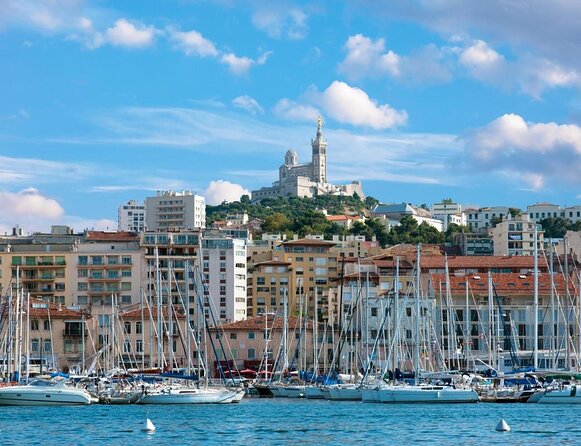
- Notre Dame de la Garde is the high point: The basilica and its square give you a useful 360-degree view for understanding Marseille’s shape.
- Heat planning is built into the walk: There are eight water points, shaded areas, wooded parks, sea breezes, and early or late time slots.
- Check the language before paying: The experience is available in French, and an English-language booking can cause problems if not clarified in advance.
Why this Marseille walk feels different
Many Marseille excursions stay near the Vieux Port, Le Panier, and a few major monuments. This one uses the city as a long outdoor classroom. You are not simply shown a church, a harbor, or a pretty cove. You are asked to connect them.
The route helps explain Marseille through three ideas: its dependence on the Mediterranean, its long struggle and exchange with central French power, and the way its neighborhoods spread up hills and along the coast. That makes the walk useful early in your stay. After three and a half hours, you should have a better mental map of the city, not just a collection of photographs.
Olivier is the guide named most often in the experience details. His approach combines history with anecdotes, local architecture, geography, and the everyday identity of Marseille. The tone is not meant to be academic. You can expect stories about neighborhoods, buildings, famous local figures, and the city’s distinctive character, including an anecdote connected with footballer Eric Cantona’s childhood home.
The 97 percent recommendation rate and 4.9 rating suggest a very strong record, though the sample is small at 35 ratings. The one serious complaint involved a language misunderstanding and a last-minute cancellation. That is not a minor detail for international visitors. Confirm that you can follow a French-language tour before booking.
More Hiking Tours in Marseille
- Marseille: Calanques National Park Guided Hike with Picnic
★ 4.9 · 516 reviews - From Marseille: Calanques National Park Guided Hike
★ 4.8 · 489 reviews - Hiking in the Calanques National park from Marseille
★ 4.5 · 211 reviews
Starting at the Old Port and reading Marseille from the water
You meet at 19 Quai des Belges, right at the Old Port. This is an excellent starting point because Marseille’s story begins here, and Olivier uses the harbor to explain the city’s basic relationship with the sea.
The opening 30 minutes focus on the port from antiquity through the reign of Louis XIV. You will hear how the city developed around this space and why the Mediterranean and the Orient shaped local trade, habits, and identity. The guide also sets expectations for the walk, including the pace, the route, and what may be pulled from his backpack during the outing.
The Old Port is also where the walk ends. That gives the experience a neat shape. You begin with the city’s historic center of gravity, leave it behind for the coast and hills, then return with a clearer idea of how the parts fit together.
Do not expect a long museum-style talk at the start. This is a moving tour, and the port introduction is meant to prepare you for what follows.
Vallon des Auffes and the Corniche Kennedy
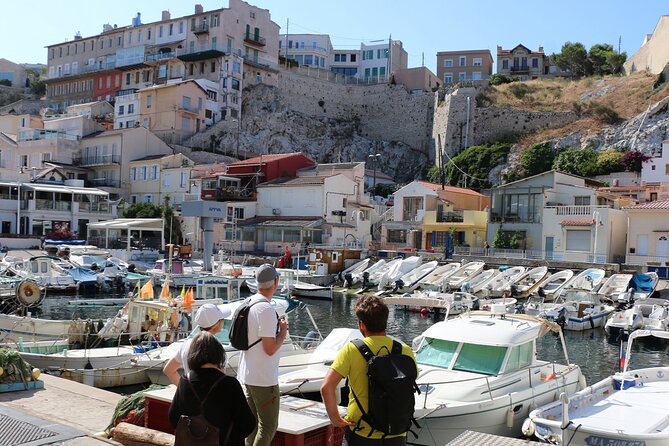
From the center, the route reaches Vallon des Auffes, one of Marseille’s most appealing seaside corners. The cove is known for its preserved fisherman houses, which sit in a tight, sheltered setting that feels far removed from the broad avenues nearby.
Olivier uses the village to discuss fisherman life and the decisions that allowed this small area to survive as Marseille expanded. That is one reason the stop matters. It is not only photogenic. It shows how a city can grow quickly while still retaining small pockets of older housing.
You get about 10 minutes here, so this is more of a focused pause than a long free period. Bring your camera, but listen closely too. The value is in understanding why the cove looks as it does.
The walk then follows part of the Corniche Kennedy. Here, the open sea gives you a broader sense of Marseille’s position on the Mediterranean. The 20-minute stretch is less about monuments and more about horizon, air, and the city’s long habit of facing outward toward the water.
This section can feel exposed in strong sun, but the sea breeze helps. The tour is planned with heat in mind, including shade and water access along the wider route.
Pharo Palace, Second Empire power, and the city’s expansion
Palais du Pharo gives the hike a useful change of pace. Its grounds provide greenery and wide views toward the Old Port and the Grand Port of Marseille.
The palace was built under Napoleon III, and Olivier uses it to explain how much Marseille changed during the Second Empire. This is a key historical point. The Marseille you see today was shaped heavily during that period, when major public works, roads, buildings, and urban changes altered the city’s scale.
A map of Marseille helps make the explanation practical. Instead of hearing only dates and names, you can look out across the port and connect political decisions with the shape of the city.
The stop lasts about 30 minutes. It is also one of the better places to catch your breath, especially if the weather is warm. You are still walking a long distance, so these pauses matter. The tour has an active rhythm, but it does not aim to rush you from one photo stop to the next.
More Marseille & Provence trips worth a second look
- Marseille: Urban Hiking Tour with a Local Guide
★ 4.9 · 198 reviews - Cassis: 3 Calanques Half-Day Hiking Tour with Swimming
★ 4.7 · 158 reviews - Marseille: Guided Hiking Calanques National Park from Luminy
★ 4.8 · 100 reviews - Guided hike in the Calanques National Park
★ 5.0 · 37 reviews
Park Valmer and a greener side of the coast

Le Parc Valmer shifts the mood again. After the sea and large port views, you enter a Mediterranean park with trees and shade. The route describes this as moving from the big blue to the big green, and that is a fair picture of the change.
The park and Villa Valmer open a conversation about Marseille’s economic past. Olivier connects the area with the old olive oil trade and then with the city’s present role as a tourism center. That gives you a more rounded view of Marseille. The city is not only a port, a resort, or a historic site. Its fortunes have changed with trade, industry, and visitors.
The half-hour stop should appeal to you if you like architecture and gardens but do not want a separate formal garden tour. It also provides shade and a quieter break. Since the route later climbs toward Notre Dame de la Garde, this is a good time to drink water and adjust your pace.
Bompard and the Chemin du Vallon de l’Oriol
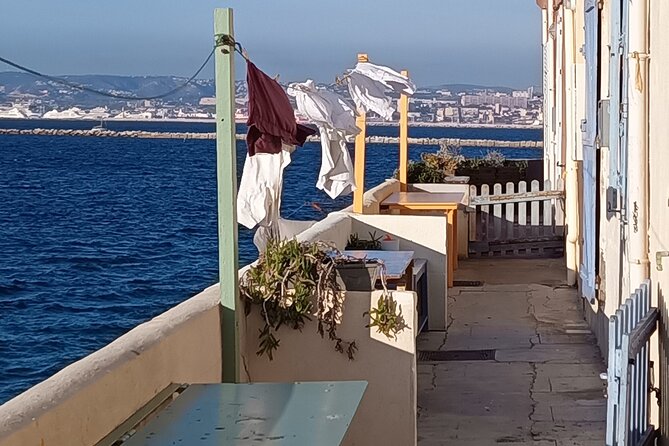
The Chemin du Vallon de l’Oriol takes you away from the immediate waterfront and into Bompard. This is one of the route’s more valuable sections because it shows Marseille as a residential city rather than a postcard.
You pass older villas and bastides associated with the development of the city during the 20th century. The changing housing styles help explain how neighborhoods grew beyond the traditional port center. Olivier also uses the path to begin the story of Notre Dame de la Garde and its role in Marseille’s culture.
The route is described as quiet and less obvious than the main tourist roads. You should not expect a long flat walk here. The path leads gradually toward the basilica, and the combination of hills and stairs is part of the experience.
This is where good shoes become essential. One previous visitor offered the most practical advice of the entire experience: wear proper walking shoes. I would add that you should not save this tour for the day your feet are already worn out from a long arrival or cruise excursion.
Malmousque, a calm cove with a local feel
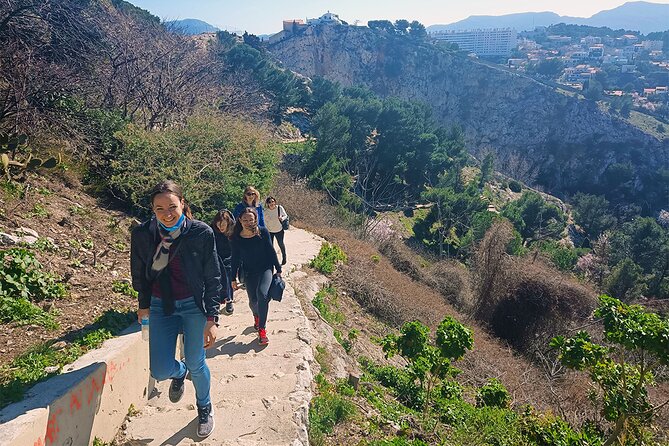
Anse de Malmousque is another highlight. The district includes a cove, a small port, handsome buildings, and fisherman housing. It has a quieter feel than the Old Port and a strong connection to seaside living.
Olivier uses Malmousque to explain several layers of Marseille at once: its ancient Mediterranean connections, rapid urban growth over the last two centuries, and the way residents use the coast as part of daily life. The area’s Greek associations and low-key atmosphere make it a good counterpoint to the grander public spaces earlier in the walk.
The stop lasts about 30 minutes. You have time to appreciate the view and the character of the district, though this is still a guided hike rather than a free exploration period. Stay with the group so you do not lose the thread of the local details.
Malmousque is also a reminder that Marseille’s appeal is not limited to famous monuments. Some of the most memorable parts of the route come from seeing how ordinary homes, coves, lanes, and public paths fit together.
The steep return through Boulevard André Aune
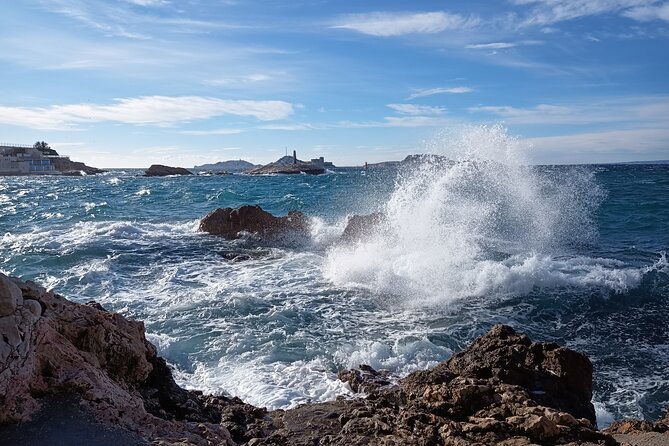
The route back toward the Old Port is not an afterthought. It takes you along Boulevard André Aune, described as one of the steepest boulevards in Marseille.
From above, you get another strong view. Then the walk gradually enters the city center, with the slope bringing you physically and visually back into the urban core. Olivier uses the buildings along the way to explain Marseille’s distinctive housing patterns and the city’s relationship with central government and local independence.
This 10-minute section is short, but it may be the hardest part for some people. Downhill walking can be tough on knees, while the earlier climbs may have already tested your legs. The guide’s slow pace and breaks help, but you should still judge this experience as an active outing.
The route’s 10-kilometer distance is not hidden behind transport. You walk the entire way. That is the chief reason the tour reaches places that are difficult to visit by car or bus, but it is also the chief reason to skip it if you need a low-effort day.
Notre Dame de la Garde and the best city view
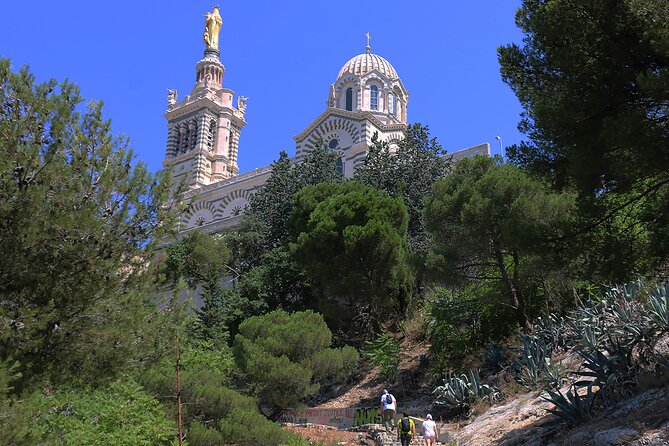
Notre Dame de la Garde is the physical and emotional high point of the walk. The basilica is impressive on its own, but the square outside gives the visit its practical value: a 360-degree view across Marseille.
From here, Olivier can point out the city’s major areas, monuments, ports, and extensions. After walking through the neighborhoods, you are in a good position to understand the pattern. The city is no longer an abstract map. You have followed its coast, climbed its residential slopes, and returned toward the center.
The basilica also matters culturally. Olivier explains how people in Marseille relate to this place and why it has such a strong place in local life. You get about 30 minutes to take in the building and the view.
Because this is the summit, the stop can feel like a reward. It is also the point where the tour’s history, geography, and culture come together most clearly. Bring patience for the climb, because the payoff is not just a monument visit. It is the chance to see the full structure of Marseille at once.
Returning to the Old Port through the Palais de Justice
The final stretch brings you back to the Old Port, passing between the Palais de Justice and the Commerce Court. These Second Empire buildings offer one last look at the authority and public order that shaped Marseille’s center.
Olivier uses them to discuss the city’s long habit of questioning central power, justice, and the way laws are made. This adds a political and civic dimension to the walk. Marseille is presented not as a passive provincial city, but as a place with its own strong identity and a complicated relationship with authority.
The tour ends where it began, near the Old Port. The planned finish suggests a natural place to sit at a cafe on Cours Estienne d’Orves for a beer or hot chocolate. That drink is not included, but it is a sensible way to end after several hours on foot.
Heat, pace, group size, and practical value
The price is $41.27 per person. For three and a half hours with a maximum of 10 people, that is a reasonable price if you want a guide who links many parts of Marseille into one story. You are paying for access to a route that would be difficult to organize alone, plus local interpretation in residential districts and smaller coastal areas.
The value is weaker if you only want the famous sights. You can visit the Old Port and Notre Dame de la Garde independently, and public transport can reach several major points. The advantage here is the connection between them, along with the smaller paths and neighborhood details in between.
The tour includes eight water points, shaded sections, wooded parks, and breaks. Early morning and late afternoon time slots help avoid the worst heat. Sunscreen is available, but you should still bring water, wear good shoes, and use sun protection.
Most people can participate, and service animals are allowed. The tour is near public transportation, uses a mobile ticket, and requires good weather. If poor weather cancels the walk, you can choose another date or receive a full refund. Standard cancellation allows a full refund when you cancel at least 24 hours ahead.
The experience is booked about 16 days in advance on average, so do not assume you can wait until the last morning in high season.
Who should choose this urban hike
You should book this if you enjoy walking, local history, city geography, and views earned by climbing. It suits an active first-time visitor who wants a broad introduction to Marseille in one morning or afternoon.
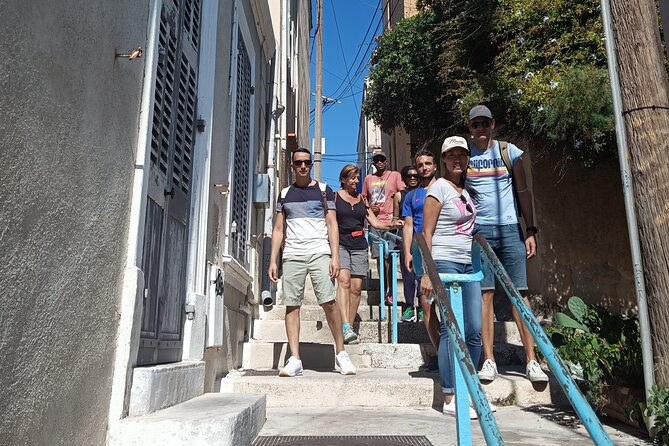
It is also a good match if you prefer small groups and personal storytelling over a large coach tour. Olivier’s humor, passion for Marseille, and knowledge of local customs are central to the experience.
You should think twice if you dislike hills, stairs, strong sun, or a fixed walking route. Families and older visitors may manage it, since most people can participate, but fitness levels vary. The tour description calls it accessible to everyone, yet the distance and steep sections still deserve an honest look.
French is the crucial language point. The guide’s response to a language complaint makes clear that the available tour is French-language. If you need English, ask before booking and wait for confirmation. Do not assume that an English booking page means the live tour will be conducted in English.
FAQ
Where does the urban hike begin?
The hike begins at 19 Quai des Belges, 13001 Marseille, France, at the Old Port.
Where does the tour end?
The activity ends back at the meeting point in the Old Port area.
How long is the experience?
The tour lasts approximately 3 hours and 30 minutes.
How far do you walk?
The route covers about 10 kilometers on foot.
What are the main places visited?
The route includes the Old Port, Vallon des Auffes, the Corniche Kennedy, Palais du Pharo, Parc Valmer, Bompard, Chemin du Vallon de l’Oriol, Malmousque, Boulevard André Aune, Notre Dame de la Garde, the Palais de Justice, and the Old Port again.
Is the walk suitable for most people?
Most people can participate, but you should be comfortable walking about 10 kilometers and handling hills and stairs. Good walking shoes are advised.
Is the tour available in English?
The available experience is in French. Confirm the language before booking if you need an English-language guide.
How many people can join?
The group has a maximum of 10 participants.
What happens if the weather is poor?
The tour requires good weather. If it is canceled for that reason, you can receive a full refund or choose a different date.
Can I cancel for a full refund?
Yes. You must cancel at least 24 hours before the local start time to receive a full refund. Cancellations or changes made less than 24 hours before the start are not refunded or accepted.
Should you book The Urban Hike of Marseille?
I would book this tour if you want to understand how Marseille fits together, not simply check off its two biggest sights. The combination of coast, hidden lanes, parks, residential districts, local architecture, and Notre Dame de la Garde gives you a much fuller picture than a short harbor walk.
Book it early, confirm the French-language format, and arrive ready for a proper walk. If you bring good shoes and accept the hills, $41.27 buys a lively, personal introduction to Marseille with Olivier and a route that reaches well beyond the standard tourist path.
Recently reviewed around Marseille & Provence
- Skip the Line: Museum of Romanity Ticket★ 4.5 · 45 reviews
- Guided tour Distillery of Lavender between Nîmes & Arles★ 5.0 · 84 reviews
- A Private Guided Historical and Cultural Tour in Nîmes★ 4.5 · 32 reviews
- Provence Hot-Air Balloon Ride from Forcalquier★ 4.5 · 75 reviews
- Horse ride in Haute Provence Luberon and Forcalquier★ 5.0 · 77 reviews
- Sailing day in the heart of the Calanques★ 4.5 · 61 reviews
- Sormiou Calanques National Park Electric Bike Tour from Marseille★ 5.0 · 60 reviews
- Provence : Aix en Provence, Cassis and Marseille Private Tour★ 4.5 · 53 reviews
Hiking & Trekking, compared.
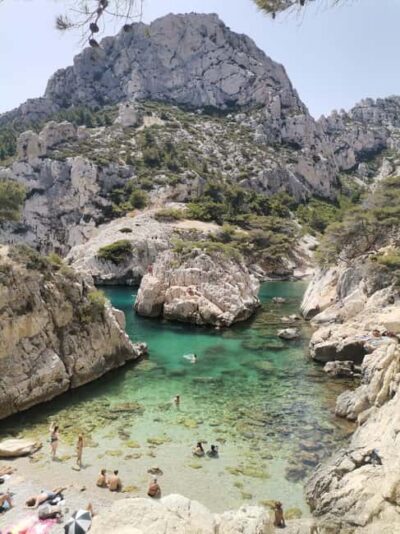
Calanques National Park Guided Hike with Picnic
Read our review →
Hiking in the Calanques National park from Marseille
Read our review →
Cassis: 3 Calanques Half-Day Hiking Tour with Swimming
Read our review →
Tour with the Mountain Train, Trek to Mystic Forest and Castle
Read our review →
Guided Hiking Calanques National Park from Luminy
Read our review →
Browse the lists this tour appears in