
Reviewed · BRITTANY TOURS
Unusual guided tour of Dinan immersed in the Middle Ages
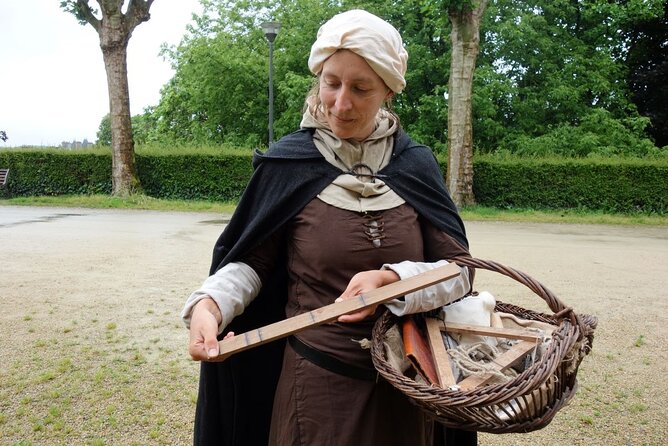
Dinan’s old walls become a working medieval building site on this unusual tour. Barbe, an assistant mason from the 15th century, leads you from the Ducal tower along the ditches and into the old town, explaining how defenses and houses were made while a war threatened Brittany. I love the hands-on construction angle and the way the tour uses tools and costume instead of treating Dinan as a collection of pretty facades.
I also like the clear route from the ramparts to Place Saint-Sauveur, plus the effort to correct old ideas about women in medieval society. The main consideration is practical: the meeting-point GPS marker has caused confusion, so check the written location carefully before arriving.
In This Review
- Key points to know before booking
- Why Dinan works so well for a medieval story
- Starting at the Ducal tower and small ditches
- Moving from fortifications into the old streets
- A guide who stays in character
- How the historical tools change the walk
- Group size, timing, and the $22.93 price
- Who will enjoy this experience most
- Meeting point advice and cancellation flexibility
- Should you book Barbe’s medieval Dinan walk?
- FAQ
- How long does the Dinan tour last?
- Where does the tour begin?
- Where does the tour end?
- Is the tour suitable for children?
- How many people can join the tour?
- Can I cancel for a full refund?
Key points to know before booking

- Barbe’s character-led approach: Your guide remains in the role of a 15th-century assistant mason, giving the walk a strong sense of place.
- Construction takes center stage: Learn how medieval walls and houses were built, not just who lived in them.
- A useful war-and-city connection: Dinan’s defenses make more sense when you understand the conflict between the King of France and the Duke of Brittany.
- Two different settings: Spend about an hour by the ramparts and ditches, then 30 minutes in streets and squares.
- Good for families: The tour is designed for adults and children over 8, with historical tools and audience participation.
- Simple, low-cost format: At $22.93 per person for about 90 minutes, it offers a focused introduction to Dinan without taking up half your day.
Why Dinan works so well for a medieval story
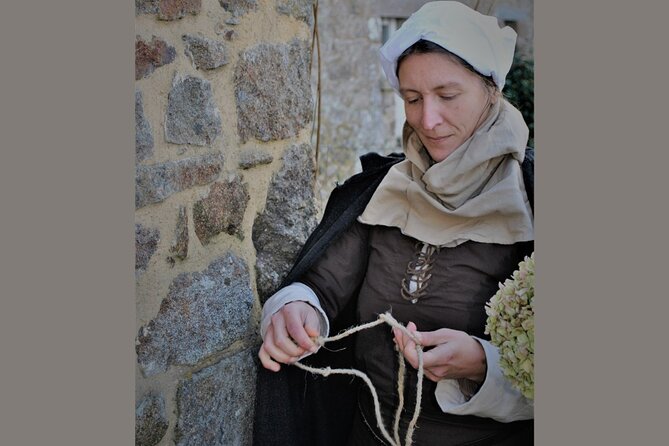
Dinan is the right place for a tour built around masonry, defenses, and daily life. Its ramparts, towers, narrow streets, and old squares give Barbe real features to point at as she explains how a 15th-century town functioned.
The story begins during a period of conflict between the King of France and the Duke of Brittany. That political struggle was not an abstract matter for people in Dinan. It meant the town needed protection, and the need for protection affected its walls, gates, buildings, and work crews.
I like this approach because it gives you a reason to look closely. A wall is no longer just a photogenic backdrop. It becomes evidence of labor, planning, military concern, and the limits of medieval building methods.
The tour also connects public defenses with private homes. You hear about the construction of a rampart, then about the techniques used to build a house. That contrast helps you understand how the same town served soldiers, masons, merchants, families, and craftspeople.
Barbe’s role as an assistant mason is especially useful. She is not presented simply as a noble, soldier, or famous historical figure. Instead, she represents someone involved in the physical work of making a city safer and more livable.
More Brittany trips worth a second look
- Saint-Malo: Guided Boat Tour with Local Captain
★ 4.9 · 300 reviews - GUIDED IN SEGWAY – MENHIRS – 1:30
★ 4.8 · 53 reviews - Nantes: Private custom tour with a local guide
★ 4.7 · 30 reviews
Starting at the Ducal tower and small ditches
The meeting point is on the Promenade des Petits Fossés, near the foot of the Ducal tower. The tour then follows the small ditches beside the castle and ramparts for about an hour.
This first section carries most of the building and military material. You learn why Dinan needed defenses and how medieval construction techniques helped create them. Barbe uses historical tools to support the explanations, giving the subject a practical feel rather than leaving it as a list of dates and rulers.
You can expect the guide to explain the work involved in building or repairing a wall. The focus is on methods and purpose: how a defense was made, why it was placed there, and how the town’s political situation affected the work.
That makes this portion particularly good for anyone who likes engineering, architecture, or military history. You do not need a background in any of those subjects. The material is presented for a general audience, and the guide’s role-play helps turn technical points into a story.
The setting also gives you a better sense of Dinan’s defensive shape. From the ditches and ramparts, you can see how the town’s protection was tied to its position and built environment. You are not only told that Dinan was fortified. You follow the line of those defenses and consider the effort required to maintain them.
The main drawback is that this section may be less appealing if you prefer a fast-moving sightseeing walk. Construction takes time to explain, and the tour gives that subject unusual attention. I see that as the point of the experience, but it is worth knowing before you book.
Moving from fortifications into the old streets
After about an hour near the ramparts, Barbe leads you into several streets and squares of Dinan. This final 30-minute section shifts from large public defenses to the smaller details of medieval urban life.
Here, you learn about different building methods and the way people lived at the time. The route ends at Place Saint-Sauveur, beside the Basilica Saint-Sauveur, giving the walk a clear finish in one of Dinan’s central historic spaces.
I like the change of scale. The ramparts show how a town defended itself, while the streets help you picture how residents used the town day after day. A house, alley, or square can reveal practical choices about shelter, work, movement, and community life.
The walk is also designed to challenge simple assumptions about the Middle Ages. Barbe does not present the period as a world where everyone had a fixed role based on modern stereotypes. Her explanations give special attention to women’s place in medieval society and offer a more balanced view of what women could do and how they contributed.
That theme has received strong emphasis in the experience. It is not a separate lecture added onto the walk. It is woven into the wider story of construction and everyday life, which makes the point feel more relevant to the places around you.
The last stop at Place Saint-Sauveur is convenient if you want to continue exploring Dinan afterward. The tour does not return you to the starting point, so you finish in a different part of the old town. That is useful for continuing on foot, but you should note the end location when planning your day.
A guide who stays in character
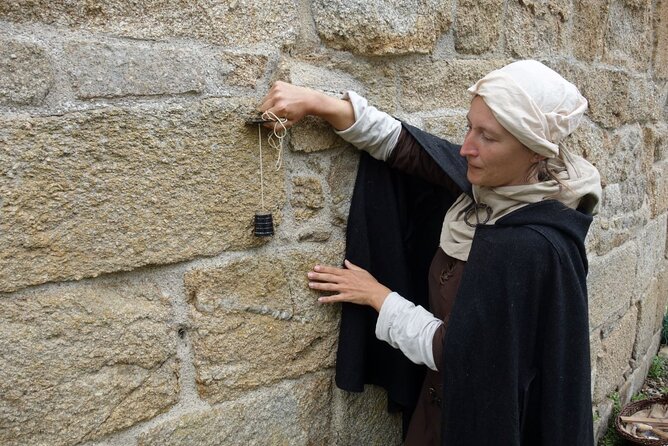
Barbe is the key to the experience. She appears as an assistant mason working on construction sites around Dinan, and the period costume supports that role from the beginning to the end of the walk.
The costume is not just decoration. It helps establish the point of view. Instead of hearing about medieval labor from a distant modern narrator, you receive the information through a character connected to the tools, materials, and work of the city.
Barbe’s style is also participatory. You can expect her to involve the group and keep the explanations accessible. The feedback attached to this experience repeatedly highlights her energy, clarity, passion, and ability to hold attention.
That matters on a history walk. Dinan offers plenty of visual material, but a guide still needs to connect those walls and buildings into a story. Barbe’s character gives the tour a consistent voice, while her construction background gives it a subject that feels fresh.
The guide also draws links between medieval life and the modern world. Those comparisons can help you understand unfamiliar customs without making the past seem identical to the present. The result is a more thoughtful look at the period, especially when discussing work, gender, and the organization of a town.
A different way to spend the day, same corner of France:
- From La Rochelle: Sailing Cruise to Fort Boyard
★ 4.8 · 623 reviews - Nantes CityPass : 24/48/72 Hours/7 Days Full Access
★ 4.3 · 320 reviews - Bay of Quiberon or Morbihan gulf: Evening 2 hours navigation
★ 4.7 · 135 reviews - Tour from Rennes : Mont Saint-Michel & Cancale & Saint-Malo
★ 4.7 · 121 reviews
How the historical tools change the walk
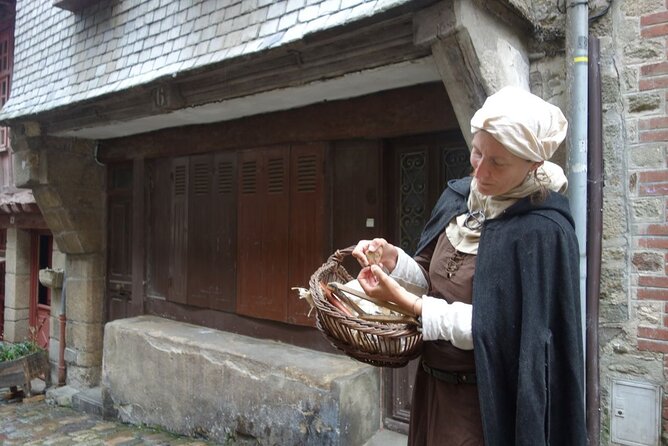
Many city tours rely almost entirely on spoken explanation. This one adds historical tools to the experience, which is a smart choice for a subject built around construction.
Tools make the work easier to picture. You can consider the difference between discussing a medieval wall in general terms and seeing the kinds of equipment connected with building work. Even without detailed technical knowledge, the objects give the conversation something concrete.
The tools also suit the guide’s character. Barbe is not pretending to be a court historian. She is connected to the work itself, and the objects reinforce that identity.
This practical focus is one of the strongest reasons to choose the walk over a standard overview of Dinan. If you want a tour that explains how a city was physically made, rather than simply naming important buildings, this experience should suit you well.
The format can also help children over 8 stay involved. A young person may not remember every detail about medieval politics, but tools, walls, building problems, and a guide in costume offer clear points of interest. Adults who enjoy history can still appreciate the more serious discussion of war, construction, and social roles.
Group size, timing, and the $22.93 price
The tour lasts about 1 hour 30 minutes, though the experience is described as running from 1 hour 30 minutes to 2 hours. That is a useful amount of time for a focused introduction to Dinan. You get enough time for context without giving up most of the day.
The maximum group size is 25 people. That is not a private tour, but it is still limited enough for a guide-led story to work well, especially if Barbe is asking questions or showing tools.
At $22.93 per person, the value depends on what you want from a city walk. If you only need directions around Dinan, you can explore independently for less. If you want a guide to interpret the walls, explain construction, connect the town to Breton politics, and present the period through a character, the price is reasonable for 90 minutes of organized storytelling.
The tour is also easy to fit into a wider visit. It is short enough to pair with independent time around Dinan, a meal, or a visit to other sights. Since it ends at Place Saint-Sauveur rather than at the starting point, you can use the finish as a new base for exploring.
Booking demand is moderate, with people reserving about 16 days ahead on average. You may not need to plan months in advance, but booking ahead is sensible if your time in Dinan is fixed or if you want a particular date.
Who will enjoy this experience most
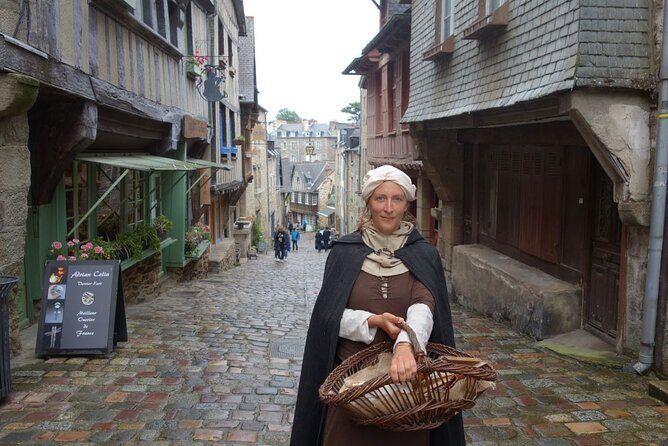
I would choose this tour if you want more than a pretty walk through medieval streets. It suits you especially well if you enjoy architecture, old building methods, local history, or tours that let a guide tell the story from an unusual point of view.
Families with children over 8 are also a natural fit. The costume, tools, and role-play give younger participants something to follow, while the explanations about war and construction give adults plenty of substance.
It is a good choice for visitors who want a balanced account of medieval society. The discussion of women’s roles adds a useful layer and avoids presenting the period through a narrow military or royal story.
You may want a different tour if your main goal is a broad survey of every major sight in Dinan. This walk gives particular attention to defenses, buildings, and daily life. It is not designed as a complete tour of every church, street, and monument.
The 90-minute walking format also means you should be comfortable moving between the ramparts, ditches, streets, and squares. The supplied information says most people can participate, and service animals are allowed. The route is near public transportation, which makes arrival easier.
Meeting point advice and cancellation flexibility
Take care with the meeting point. The written start location is Promenade des Petits Fossés, 22100 Dinan, at the foot of the Ducal tower area. One booking detail to watch is the GPS location, which has been reported as inaccurate, so rely on the stated address and landmark rather than following a map pin without checking.
The ending point is Basilique Saint-Sauveur, 14 Place Saint-Sauveur. Since the tour finishes there, plan your next stop from the basilica rather than assuming you will return to the ramparts.
Your mobile ticket is confirmed at booking. Free cancellation is available if you cancel at least 24 hours before the local start time. Changes or cancellations made inside that 24-hour window are not accepted for a refund.
The experience requires a minimum number of participants. If that minimum is not reached and the tour is canceled, you are offered another date or experience, or a full refund.
Should you book Barbe’s medieval Dinan walk?
Book it if you want a focused, lively explanation of how medieval Dinan was built and defended. The cost is fair, the route is manageable, and the period character gives the tour more personality than a basic architectural stroll.
I would recommend it most strongly to families with older children, history fans, and anyone curious about construction or women’s lives in the Middle Ages. The 4.9 rating from 40 reviews and 100 percent recommendation fit the experience’s strongest qualities: a passionate guide, clear explanations, audience involvement, and a memorable sense of time and place.
Skip it only if you want a fast list of monuments or a completely self-guided visit. For everyone else, Barbe offers a useful way to look at Dinan’s walls, houses, and streets with fresh eyes. Just confirm the Promenade des Petits Fossés meeting point before you set out.
FAQ
How long does the Dinan tour last?
The tour lasts approximately 1 hour 30 minutes. The experience may run from 1 hour 30 minutes to 2 hours.
Where does the tour begin?
It begins at Promenade des Petits Fossés, 22100 Dinan, France, near the foot of the Ducal tower and the small ditches beside the castle and ramparts.
Where does the tour end?
The tour ends at Basilique Saint-Sauveur, 14 Place Saint-Sauveur, Dinan.
Is the tour suitable for children?
The experience is designed for adults and children over 8 years old.
How many people can join the tour?
The maximum group size is 25 people.
Can I cancel for a full refund?
Yes. You can cancel at least 24 hours before the experience start time for a full refund. Cancellations or changes made less than 24 hours before the start time are not accepted for a refund.
Recently reviewed around Brittany
- Visit to Saline – Guérande Salt Marshes★ 5.0 · 86 reviews
- One hour quad ride between Nantes and La Baule★ 5.0 · 35 reviews
- Six day French Cooking Course in Brittany★ 5.0 · 30 reviews
- Boat trip on the Rance Canal★ 5.0 · 38 reviews
- [Walking Tour] Discover the Best of Brest in 2 hours★ 5.0 · 102 reviews
- Tour from Rennes : Mont Saint-Michel & Cancale & Saint-Malo★ 4.7 · 121 reviews
- Sea trip Golfe du Morbihan Arzon★ 4.9 · 29 reviews
- Nantes: Private custom tour with a local guide★ 4.7 · 30 reviews
Brittany Tours, compared.


Nantes CityPass : 24/48/72 Hours/7 Days Full Access
Read our review →
Saint-Malo: Guided Boat Tour with Local Captain
Read our review →
Bay of Quiberon or Morbihan gulf: Evening 2 hours navigation
Read our review →
Tour from Rennes : Mont Saint-Michel & Cancale & Saint-Malo
Read our review →![[Walking Tour] Discover the Best of Brest in 2 hours](https://im.bestfrancetours.com/wp-content/uploads/walking-tour-discover-the-best-of-brest-in-2-hours-400x267.jpg)
[Walking Tour] Discover the Best of Brest in 2 hours
Read our review →
Browse the lists this tour appears in