
Reviewed · MARSEILLE & PROVENCE TOURS
Marseille Guided Tour for 4 Hours with a Bilingual Local Guide
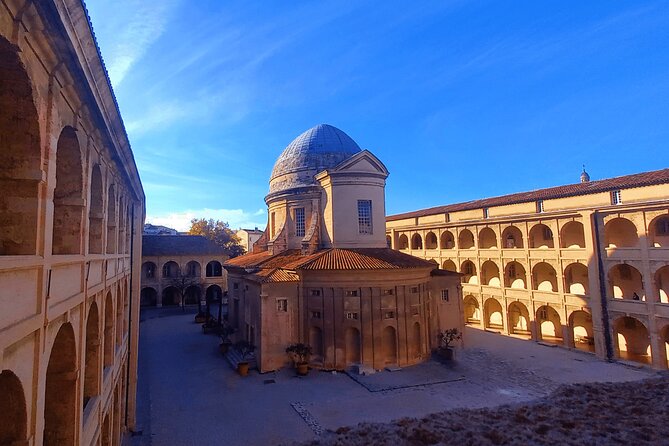
Marseille reveals itself best on foot, and this four-hour route moves from the grand La Major Cathedral through old lanes, harbor landmarks, hilltop views, and a small fishing cove. Guide Charles Mondon brings maps, photos, local context, and a warm conversational style, making the city easier to understand than it would be from a coach window.
I like the small group of up to eight, which gives Charles room to answer questions and adjust the pace. I also like the personal recommendations sent after the walk, especially if you book this near the start of your stay. The main catch is simple: this is a serious urban hike, with hills, stairs, and roughly 10 kilometers of walking for some groups.
In This Review
- Key points to know
- Why this walking tour works as a first look at Marseille
- La Major Cathedral gives the morning a grand start
- Le Panier is where the walking becomes personal
- La Canebière connects the old port to modern Marseille
- Notre-Dame de la Garde demands the biggest effort
- Vallon des Auffes feels far from the city center
- Palais du Pharo puts the harbor in a wider frame
- Saint-Victor adds an older, quieter note
- What Charles adds to the experience
- How hard is the walk?
- Timing, meeting point, and what is included
- Who should book this Marseille walk?
- Should you book this tour?
- FAQ
- How long does the Marseille guided tour last?
- Where does the tour start and finish?
- How large is the group?
- Is lunch or bottled water included?
- How physically demanding is the walk?
- What happens if the weather is poor?
Key points to know
- Charles Mondon leads the walk: He speaks very good English and explains Marseille through its history, neighborhoods, and present-day life.
- The route covers both sides of the city: You visit Le Panier and La Major, then cross toward the Canebière, Notre-Dame de la Garde, the coast, and the Old Port.
- Expect a workout: Depending on the exact route and pace, the walk can reach about six miles or more than 20,000 steps.
- The best views come with uphill effort: Notre-Dame de la Garde and Palais du Pharo provide sweeping views over Marseille and the Mediterranean.
- You see places coaches cannot reach: Narrow lanes, stairways, old corners of Le Panier, and the intimate Vallon des Auffes are central to the experience.
- The finish is practical: The tour ends near Métro Vieux Port, with buses, subway, boats, and walking routes available for the rest of your day.
Why this walking tour works as a first look at Marseille
Marseille is a city of sharp contrasts. A monumental cathedral sits near old working-class streets. A busy harbor gives way to quiet coastal inlets. Hilltop churches look out over modern apartment blocks, historic forts, islands, and open sea.
This tour links those contrasts in one continuous half-day. Instead of spending four hours in one compact district, you get a broad introduction to the city’s old center, southern viewpoints, waterfront quarters, and religious landmarks.
That range is the main value. At $60.47 per person, the price is not bargain-basement for a walking tour, but it includes a private guided experience with a maximum of eight people. You are paying for a local route, interpretation, and the chance to ask questions, not for entrance fees or a meal. Since the stops are free, the guide’s time and local understanding are what make or break the purchase.
I would take this tour early in a Marseille stay. Charles sends recommendations after the walk, and the route gives you a useful map in your head. You can then choose where to return for food, museums, shopping, or more time beside the water.
More Marseille & Provence trips worth a second look
- Camargue: Half-Day 4×4 Guided Safari Adventure
★ 4.6 · 846 reviews - Marseille: Calanques National Park Guided Hike with Picnic
★ 4.9 · 516 reviews - From Marseille: Calanques National Park Guided Hike
★ 4.8 · 489 reviews
La Major Cathedral gives the morning a grand start
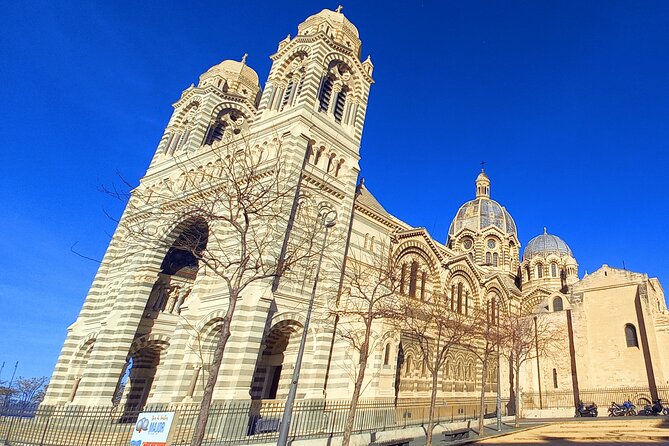
Meet at Cathédrale La Major at 9:00 a.m. The cathedral is both the meeting point and the first stop, so you begin with one of Marseille’s most striking buildings rather than a generic street corner.
La Major is known for its Byzantine-Roman design, large domes, and detailed mosaics. Its scale helps set the tone for Marseille, a port city with links across the Mediterranean and a long religious and commercial past.
The scheduled visit is about 10 minutes, with free admission. That is enough for an introduction and an exterior look, but not a long, quiet church visit. If you want to study every mosaic or sit inside for a while, you should plan to return on your own.
This is also a useful place to wear in your walking shoes and check your water supply. The route becomes more demanding later, especially around the climbs toward Notre-Dame de la Garde.
Le Panier is where the walking becomes personal
From La Major, the route heads into Le Panier, Marseille’s famous old district. Allow about 50 minutes here, though the experience is not a single attraction with a fixed entrance. It is a walk through narrow streets, lanes, stairs, colorful buildings, small cafés, and artisan shops.
Le Panier is best understood by moving through it slowly. Its mixed Mediterranean and North African influences are part of the district’s character, and the tight street plan creates the kind of corners you would easily miss from a vehicle.
This is one of the strongest reasons to choose a walking guide instead of a coach tour. A bus can point at the old quarter, but it cannot take you through its stairways and small passages. Charles uses the streets to explain how the neighborhood developed and how Marseille’s different communities shaped the city.
You should also expect uneven footing and some uphill walking here. The district rewards curiosity, but it is not designed for a fast, effortless stroll. If you have knee problems or limited stamina, tell Charles at the start so the pace and route can be adjusted.
La Canebière connects the old port to modern Marseille
The tour then reaches La Canebière, the well-known avenue running from the north side toward the south side of the Old Port. The walk here lasts about 30 minutes and shifts the mood from tight old lanes to a broader urban artery.
Charles explains the street’s history and the monuments around it, including the Old Port and the Opera House. This section matters because Marseille can seem like a collection of separate districts when you first arrive. La Canebière helps connect the old quarter, the harbor, the commercial center, and the streets beyond.
Do not expect a long stop at each monument. This is a moving city walk, and the Canebière section is mainly about orientation and context. If your interests lean heavily toward architecture or opera, you may want extra time in this area after the tour ends.
A different way to spend the day, same corner of France:
- Marseille: City Sightseeing Hop-On Hop-Off Bus Tour
★ 3.8 · 2,820 reviews - From Arles: Half-Day 4×4 Camargue Safari
★ 4.7 · 1,772 reviews - Marseille: Côte Bleue Calanques Half-Day Kayak Tour
★ 4.7 · 877 reviews - 3.5 Hour Camargue 4×4 Safari from Le Grau-du Roi
★ 4.5 · 775 reviews
Notre-Dame de la Garde demands the biggest effort
The climb toward Basilique Notre-Dame de la Garde is the tour’s physical high point. The stop itself lasts about 40 minutes, but getting there is part of the challenge.
The basilica sits on a hill above Marseille and is marked by a gleaming statue of the Virgin Mary. Inside, intricate mosaics add color and detail. Outside, the reward is a wide view over the city and Mediterranean, with the harbor and surrounding urban districts spread below.
This is the view most likely to define your first impression of Marseille. It also explains why the tour cannot be treated as a flat sightseeing walk. Several people have completed around six miles or more than 20,000 steps on the full route, with repeated inclines and stairs.
Charles has shown flexibility here. If the steepest climb is too much, he may help arrange a bus option, and the tour has adapted with public transport when needed. That does not make the walk fully easy, and you should not book it assuming every hill can be avoided. Still, the willingness to adjust is important for mixed-ability groups.
Bring water, especially in warm weather. One group used more than 1.5 liters each on a day around 37 C. Lunch and bottled water are not included, so you need to plan for your own drinks and food.
Vallon des Auffes feels far from the city center
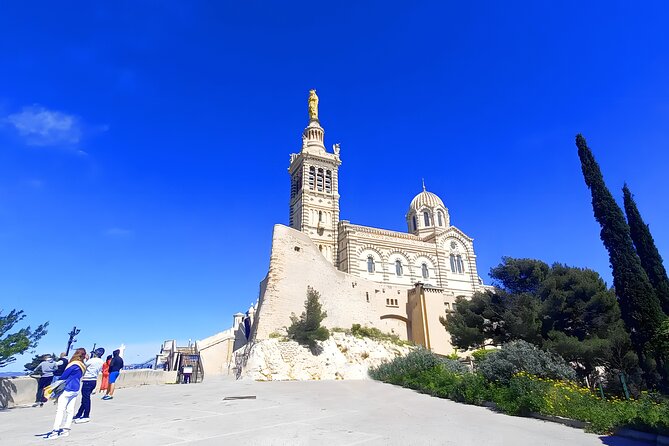
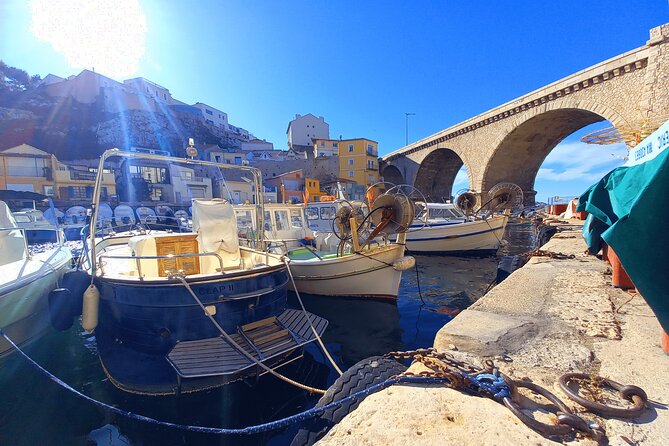
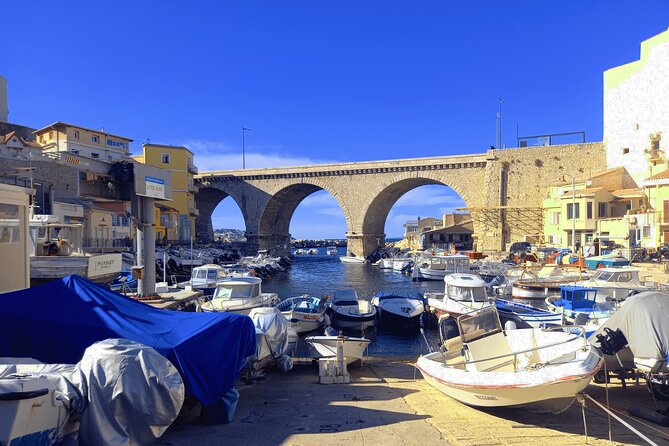
After the basilica, the route heads toward Vallon des Auffes, a small fishing harbor set between rocky slopes and the Mediterranean. The scheduled time is about 50 minutes, making this one of the longer stops.
The cove offers a sharp change from the traffic and broad avenues of central Marseille. Traditional fishing boats sit in the harbor, and waterfront restaurants focus on seafood. The setting is scenic without feeling like a polished resort district, which is part of its appeal.
This stop also adds a coastal side to the tour. Until this point, much of the route has focused on streets, monuments, churches, and city views. At Vallon des Auffes, you get a closer sense of Marseille’s connection to the sea.
You will not have lunch included here, and 50 minutes may not leave enough time for a relaxed restaurant meal. Treat it as a chance to see the harbor, take photographs, and note places you might revisit later.
Palais du Pharo puts the harbor in a wider frame
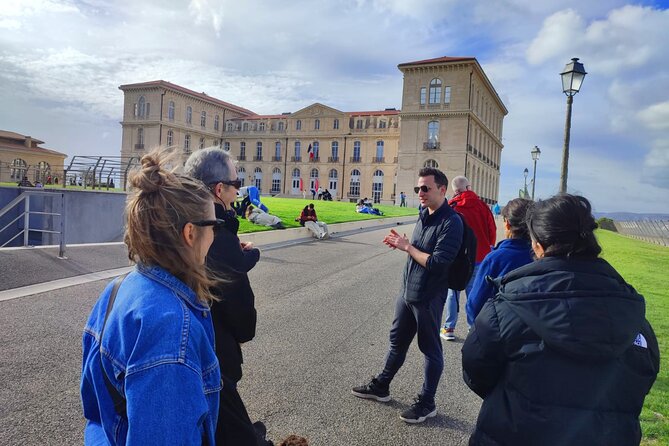
The next stop is Palais du Pharo, a historic palace on a promontory above the Old Port. Allow around 40 minutes.
From its terraces and gardens, you can look back across the harbor and city. Charles uses the viewpoint to explain nearby monuments, including Fort Saint-Jean, MUCEM, and the Cosquer museums. This is valuable because those attractions can be confusing when seen separately from the waterfront.
The Pharo stop is less about entering a palace and more about seeing how Marseille’s port fits together. You gain a sense of distance and direction, which helps if you plan to explore MUCEM or the Old Port later.
The gardens and open terraces also provide a natural pause after the coastal walking. Still, the stop does not erase the physical demands of the day. You will continue walking afterward, so save some energy.
Saint-Victor adds an older, quieter note
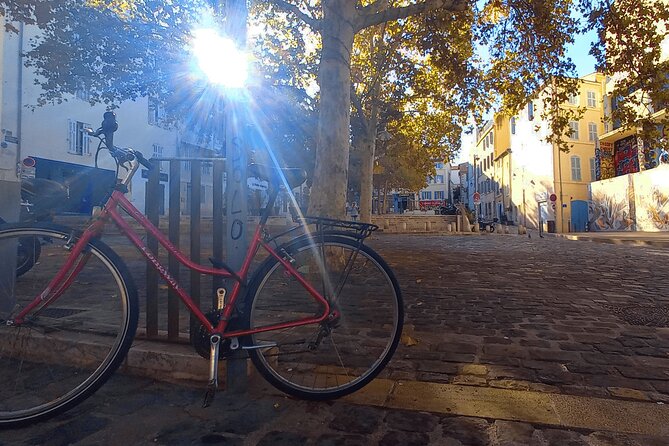
The final major stop is Abbaye Saint-Victor, visited for about 20 minutes. This ancient monastery near the Vieux Port brings the route back toward Marseille’s old center.
Its Romanesque architecture, sacred spaces, and crypts connect the city to centuries of religious history. The atmosphere is calmer than the harbor streets, and the compact visit gives the tour a reflective finish before you return toward the center.
The abbey is especially useful for anyone who wants more than postcard views. Marseille’s identity is not only about the sea and busy port. Places like Saint-Victor show the older layers beneath the modern city.
Because this is a short stop, you should not expect a lengthy archaeological or religious study. Charles provides the story and significance, then the route moves on.
What Charles adds to the experience
The guide is the central reason this route earns its price. Charles Mondon is described as enthusiastic, organized, funny, and deeply connected to Marseille. He uses historic maps and photographs to make earlier versions of the city easier to picture.
His English is reported as very clear, and the tour is offered in English. The bilingual local guide format is useful for international visitors who want direct conversation rather than a recorded audio device.
I also value the practical communication. Charles has sent clear meeting instructions with a map and photograph, helped with weather-related changes, and followed up with recommendations for places to eat and visit. Those details matter in a city where the streets, transit options, and districts can feel scattered at first.
The small group makes this personal. With no more than eight people, you have a reasonable chance to ask about Marseille’s history, food, neighborhoods, and safety. Charles can also notice when someone needs a rest or an easier transport option.
That said, the tour is not a private car tour. You will not cover the route seated, and the guide cannot remove every stairway or incline. The experience works best when you want conversation and local explanation while walking, not when you want a gentle sightseeing circuit.
How hard is the walk?
Take the fitness warning seriously. The route includes long distances, hills, stairs, and steep sections. Some groups have covered about 10 kilometers, while others describe the day as more than 20,000 steps or six miles.
The exact total may change with the group’s pace, weather, and transport choices. Even the shorter estimates still point to a demanding half-day.
Wear supportive walking shoes. Carry water and use sun protection in hot weather. Take advantage of the rest breaks, which Charles has used after harder inclines. The tour is not recommended for people over 70, and anyone with knee, balance, or stamina concerns should think carefully before booking.
The guide has adjusted the route for people with knee problems and has offered bus transport for the hardest climb. That is helpful, but it is not the same as an accessible tour. Ask yourself if you can comfortably manage a city walk with repeated elevation changes.
Timing, meeting point, and what is included
The tour begins at 9:00 a.m. at Cathédrale La Major, Place de la Major, in Marseille. It ends near Métro Vieux Port, right in the heart of the Old Port.
That finish is convenient. From there, you can continue on foot or use the bus, subway, or boat. If you are visiting from a cruise ship, the meeting point can be reached by taxi, but the port transfer is not included.
The experience lasts about four hours. Admission is free at the listed stops, and the tour includes the local guide, private guiding, and personal recommendations sent afterward.
You pay separately for lunch, bottled water, public transport if needed, and any food or drinks along the route. At $60.47 per person, I consider it fair for a small-group route covering this much ground, especially if you use Charles’s suggestions for the rest of your stay. It is less compelling if you only want a short introduction near the Old Port or dislike paying for a walk with no included refreshments.
Free cancellation is available up to 24 hours before the 9:00 a.m. start. Poor weather can lead to a new date or a full refund, while late changes and cancellations are not accepted.
Who should book this Marseille walk?
I would choose this experience if you want a broad first look at Marseille and enjoy learning while moving. It suits people interested in urban history, local culture, architecture, coastal views, and neighborhoods beyond the standard Old Port circuit.
It is also a good fit for solo visitors and small groups who want a guide they can talk with. Charles’s follow-up suggestions add value after the four hours are over.
I would not choose it for a relaxed morning, a flat route, or a group with serious mobility limits. Families with young children may also find the distance and hills tiring, though the supplied information does not set a minimum age.
Should you book this tour?
Book it if you can handle a long, hilly walk and want Marseille explained by someone who clearly cares about the city. The route gives you La Major, Le Panier, La Canebière, Notre-Dame de la Garde, Vallon des Auffes, Pharo, and Saint-Victor in one ambitious morning.
The smartest plan is to take it near the beginning of your visit, bring plenty of water, and keep the afternoon flexible. You will finish near the Old Port with a better sense of where to spend the rest of your time.
Skip it if you need frequent transport, a low-effort route, or included food and drinks. For fit walkers who want a serious introduction rather than a quick photo stop, this is a strong value at $60.47.
FAQ
How long does the Marseille guided tour last?
The tour lasts approximately four hours and begins at 9:00 a.m.
Where does the tour start and finish?
It starts at Cathédrale La Major, Place de la Major, Marseille. It ends near Métro Vieux Port in the center of the Old Port.
How large is the group?
The maximum group size is eight people.
Is lunch or bottled water included?
No. Lunch and bottled water are not included, so you should bring or buy your own water and plan separately for food.
How physically demanding is the walk?
The route includes hills, stairs, and substantial walking. Depending on the route and pace, it can reach about 10 kilometers, six miles, or more than 20,000 steps. A moderate level of physical fitness is required, and the tour is not recommended for people aged 70 or older.
What happens if the weather is poor?
The experience requires good weather. If it is canceled because of poor weather, you can receive a different date or a full refund. You can also cancel up to 24 hours before the start for a full refund.
Recently reviewed around Marseille & Provence
- Skip the Line: Museum of Romanity Ticket★ 4.5 · 45 reviews
- Guided tour Distillery of Lavender between Nîmes & Arles★ 5.0 · 84 reviews
- A Private Guided Historical and Cultural Tour in Nîmes★ 4.5 · 32 reviews
- Provence Hot-Air Balloon Ride from Forcalquier★ 4.5 · 75 reviews
- Horse ride in Haute Provence Luberon and Forcalquier★ 5.0 · 77 reviews
- Sailing day in the heart of the Calanques★ 4.5 · 61 reviews
- The Urban Hike of Marseille★ 5.0 · 35 reviews
- Sormiou Calanques National Park Electric Bike Tour from Marseille★ 5.0 · 60 reviews
Marseille & Provence Tours, compared.



3.5 Hour Camargue 4×4 Safari from Le Grau-du Roi
Read our review →

Marseille Food Tour – Full Meal of Local Tastes by Do Eat Better
Read our review →
Calanques National Park Guided Hike with Picnic
Read our review →
Browse the lists this tour appears in