

Reviewed · AUDIO TOURS
From Paris: Giverny Day Trip with Audio Guide or Live Guide
Claude Monet’s garden at Giverny is the star here, and it earns its fame. You’ll see the Japanese-style water garden, weeping willows, and lily ponds that fed some of the most familiar images in Impressionist art. Inside the house, bright rooms and personal details make Monet feel less like a distant name in a museum and more like a working artist with strong taste.
I like the easy coach ride from central Paris, since Giverny has no direct public transport. I also like the choice between a live guide, an audio guide, or free time on your own. The main drawback is time: five hours is enough for the house and gardens, but many people want another 30 to 60 minutes for the village, a coffee, or a slower look at the flowerbeds.
In This Review
- Key points to know before booking
- Why Giverny is worth leaving Paris for
- The coach ride from Paris to Monet’s village
- Arriving at the Claude Monet Foundation
- Monet’s house, room by room at your own pace
- The flower garden and its changing colors
- The famous lily pond and Japanese bridge
- How much time you really get
- The village of Giverny beyond the garden gates
- Live guide, audio guide, or independent visit
- Is $93 good value?
- Who should book this Giverny trip?
- Should you book the Giverny half-day tour?
- FAQ
- How long does the Giverny trip from Paris last?
- What is included in the price?
- Is lunch included?
- Is hotel pickup and drop-off provided?
- Can I visit Giverny without a live guide?
- Which languages are available for the live guide?
- Is the tour suitable for wheelchair users?
Key points to know before booking
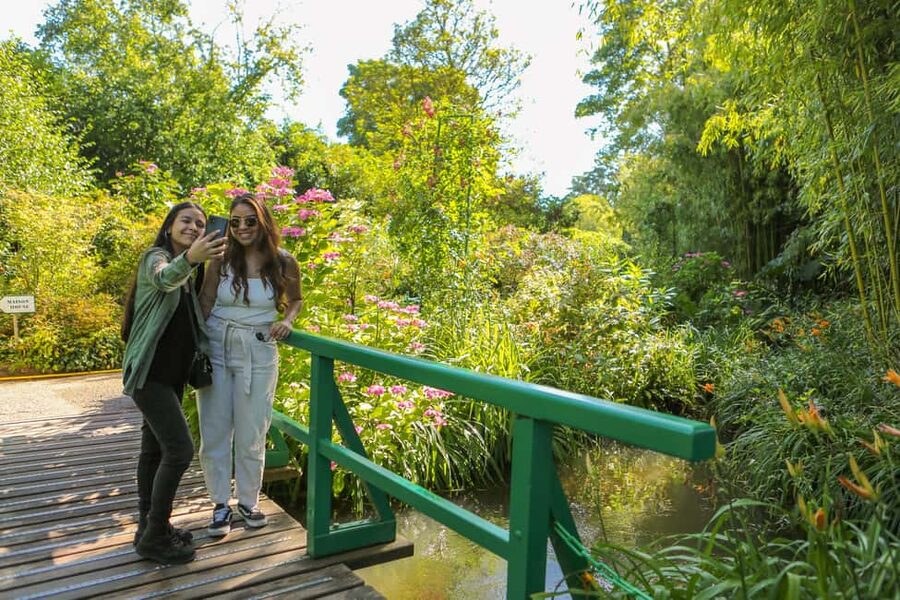
- Monet’s water garden is the highlight: See the lily pond, Japanese bridge, and drooping willows that inspired his paintings.
- Air-conditioned transport saves effort: The coach takes you from Paris through the western suburbs, across the Seine, and into Normandy.
- Choose your style of visit: A live guide adds stories and direction, while an audio guide or independent entry lets you set your own pace.
- Skip-the-line entry matters in summer: The queue can be very long, especially during peak flower season.
- Five hours goes quickly: You have time for the main sights, but not much spare time for lunch or the village.
- The price is reasonable for convenience: At $93, transport and admission are included, but food and hotel transfers are not.
Why Giverny is worth leaving Paris for
Giverny is about 50 miles west of Paris, in Normandy near the River Seine. The ride takes you away from city traffic and toward wheat fields, wooded plateaus, and the smaller roads around Vernon and Giverny. Depending on traffic, the journey can take roughly an hour to an hour and a half each way, so the coach ride is a real part of the outing.
That distance is exactly why this tour makes sense. There is no direct public transport to Giverny, and arranging trains, local connections, and admission on your own takes more time and planning. Here, you meet in Paris, ride in an air-conditioned coach, and arrive with entry arranged.
The countryside is not the main event, but it adds a pleasant change of pace. Guides often point out details along the route and give background on Monet before you arrive. If you are spending several days in Paris, this half-day trip gives you a welcome break from museums, traffic, and stone streets.
More Paris trips worth a second look
- Giverny and Monet’s House Half Day Trip from Paris Guide or Audio
★ 4.0 · 1,319 reviews - Paris: Catacombs Entry & Seine River Cruise with Audio Guide
★ 4.4 · 1,150 reviews - From Paris: Versailles Palace Self Guided & Gardens tickets
★ 4.4 · 1,100 reviews
The coach ride from Paris to Monet’s village
The meeting point can vary according to the option you book, so check your confirmation carefully. Several meeting points have been described as central and easy to reach, including locations near the Eiffel Tower, but one practical complaint is worth taking seriously: the coach may leave from a different nearby spot than the place where you meet the guide.
Arrive early, and look for the guide rather than assuming the bus itself will be obvious. A red umbrella has been used to help groups gather, and guides generally give clear instructions about where to meet again. This matters at Giverny, where it is easy to become absorbed in the flowers and lose track of time.
The coaches are usually spacious and air-conditioned. That is especially useful in July and August, when Paris can be hot and the garden has little shade in some areas. Most people find the ride comfortable, though equipment quality can vary. A few reports noted defective seat levers, weak air conditioning, or a dirty and cracked windshield.
There is no toilet on the bus, so plan ahead before departure. Bring water and a small snack, but do not bring large luggage. Pets, smoking, and large bags are not allowed, and the activity is not suitable for wheelchair users.
Arriving at the Claude Monet Foundation
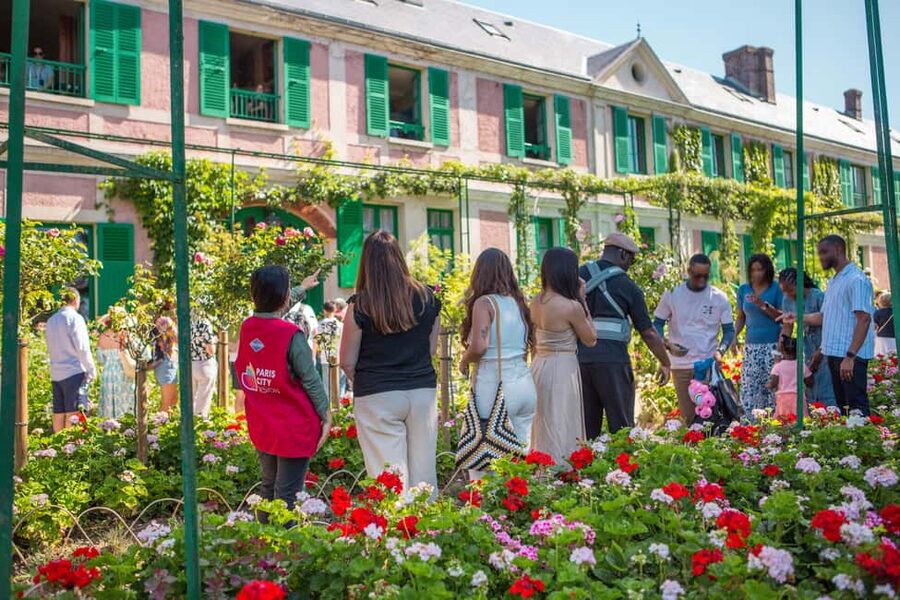
The house and gardens belonged to Claude Monet, who lived in Giverny for 43 years. His son donated the property to the Académie des Beaux-Arts in 1966. After major restoration work, the site opened to the public as a museum in 1980.
That restoration matters because this is not simply an empty historic house with a few beds and chairs. The property is presented as a place where Monet lived, painted, planned, and experimented. The rooms are colorful, personal, and closely tied to the gardens outside.
The visit generally begins with a group introduction or directions from the guide. A live guide may lead you around key areas, explain Monet’s family life and artistic influences, and point out details you could easily miss. Agnes, Alexandra, Alex, Christelle, Crystal, Felipe, Phillip, Stefan, and Zoltan are among the guides praised for clear explanations, organization, and friendly help. The exact guide depends on the day and should not be treated as a guaranteed part of your booking.
Do not expect a private, room-by-room guided tour of the house. You are free to explore the house and grounds, with the guide providing commentary at set points or before you enter. That arrangement suits independent visitors, but people wanting a long art lecture inside every room may find the experience more limited than expected.
Monet’s house, room by room at your own pace
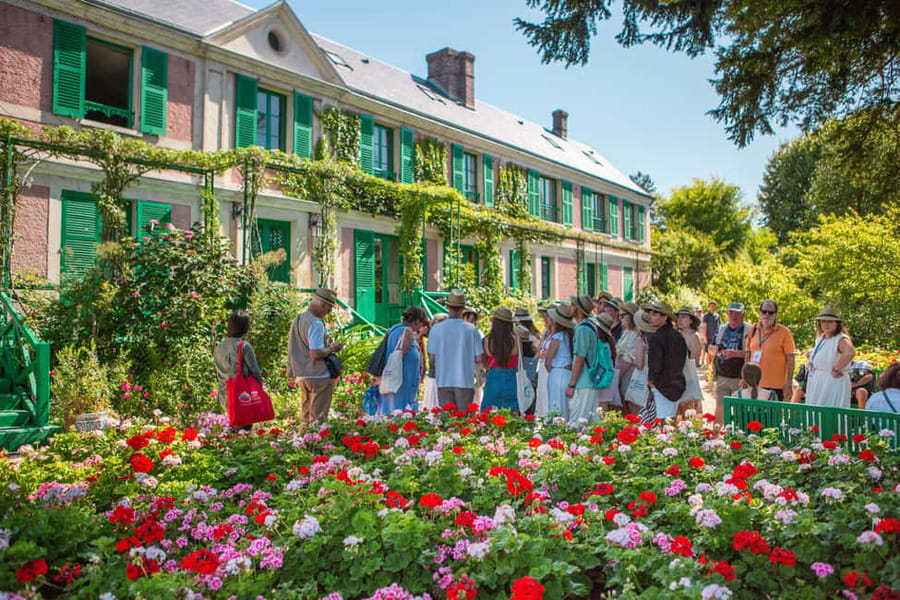
The house is appealing because it shows Monet’s eye for color beyond his canvases. Bright interiors echo the strong tones outside, and the rooms help explain why Giverny was not just a convenient address. It was part home, part studio, and part living work of art.
Take your time with the details you can see rather than rushing through for a quick photograph. The house is not huge, and the five-hour schedule means you should balance indoor rooms with the gardens. A live guide can help you decide which details matter most if your time is short.
The independent-entry option is a good fit if you already know Monet’s work or prefer quiet exploration. One advantage is that you can move through the house and gardens without staying with a group. The tradeoff is that you miss the extra stories guides often provide, including facts about Monet’s life and explanations of how particular parts of the property relate to his paintings.
The audio guide offers a middle ground. It gives you commentary in English, Italian, Japanese, Korean, Russian, Spanish, Portuguese, Chinese, French, or German, depending on the option selected. Check how the audio guide is delivered and test it early. One visitor had trouble with the sound, including the opening seconds of each section, so do not wait until the far end of the garden to discover a technical problem.
A different way to spend the day, same corner of France:
- Paris: Louvre Museum Timed-Entrance Ticket
★ 4.6 · 71,977 reviews - Disneyland® Paris 1-Day Ticket
★ 4.6 · 49,412 reviews - Paris: Versailles Palace and Gardens Full Access Ticket
★ 4.6 · 41,579 reviews - Paris: Evening River Cruise with Music
★ 4.4 · 22,721 reviews
The flower garden and its changing colors

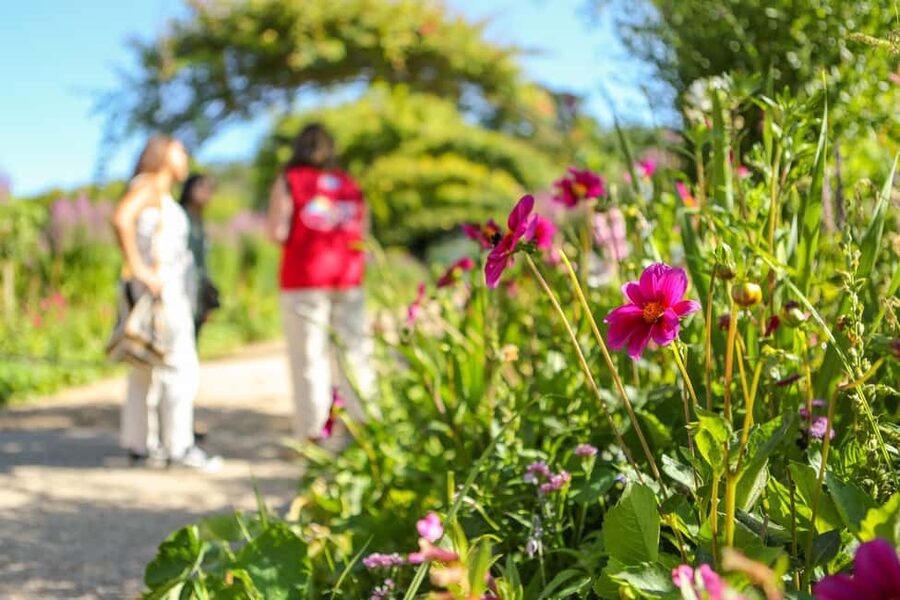
Outside, the Clos Normand flower garden is arranged in broad beds and paths rather than left as a simple lawn. The point is not just to admire individual flowers. Look at how Monet used color, height, and repeated shapes across the garden.
The appearance changes with the season. In late spring and summer, roses and climbing plants can be a major draw. By early autumn, some summer blooms may have faded, yet the beds can remain colorful and full. A fall visit may not match the classic summer photographs, but it can also bring fewer people and a calmer feel.
I would not book this trip only for one particular flower. Gardens change, and weather affects the experience. Book it because you want to see the place as a whole, including the structure of the beds, the house, and the water garden that ties the visit together.
Comfortable shoes are essential. The grounds require walking, and you will want to pause, turn back, and change direction rather than follow a straight route. Sunglasses are useful on bright days, especially around open flowerbeds and reflective water.
The famous lily pond and Japanese bridge

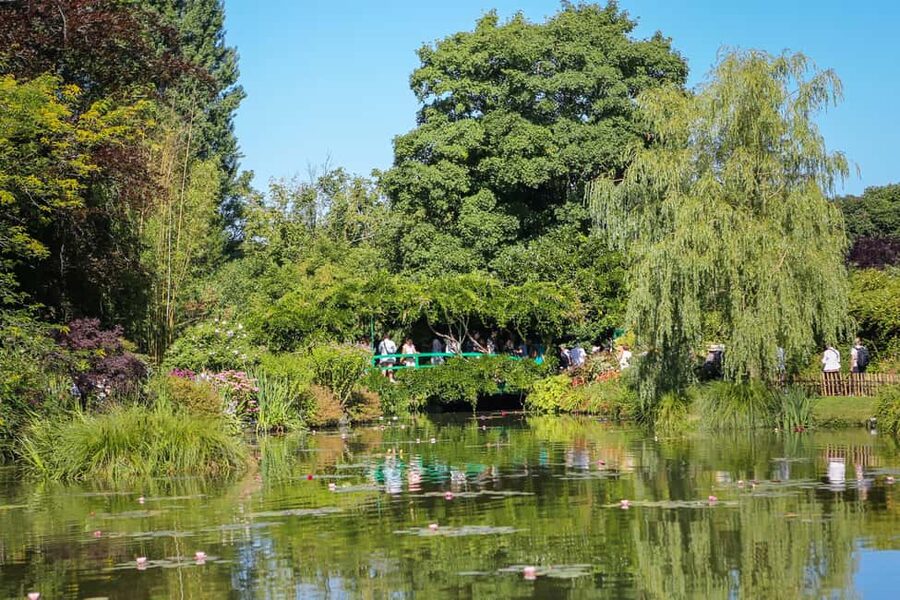
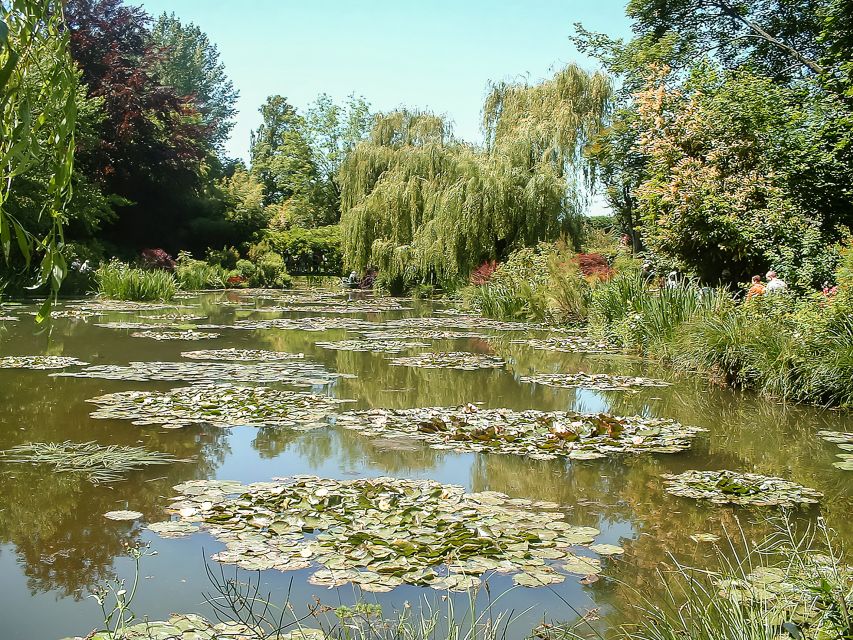
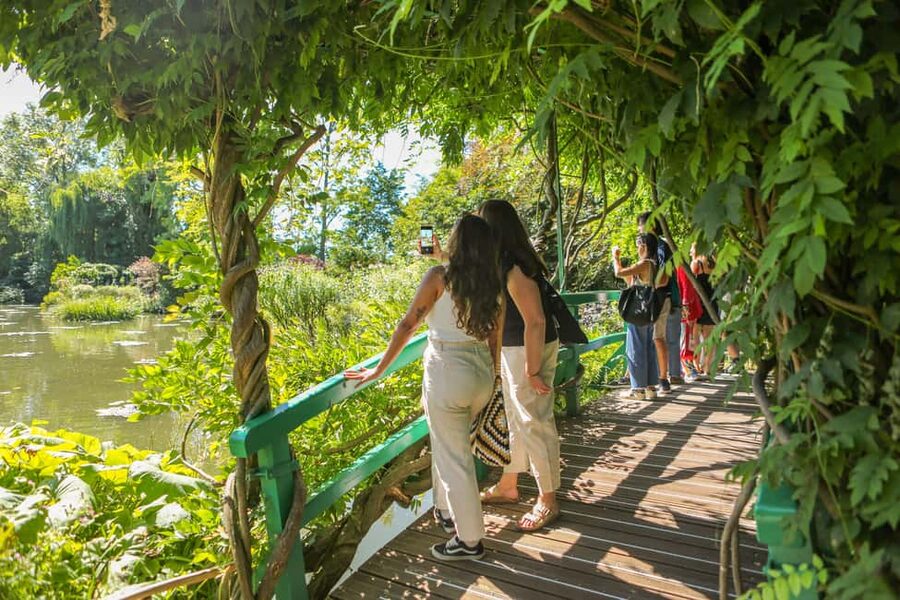
The water garden is the emotional center of the visit. Here you see the pond, lily pads, Japanese-style bridge, and weeping willows that appear in Monet’s paintings. The setting is peaceful when crowds allow, and it gives you a direct sense of how he studied changing light, reflections, and color.
Do not expect the pond to look exactly like a painting. Monet altered nature to suit his vision, and the real garden is a maintained public site with paths and other people. Still, the connection between the place and the paintings is unusually clear. You can look at the water, then at reproductions or images supplied by a guide, and understand the source without much explanation.
This is where a live guide can add real value. Some guides carry copies of paintings and use them to show how a view at Giverny became an artwork. Others point out the spots that deserve a pause and help the group move through the garden without missing the pond.
Crowds are the main challenge. In peak season, people may queue for a long time to enter, and the pond can feel crowded once inside. Skip-the-line entry is therefore more than a small convenience. It protects the limited time you have in Giverny.
How much time you really get
The activity lasts five hours from Paris and back. That sounds generous until you subtract the drive, the meeting process, and the return journey. In practice, you should expect enough time for the house and both garden areas, but not a leisurely day at the site.
Several people wanted another half hour or more. The common reason is simple: the gardens reward slow looking. You may want to photograph the bridge, sit near the pond, inspect the flowerbeds, and then walk through the village. The schedule makes you choose.
Morning departures can help you avoid some of the heaviest crowds, especially if you arrive early in the season or outside the busiest summer dates. Afternoon departures have their own advantage. People leaving the site may reduce the crowd in the gardens, though you still need to watch the return time closely.
Guides usually repeat the departure time and meeting location. Take a photo of the meeting instructions, set an alarm, and allow time to walk back from the far side of the property. The group cannot wait indefinitely, even when the guide does everything possible to gather stragglers.
There may be little time for a proper meal. A small snack window is available in the garden area, but it may not be enough for a full lunch. I would eat before the tour or carry a permitted snack, then plan for a late lunch after returning to Paris.
The village of Giverny beyond the garden gates
Giverny is a tiny hamlet, and the house and gardens are the main reason to come. The village itself adds atmosphere, but the standard half-day schedule does not guarantee enough time for a long walk, coffee, or lunch there.
If you care most about Monet’s house and water garden, this will not bother you. If you want to browse the village slowly, ask yourself if a longer visit would suit you better. Several people enjoyed the extra village time when the schedule allowed it, while others never had enough time to wander beyond the main property.
The best approach is to treat the village as a bonus, not the core promise. See the house and gardens first. Only then use spare minutes for nearby streets and cafés.
Live guide, audio guide, or independent visit
Your choice of format changes the experience more than the basic transport does.
A live guide is best if you want context without doing preparation. Commentary may begin on the drive, continue at the property, and resume on the way back. Guides have explained Monet’s work, personal life, family, and influences, and some use paintings or photographs to make the connections clear.
The live option also helps with practical matters. A good guide keeps the group together, repeats the departure time, explains where to meet, and directs you toward the most important parts of the garden. Agnes was particularly praised for being cheerful, organized, attentive, and willing to take photographs. Others appreciated guides who balanced instructions with time to explore alone.
An audio guide suits you if you prefer to move independently but still want commentary. The language list is broad, though availability depends on the option selected. Test the equipment or phone connection at the start, and bring headphones if the booking instructions call for them.
The self-guided option gives you the most freedom. It is a good choice if you want to photograph flowers, read at your own speed, or avoid a group. You will need to manage your own time, so set an alarm and keep the meeting point in mind.
Is $93 good value?
At $93 per person, this is not the cheapest possible way to see a garden. You are paying for more than admission: the price includes return coach transport from Paris, entrance to Monet’s house and gardens, and a guide or audio guide if selected.
The value is strongest if you want a simple half-day outing without arranging transport yourself. Giverny is far enough from Paris that a small mistake with train connections or local transport could cost both time and money. The skip-the-line feature is also valuable during peak season, when an ordinary entrance queue can be extraordinarily long.
The value is weaker if you want a full day at Giverny. You may feel rushed, especially if you hope to eat in the village or linger by the pond. In that case, paying more for a longer arrangement, if available, could make sense. This specific activity is built for convenience and the main sights, not for a slow rural day.
Free cancellation up to 24 hours before departure and reserve-now, pay-later booking make it easier to fit into a changing Paris schedule. Hotel pickup and drop-off are not included, and lunch is extra.
Who should book this Giverny trip?
I would recommend it to first-time Giverny visitors, Impressionist art fans, couples, families with older children, and anyone who wants to avoid complicated transport planning. It also works well as a break from Paris sightseeing, especially on a hot day when an air-conditioned coach is welcome.
The live-guide option is best for you if Monet’s life and painting methods are part of the appeal. Choose the audio or independent option if you prefer to linger without a group, but be strict with your watch.
I would be cautious about booking it if you use a wheelchair, need a full meal during the outing, dislike fixed departure times, or want a long visit to the village. The gardens are beautiful, but the schedule is tight and the property can be crowded.
Should you book the Giverny half-day tour?
Yes, if your goal is to see Monet’s house and gardens from Paris with minimal fuss. The coach, prearranged entry, and helpful guides remove the hardest parts of the visit, while the lily pond and flowerbeds provide a genuine connection to Monet’s art.
Book a morning departure for the best chance of a quieter visit, or consider the afternoon if you prefer to arrive as some of the crowd is leaving. Bring comfortable shoes, sunglasses, and a snack. Most important, treat five hours as a focused visit, not a leisurely day in the country.
FAQ
How long does the Giverny trip from Paris last?
The activity lasts five hours, including transportation between Paris and Giverny.
What is included in the price?
The price includes air-conditioned bus transportation and entrance to Claude Monet’s house and gardens. A live guide or audio guide is included only when you choose that option.
Is lunch included?
No. Lunch is not included, and the schedule may leave little time for a full meal. Bringing a small snack and eating before or after the trip is practical.
Is hotel pickup and drop-off provided?
No. You must make your own way to the designated meeting point, which can vary depending on the option booked.
Can I visit Giverny without a live guide?
Yes. You can choose an audio-guided option or visit independently at your own pace.
Which languages are available for the live guide?
Live guide options may be available in English, French, Spanish, German, Portuguese, Italian, Japanese, and Chinese.
Is the tour suitable for wheelchair users?
No. The activity is listed as unsuitable for wheelchair users.
More 1-Day Tours in Paris
- Normandy D-Day Sites & Cemetery Day Trip from Paris with Lunch
★ 5.0 · 6,877 reviews - Day Trip to Mont-Saint-Michel from Paris
★ 4.5 · 4,876 reviews - Disneyland® Paris 1-Day Flexible Date Ticket
★ 4.3 · 4,347 reviews - Loire Valley Castles Day Trip from Paris with Complementary Wine
★ 4.5 · 3,907 reviews
Recently reviewed around Paris
- Louvre Private Tour – The Essentials and More with Expert Guide★ 5.0 · 227 reviews
- 2CV tour by night★ 5.0 · 55 reviews
- Eiffel Tower Second or Summit Floor Access by Elevator with Views★ 3.5 · 161 reviews
- The only Paris Wine Tasting experience you need to do – 2 hours★ 5.0 · 265 reviews
- 2 Hour Street-art Walk and Space Invaders Hunt in Paris★ 5.0 · 27 reviews
- 2 hour outdoor group activity in Paris: SAINT GERMAIN★ 5.0 · 48 reviews
- Sainte-Chapelle, Conciergerie & Palais de Justice Private Tour★ 5.0 · 72 reviews
- Private 2 – Hour Paris Landmarks Tour by Golf Cart Mini Moke★ 5.0 · 38 reviews
Audio Tours, compared.

Giverny and Monet’s House Half Day Trip from Paris Guide or Audio
Read our review →
Catacombs Entry & Seine River Cruise with Audio Guide
Read our review →
Catacombs, Audio Guide, and River Cruise Option
Read our review →
Openair Double Decker Bus Audio-Guided City Tour
Read our review →
Bruges Guided or Audio Trip with Canal Cruise Option from Paris
Read our review →
Albi and Cordes/Ciel Day Trip with Audio Guides
Read our review →
Louvre Museum Timed Entrance Ticket with Audio Guide
Read our review →
Louvre Museum Hosted Entry & Masterpieces Audio Guide
Read our review →Browse the lists this tour appears in