
Reviewed · NOTRE DAME TOURS
Notre-Dame Cathedral Exterior & Latin Quarter Guided Tour
Paris reveals itself in layers on this walk: Roman baths below the medieval city, Gothic churches beside university streets, and Notre-Dame at the finish. In two hours, you move from Fontaine Saint-Michel through the Latin Quarter to the cathedral’s famous façade, with a guide explaining how each place fits into Parisian history.
I like the small group limit of 11, which makes it easier to ask questions and keep up with the guide. I also like the mix of major sights and quieter corners, especially St. Séverin and St. Julien le Pauvre. The main drawback is pace: the route covers a lot, and the amount of information can feel heavy if you prefer a slow, casual stroll.
In This Review
- Key points to know before booking
- Why this Latin Quarter walk works
- Fontaine Saint-Michel and the first look at Paris history
- St. Séverin, a Gothic church worth your attention
- Roman Lutetia at the Cluny Baths
- The Sorbonne and the intellectual Latin Quarter
- The Panthéon and France’s national memory
- Streets, bookshops, cafés, and courtyards
- St. Julien le Pauvre beside Notre-Dame
- Notre-Dame’s façade and the story of the 2019 fire
- Is the optional Seine cruise worth adding?
- Price, pace, and what you receive for $43
- Who should book this Paris walking tour?
- Should you book it?
- FAQ
- How long is the guided walking tour?
- Where does the tour start?
- Where does the tour finish?
- Is entry inside Notre-Dame included?
- Does the tour include entry to the Panthéon or museums?
- How many people are in the group?
- What language is the guided tour in?
- Is the Seine River cruise included?
- Is the tour suitable for people with mobility impairments?
Key points to know before booking
- A history-packed route: Roman Lutetia, medieval churches, French writers, revolution stories, and Notre-Dame all appear within two hours.
- The group stays small: Semi-private groups have a maximum of 11 people, and private booking is available.
- The guide makes the difference: Benjamin, Pilou, and Pierre have received especially warm praise for clear explanations, patience, humor, and local insight.
- Notre-Dame is exterior only: You see the façade, sculptures, and gargoyles, but this tour does not include entry inside the cathedral.
- The optional Seine cruise adds a second view of Paris: The one-hour boat ride includes audio commentary in 11 languages.
- Wear practical shoes: The walk is generally flat, but cobblestones, weather, and the quick pace make comfortable footwear important.
Why this Latin Quarter walk works
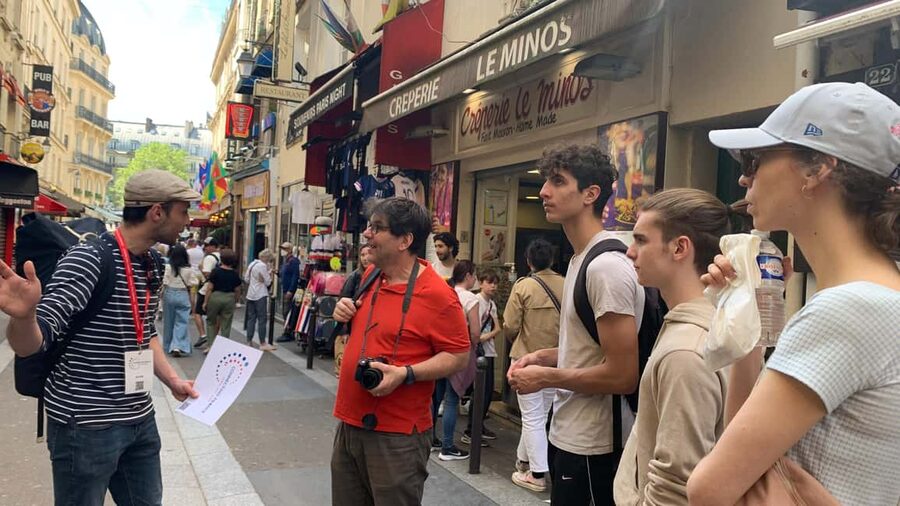
The Latin Quarter is one of the best parts of Paris for a guided walk because the sights are close together but belong to very different periods. A short stretch can take you from a Roman bath complex to a Gothic church, then onward to the Panthéon and the medieval core around Notre-Dame.
That variety gives the tour a clear purpose. You are not simply ticking off monuments. You are watching Paris develop from Lutetia, the Roman settlement, into a medieval religious center and later into a city shaped by universities, writers, scientists, and political change.
The tour begins at Place Saint-André des Arts, in front of Café G. This is a useful starting point because it puts you near the lively streets of the Latin Quarter without requiring a long transfer to the first sight. Look for a guide holding a Connecting France sign.
The group size matters here. With no more than 11 people, a guide can usually explain details without shouting over a crowd. The experience can also become more personal if you are in a very small group. One booking had only two participants, giving the guide plenty of time to answer questions and adjust the discussion.
More Paris trips worth a second look
- Paris: Louvre Guided Tour with Reserved Access & Boat Cruise
★ 4.3 · 16,353 reviews - Louvre Museum Masterpieces Guided Tour with Access
★ 4.5 · 12,023 reviews - Louvre Museum – Exclusive Guided Tour (Entry Included)
★ 5.0 · 6,296 reviews
Fontaine Saint-Michel and the first look at Paris history
The opening stop is Fontaine Saint-Michel, a dramatic 19th-century fountain dominated by the Archangel Michael defeating the Devil. It is a theatrical introduction to Paris, with a subject that feels more like a grand public monument than a simple neighborhood fountain.
This is also a practical place to begin because the fountain helps you identify the meeting area. If you are arriving by taxi or rideshare, allow extra time. Traffic around this part of Paris can be slow, so walking or using public transportation may be more dependable than arriving by car.
From here, the route moves into the smaller streets of the Latin Quarter. The change is immediate. Wide city traffic gives way to cobblestones, cafés, bookshops, and streets with a more intimate feel.
St. Séverin, a Gothic church worth your attention
St. Séverin Church is one of the strongest stops on the route. It does not have the same fame as Notre-Dame, but it offers a close look at Gothic design without the same scale and public attention.
Inside, the medieval stained-glass windows and double ambulatory are the main features to watch for. A double ambulatory is a passage that curves around the church’s central worship space, allowing you to study the structure from different angles. The design makes the building feel intricate and carefully engineered.
This stop rewards a guide who can explain architecture in plain language. Without context, Gothic churches can blur together after several days in Paris. With a good explanation, you begin to notice how light, height, arches, and circulation work together.
Pilou is especially well suited to this kind of discussion. His approach has been described as lively and easy to follow, with room for questions and stories about revolution, important figures, and Parisian life. The guide’s personality matters because the route contains a lot of facts in a short period.
Roman Lutetia at the Cluny Baths
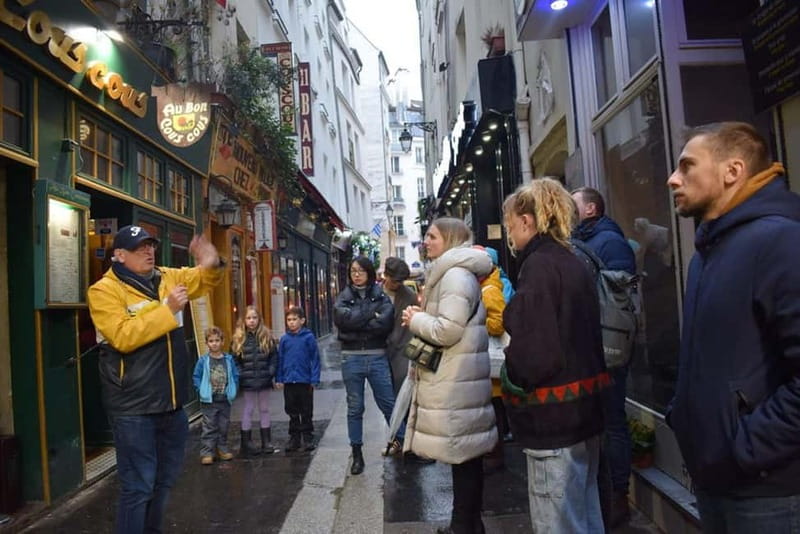
The remains of the Cluny Roman Baths offer a sharp change of mood. These ruins are reminders that Paris was already an important settlement long before the medieval churches and grand boulevards appeared.
The baths were part of daily life in Lutetia, the Roman city that occupied this area. You see the remains from outside on this tour, while the adjacent Cluny Museum contains further objects connected with the medieval period. Museum entry is not included, so you should not expect time inside the galleries as part of the two-hour walk.
This is one of the places where a guide adds real value. Ruins can be difficult to read when you see them alone. A clear explanation helps you picture their original role and understand why the site matters, even when only fragments remain.
The route also passes the Musée National du Moyen Âge and the Cluny complex. If medieval art interests you, you may want to return for a separate visit. The walking tour gives you the setting and background, but not the museum collection itself.
A different way to spend the day, same corner of France:
- Paris: Louvre Museum Timed-Entrance Ticket
★ 4.6 · 71,977 reviews - Disneyland® Paris 1-Day Ticket
★ 4.6 · 49,412 reviews - Paris: Versailles Palace and Gardens Full Access Ticket
★ 4.6 · 41,579 reviews - Paris: Evening River Cruise with Music
★ 4.4 · 22,721 reviews
The Sorbonne and the intellectual Latin Quarter
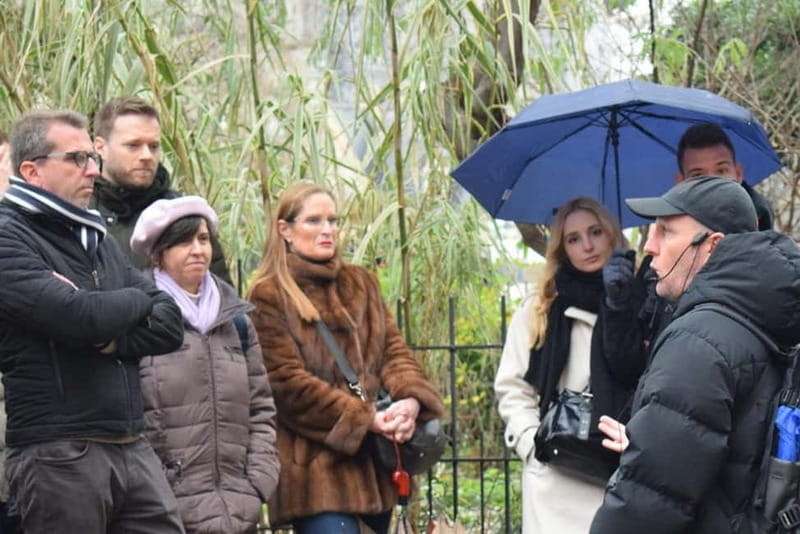
The Latin Quarter is closely tied to learning, and the walk includes sightseeing around La Sorbonne. The university presence helps explain why the neighborhood became associated with students, scholars, writers, political debate, and artistic life.
The tour does not promise an interior visit to the Sorbonne. Instead, you get the wider setting: streets lined with cafés and bookshops, old academic institutions, and the atmosphere of a district shaped by ideas as much as by monuments.
I find this part useful because it connects the physical neighborhood to the people who lived and worked here. The Latin Quarter is more than old stone. It remains a place where the identity of Paris is linked to education and public discussion.
The guide’s storytelling style is important here. Benjamin has been praised for explaining both past and present life in the district, while also answering questions patiently. Pierre is described as friendly and cheerful, with a strong grasp of the material. You may have a different guide, but these names give you an idea of the standard of presentation to expect.
The Panthéon and France’s national memory
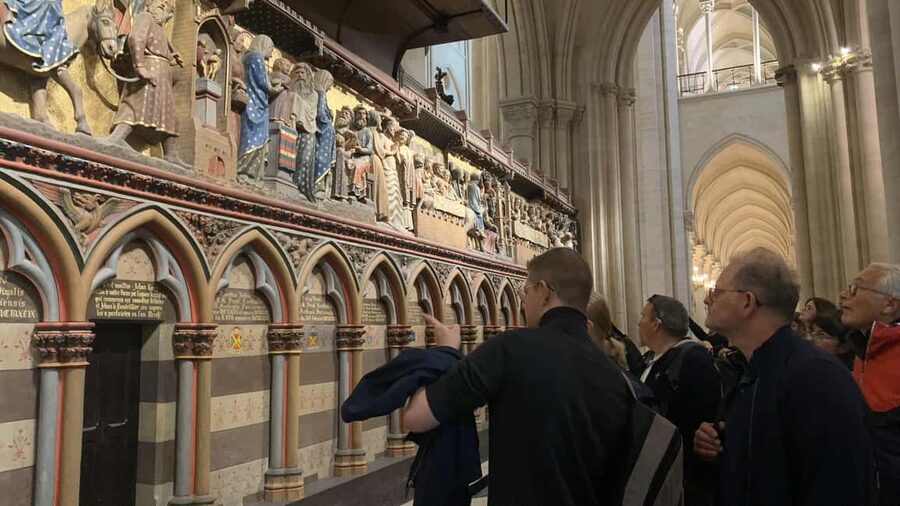
The route continues uphill to the Panthéon, one of Paris’s most imposing landmarks. The building began as a church and later became a mausoleum honoring major French figures.
From the outside, its neoclassical columns and dome are impressive. The more interesting question is how the building changed purpose. A church becoming a monument to national achievement reflects the shifting relationship between religion, politics, science, literature, and the French state.
Inside the Panthéon are figures such as Voltaire, Jean-Jacques Rousseau, Victor Hugo, and Marie Curie. Entry is not included, so you will need a separate ticket if you want to visit the interior and crypt. One practical criticism of the tour is that some people may wish admission to the Panthéon were part of the price.
Still, an exterior explanation can be enough to give the building meaning. The guide sets up the people connected with it, then places the Panthéon in the larger story of French public life. If you are especially interested in French writers, scientists, or political history, plan a return visit with more time.
Streets, bookshops, cafés, and courtyards
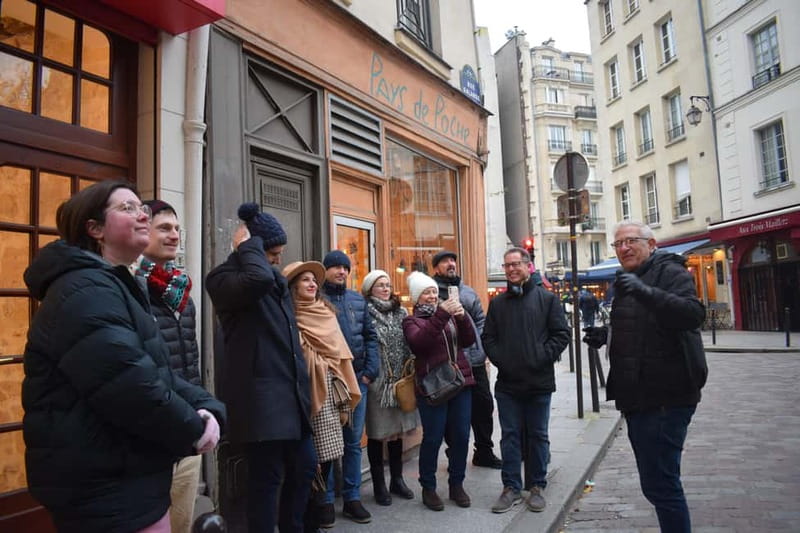
Between the major monuments, the route follows a historic street lined with bookshops, cafés, and courtyards. This section is not filler. It is where you get a sense of the Latin Quarter as a neighborhood rather than a row of attractions.
You will walk through areas that have served as an intellectual and artistic center for centuries. The small streets also offer a useful contrast with the grand scale of the Panthéon and Notre-Dame.
The pace can be brisk, so do not expect long pauses at every café or shop. The purpose is to see how the area fits together, not to stop for a meal. Food and drinks are not included, and you will likely want to schedule lunch or coffee after the tour.
St. Julien le Pauvre beside Notre-Dame
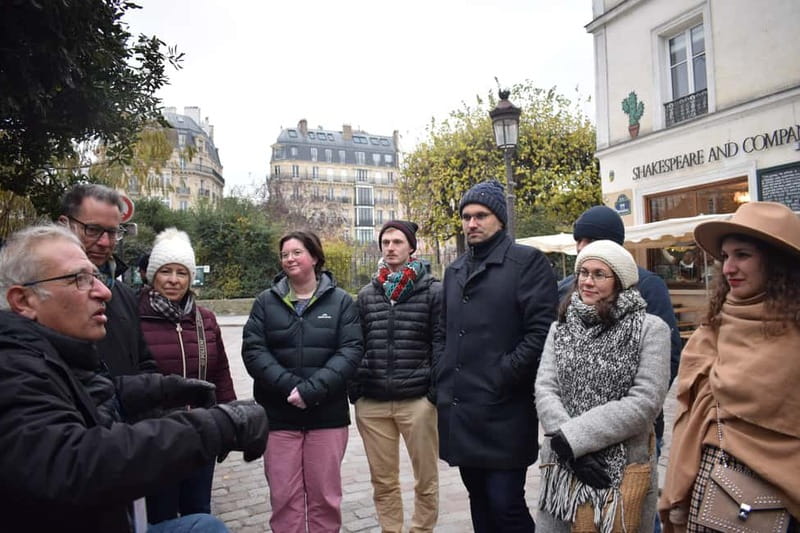
Near Notre-Dame, St. Julien le Pauvre provides one of the route’s most appealing contrasts. This 12th-century church is one of Paris’s oldest, and its Byzantine-style appearance feels quite different from the grand Gothic cathedral nearby.
Its location in a quieter square makes it easy to overlook. That is precisely why a guide is useful. You get a small medieval church with a distinct character, then turn toward one of the most famous buildings in France.
This stop also helps you understand that Notre-Dame was not an isolated monument. The area around Île de la Cité and the Latin Quarter contains several layers of religious and civic history, often within a few minutes of one another.
Notre-Dame’s façade and the story of the 2019 fire
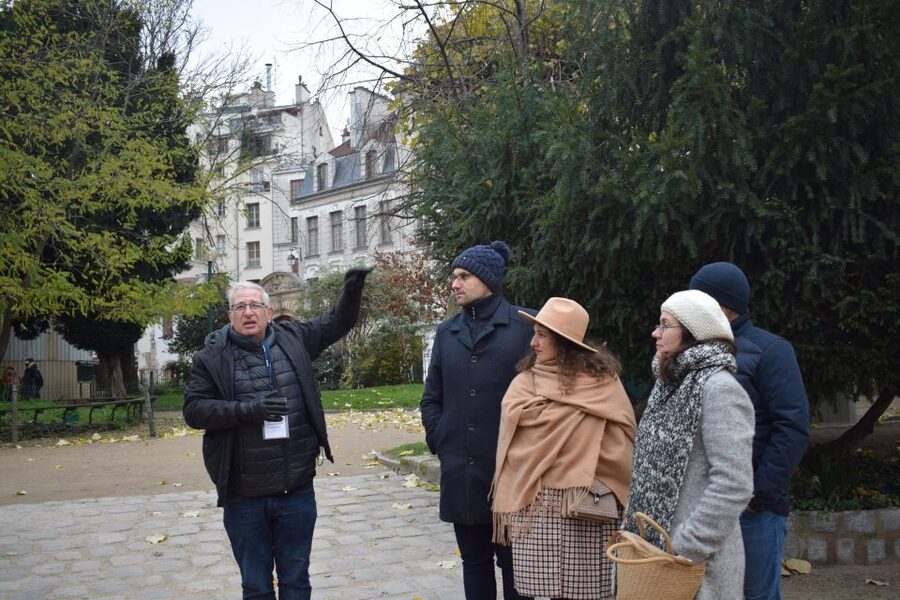
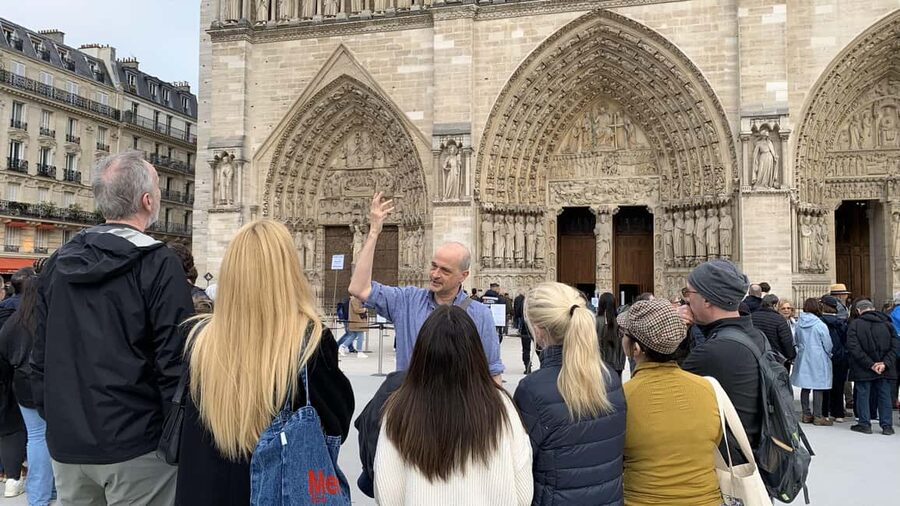
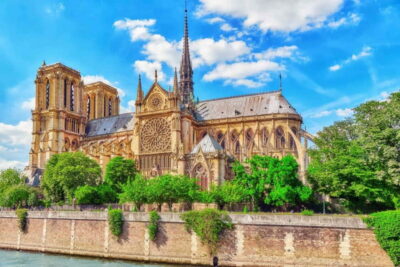
The tour finishes at Notre-Dame Cathedral, where the focus is entirely outside. You can study the façade, carved figures, and gargoyles while your guide explains the cathedral’s medieval origins and the damage caused by the 2019 fire.
That context changes the way you look at the building. The façade is not just a famous photo stop. It represents centuries of religious life, French architecture, restoration, and public memory.
You should be clear about what is and is not included. This is not an interior entry tour, and there is no cathedral admission. The guide helps you read the exterior, but you will need a separate arrangement for any permitted interior visit.
The published route finishes at Notre-Dame, while the meeting-point information also says the activity ends back at the starting point. Confirm the final endpoint when you book, especially if you have a timed reservation or another activity afterward.
Is the optional Seine cruise worth adding?
The optional boat cruise lasts one hour and travels along the Seine, described here as the most beautiful avenue in Paris. From the water, you can see panoramic views of the Eiffel Tower, Notre-Dame, Île de la Cité, Les Invalides, the Musée d’Orsay, Hôtel de Ville, the Louvre, Place de la Concorde, and the Grand Palais.
Audio explanations are available in 11 languages. This makes the cruise less dependent on the walking guide and gives you another way to understand Paris’s major monuments.
The boat ride is a good addition if you want broad city views after the close-up detail of the Latin Quarter. It also gives your feet a break. On the other hand, it adds a full hour to the outing, so check the booking details and timing before assuming it is part of the standard two-hour tour.
Price, pace, and what you receive for $43
At $43 per person, the main two-hour tour offers a small-group walk led by a professional English-speaking guide. You are paying for interpretation, organization, and access to a route that joins several periods of Parisian history.
That is fair value if you enjoy history and want more than photographs. The tour covers several major exterior sights, but it does not include museum or monument admission, food, drinks, or transport from your accommodation. If you prefer to enter the Panthéon or a museum, budget separately.
The amount of information is both a strength and a limitation. Some people appreciate the academic tone and the chance to learn a great deal. Others may find the route too fast. One useful way to think about it is as a compact orientation to the Latin Quarter, not a slow neighborhood ramble.
The route is described as flat-walking, but it is not suitable for people with mobility impairments. Cobblestones, walking speed, and the need to keep moving may be tiring. A private tour may be worth considering if you need more flexibility.
Wear comfortable shoes and dress for the weather. The tour operates rain or shine, and there is no promise of shelter during every explanation.
Who should book this Paris walking tour?
I would choose this tour if you want a strong historical framework for the Latin Quarter and Notre-Dame. It suits first-time visitors who want to understand what they are seeing, as well as repeat visitors who have photographed Paris but have not explored the smaller streets carefully.
It is particularly good for:
- People interested in Roman, medieval, and French political history
- Architecture fans who want more than the usual Notre-Dame photo
- Small groups who prefer questions and conversation
- Repeat Paris visitors looking for lesser-known churches and streets
- Anyone who likes a fast, information-filled walking tour
I would be more cautious if you want extensive free time, relaxed café stops, or interior access to the Panthéon and Notre-Dame. The route is focused and educational, not leisurely.
You can cancel up to 24 hours in advance for a full refund, and reserve now while paying later. Those policies are useful if your Paris schedule is still changing, but the key booking decision is the pace and subject matter.
Should you book it?
Book this tour if you want two concentrated hours of Paris history, a small group, and a guide who can connect Roman ruins, Gothic churches, the Sorbonne, the Panthéon, and Notre-Dame. The strongest guides, including Benjamin, Pilou, and Pierre, appear to bring warmth and clarity to a demanding route.
Skip it if you want to go inside the major monuments or spend much of the morning wandering at your own speed. For history fans and curious repeat visitors, though, the $43 price is reasonable, especially if your goal is to see how the Latin Quarter’s many layers fit together.
FAQ
How long is the guided walking tour?
The guided walking tour lasts two hours.
Where does the tour start?
The meeting point is Place Saint-André des Arts, in front of Café G. Your guide will hold a Connecting France sign.
Where does the tour finish?
The route information says the tour finishes at Notre-Dame. The meeting-point details also say the activity ends back at the meeting point, so confirm the final endpoint when booking.
Is entry inside Notre-Dame included?
No. The tour covers Notre-Dame’s exterior, including the façade, sculptures, and gargoyles. Entry inside the cathedral is not included.
Does the tour include entry to the Panthéon or museums?
No. Monument and museum admission is not included. The Panthéon, Cluny complex, and other major buildings are visited or viewed from outside.
How many people are in the group?
The semi-private group has a maximum of 11 people. A private group option is also available.
What language is the guided tour in?
The live guided tour is in English.
Is the Seine River cruise included?
The one-hour Seine River cruise is optional. It includes audio explanations in 11 languages and views of major Paris landmarks from the water.
Is the tour suitable for people with mobility impairments?
The tour is described as flat-walking but is not suitable for people with mobility impairments. A private tour may be worth considering if you need more flexibility.
Recently reviewed around Paris
- Louvre Private Tour – The Essentials and More with Expert Guide★ 5.0 · 227 reviews
- 2CV tour by night★ 5.0 · 55 reviews
- Eiffel Tower Second or Summit Floor Access by Elevator with Views★ 3.5 · 161 reviews
- The only Paris Wine Tasting experience you need to do – 2 hours★ 5.0 · 265 reviews
- 2 Hour Street-art Walk and Space Invaders Hunt in Paris★ 5.0 · 27 reviews
- 2 hour outdoor group activity in Paris: SAINT GERMAIN★ 5.0 · 48 reviews
- Sainte-Chapelle, Conciergerie & Palais de Justice Private Tour★ 5.0 · 72 reviews
- Private 2 – Hour Paris Landmarks Tour by Golf Cart Mini Moke★ 5.0 · 38 reviews
Notre Dame Tours, compared.
Paris Île de la Cité and Notre-Dame Walking Tour With Crypt
Read our review →
Notre-Dame Cathedral Exterior Tour & Free Entrance
Read our review →
Paris Highlights Bike Tour: Eiffel Tower, Louvre and Notre-Dame
Read our review →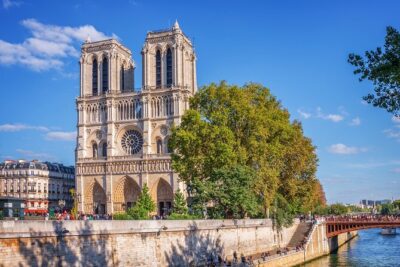
Early Access Paris Notre Dame Cathedral Walking Tour
Read our review →
Sainte-Chapelle, Conciergerie, Notre Dame Guided Tour
Read our review →
Notre Dame Outdoor Tour with Sainte-Chapelle / Crypt.
Read our review →
Notre Dame Outdoor Walking Tour and Entrance to Sainte Chapelle
Read our review →Browse the lists this tour appears in