
Reviewed · LOUVRE MUSEUM TOURS
Paris: Best of the Louvre Guided Tour with Pre-booked Ticket
The clever part of this Louvre tour is not simply seeing the Mona Lisa. It is having someone lead you through one of the world’s largest museums without letting its size swallow your morning. In two hours, you move from the former palace’s long story to its headline works, with a guide explaining why the art matters.
I like the maximum six-person group, which gives you a real chance to ask questions. I also like the timed ticket and separate entrance, since a little structure is worth a lot inside the Louvre. The catch is clear: two hours is a fast survey, and as of January 2026, you cannot re-enter after the guided visit ends.
In This Review
- Key points at a glance
- Why a two-hour Louvre tour can make sense
- Meeting at Place Colette
- Entering a palace that became a museum
- The three ladies of the Louvre
- Paintings from Botticelli to Géricault
- Sculpture, royal rooms, and extra discoveries
- What the pace feels like
- Crowds and the limits of skip-the-line entry
- The January 2026 re-entry change
- Is $130 a fair price?
- Who should book this Louvre tour?
- Should you book it?
- FAQ
- How long is the Louvre guided tour?
- What works are included in the route?
- Where is the meeting point?
- Is the Louvre ticket included?
- Can I visit the Louvre again after the tour?
- What languages are available?
Key points at a glance
- The three famous ladies: See the Venus de Milo, Mona Lisa, and Winged Victory of Samothrace on one tightly planned route.
- A former royal palace: Learn how the Louvre changed from medieval fortress to royal residence and then museum.
- Small group, personal pace: Groups are capped at six, with private options also available.
- Useful first visit: Your guide helps you find the rooms and collections worth returning to on your own.
- Several art traditions: Expect French painting, Greek sculpture, Italian Renaissance works, and more.
- Important 2026 rule: Your ticket no longer allows re-entry after the tour, so plan your museum time carefully.
Why a two-hour Louvre tour can make sense
The Louvre is so large that the main problem is not finding something to see. It is deciding what to skip. A self-guided visit can easily turn into a long march through corridors, with little sense of how the building and collections fit together.
This tour gives you a clear route. You see major works by Leonardo da Vinci, Caravaggio, Botticelli, and Théodore Géricault, along with famous sculptures and royal interiors. The guide adds the links between them, so you are not just collecting photographs.
The short format suits a first visit, a family with limited patience, or anyone with only part of a day in Paris. It does not suit you if your main goal is to study one department slowly. The Louvre holds more than 35,000 works, and two hours can only offer an introduction.
That limitation is not a flaw, as long as you book it for the right reason. Think of the tour as an orientation with a strong highlights route. You get the essentials, then use the guide’s suggestions to decide where to spend extra time.
More Paris trips worth a second look
- Paris: Louvre Museum Timed-Entrance Ticket
★ 4.6 · 71,977 reviews - Disneyland® Paris 1-Day Ticket
★ 4.6 · 49,412 reviews - Paris: Versailles Palace and Gardens Full Access Ticket
★ 4.6 · 41,579 reviews
Meeting at Place Colette
Your starting point is Place Colette, between Le Kiosque des Noctambules and the Comédie Française. Look for the colorful glass-ball sculpture, then find the guide holding a sign marked Connecting France.
This is a better meeting point than a vague instruction to meet somewhere near the Pyramid. Place Colette gives you a visible landmark, though you should still arrive with enough time to identify the sculpture and guide before the scheduled start.
The route then heads toward the Louvre Pyramid. You pass by this famous glass entrance rather than treating it as a full stop. That is sensible on a two-hour visit. The Pyramid is a strong orientation point, but the art inside deserves the clock.
Your guide handles the transition from the meeting point to the museum entrance. The tour includes a pre-booked, timed Louvre ticket and a separate entrance intended to reduce waiting. You still need to pass through security, so do not read skip-the-line as skip-security.
Entering a palace that became a museum
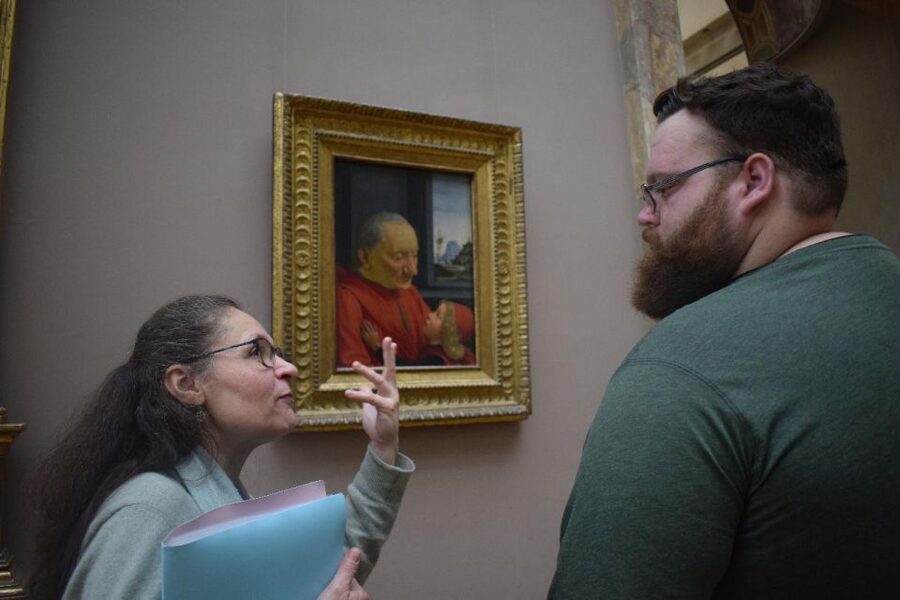
One of the best reasons to take this tour is the building itself. The Louvre is not just a container for paintings. It began as a medieval fortress, became a Renaissance royal residence, and grew over roughly 800 years through the work of kings and two emperors.
That long change can be hard to understand when you are moving alone. A guide gives you a basic timeline as you walk, pointing out how the palace expanded and how its grand rooms later became galleries.
This context makes the art easier to place. French state portraits, royal apartments, ancient sculpture, and Italian paintings are not random items gathered under one roof. They reflect the changing ambitions of French rulers and the museum’s later growth into a public institution.
The Louvre’s scale also explains why a guide matters. You will move through rooms and galleries that can feel disconnected if you do not know the larger plan. The strongest guides on this route, including Flo, Clara, Matteo, Jerome, Patrick, Marine, and Floriane, have been praised for combining stories, art interpretation, and practical crowd management.
The three ladies of the Louvre
The tour’s central promise is a visit to three famous women in art: the Venus de Milo, the Mona Lisa, and the Winged Victory of Samothrace. Each has a different appeal, and seeing them together gives the route a useful rhythm.
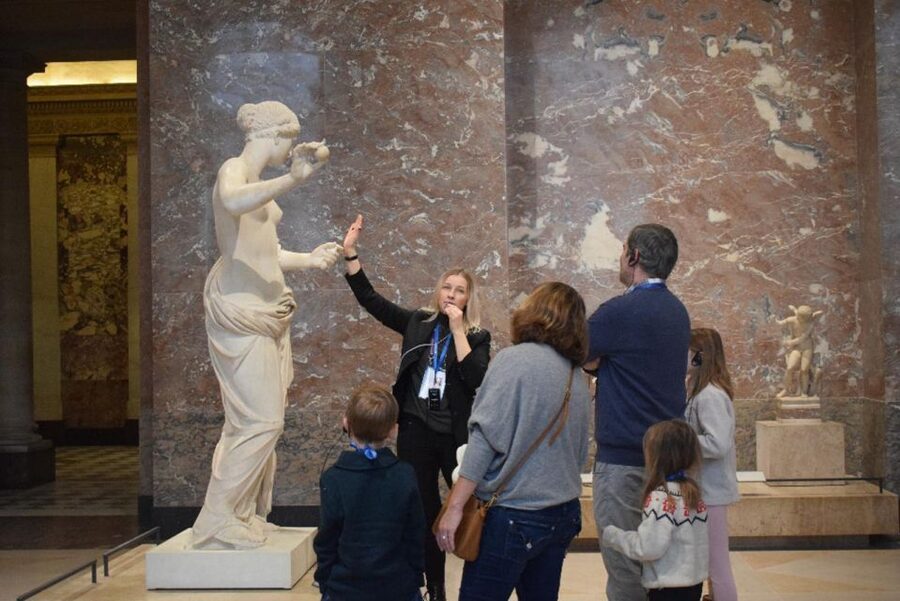
The Venus de Milo is a Greek sculpture, famous partly for its missing arms and graceful pose. Your guide can give you the basic setting and help you look beyond the postcard image. The value here is not a long lecture. It is having someone point out what to notice before the crowd carries you onward.
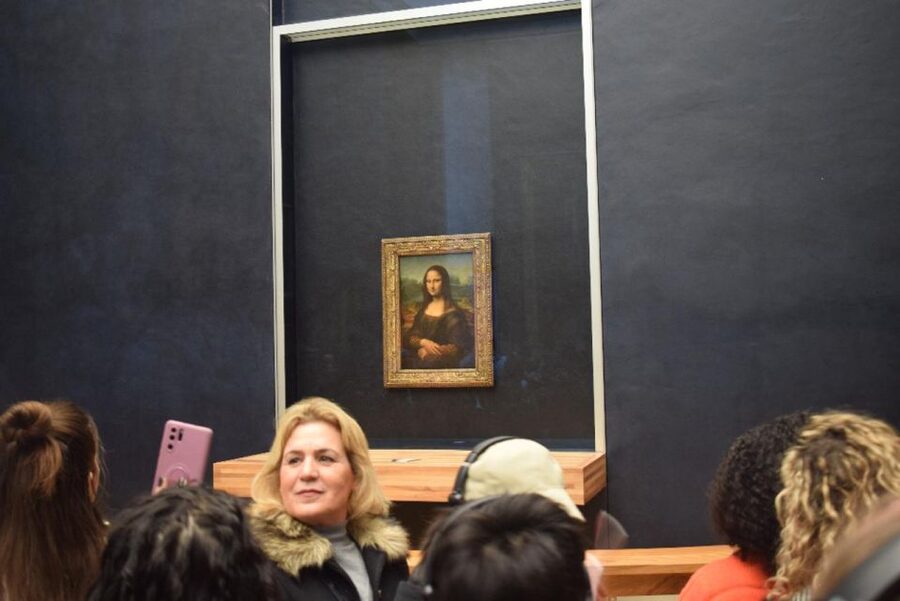
The Mona Lisa needs no introduction, but it does need patience. The room can be crowded, and your viewing time may be brief. A guide helps you reach it efficiently and provides context before or after the encounter, so the visit is not reduced to a quick photograph over someone else’s shoulder.
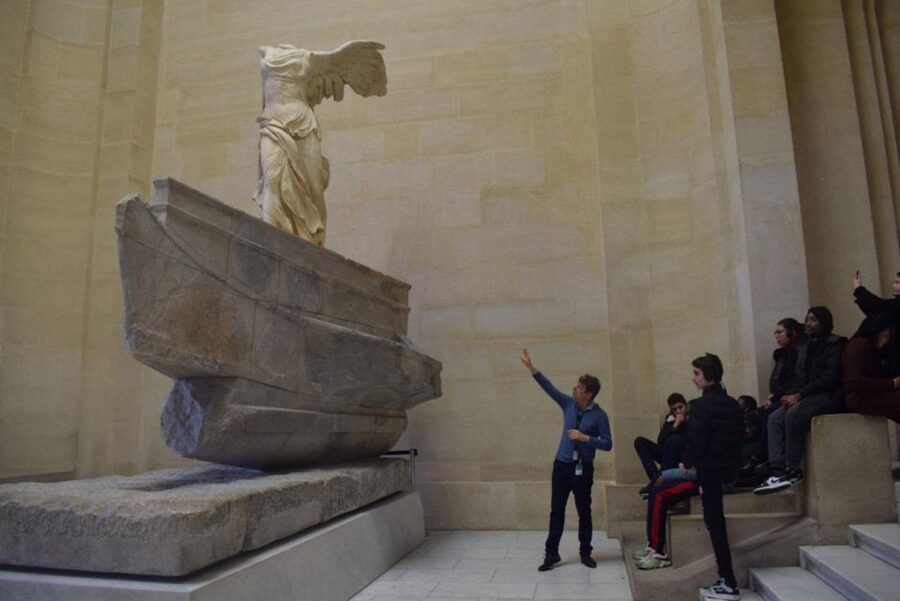
The Winged Victory of Samothrace has a different kind of impact. Its position at the top of a grand staircase makes the approach part of the work’s effect. You can take in the figure, the movement of the drapery, and the dramatic setting before continuing to the next gallery.
These three stops are popular for good reason, but they also draw crowds. The tour cannot promise an empty room or a private view. What it offers is a route that reduces the chance of missing them in the Louvre’s maze.
A different way to spend the day, same corner of France:
- Paris: Evening River Cruise with Music
★ 4.4 · 22,721 reviews - Paris: Eiffel Tower Entry Ticket with Optional Summit Access
★ 4.4 · 20,035 reviews - Paris: Eiffel Tower Summit or Second Floor Access
★ 4.3 · 17,248 reviews - Paris: Louvre Guided Tour with Reserved Access & Boat Cruise
★ 4.3 · 16,353 reviews
Paintings from Botticelli to Géricault
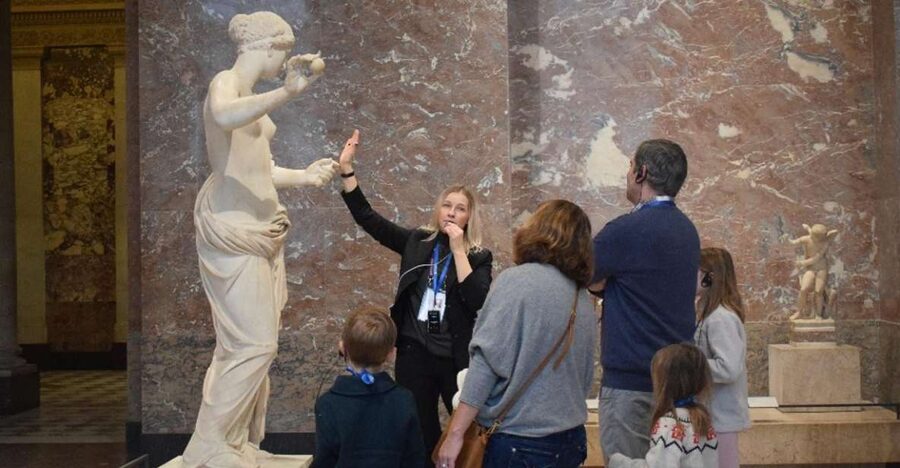
The painting portion broadens the visit beyond the Mona Lisa. Italian Renaissance works bring you into the world of artists such as Leonardo da Vinci and Botticelli, while Caravaggio offers a later, more forceful style of painting.
The guide’s job here is to give you a way to look. You might hear about the subject, the artist’s choices, the historical setting, or the details that are easy to miss from a distance. That kind of explanation is especially useful if art museums sometimes leave you unsure where to begin.
Géricault provides another change of tone. His work belongs to French painting rather than the Italian Renaissance, and the contrast helps you see that the Louvre is not one continuous artistic style. The tour moves across periods and countries without pretending you can master them all in one sitting.
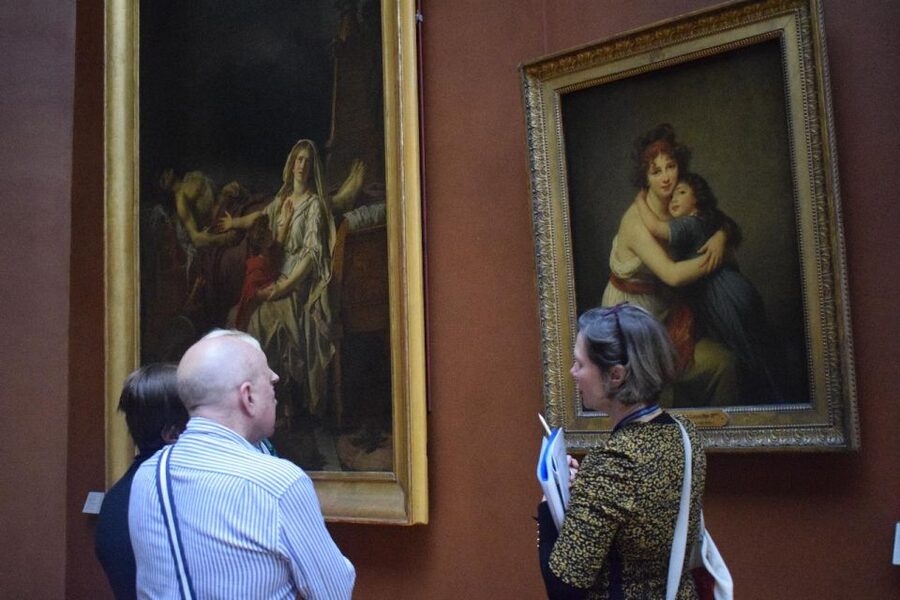
The best approach is to ask questions. The small group makes that practical. Guides have been described as willing to pause, answer questions, and adjust the emphasis when a group has a particular interest. A group of six is still moving through a public museum, but it feels much less anonymous than a large walking tour.
Sculpture, royal rooms, and extra discoveries
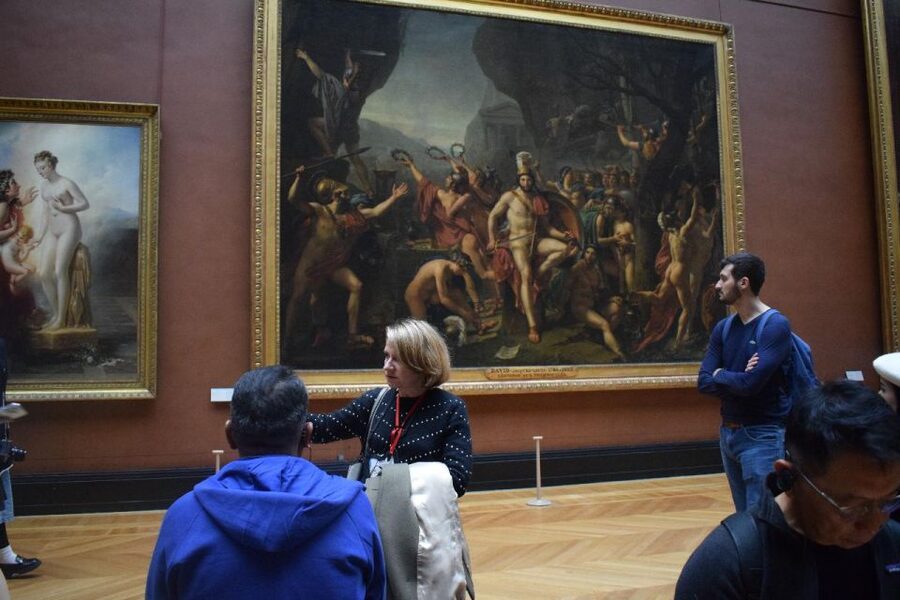
Although the headline stops are paintings and ancient sculpture, the route can include more. The tour may pass through courtyards, Napoleon’s apartments, tapestries, jewelry, and other decorative interiors, depending on the guide’s route and museum conditions.
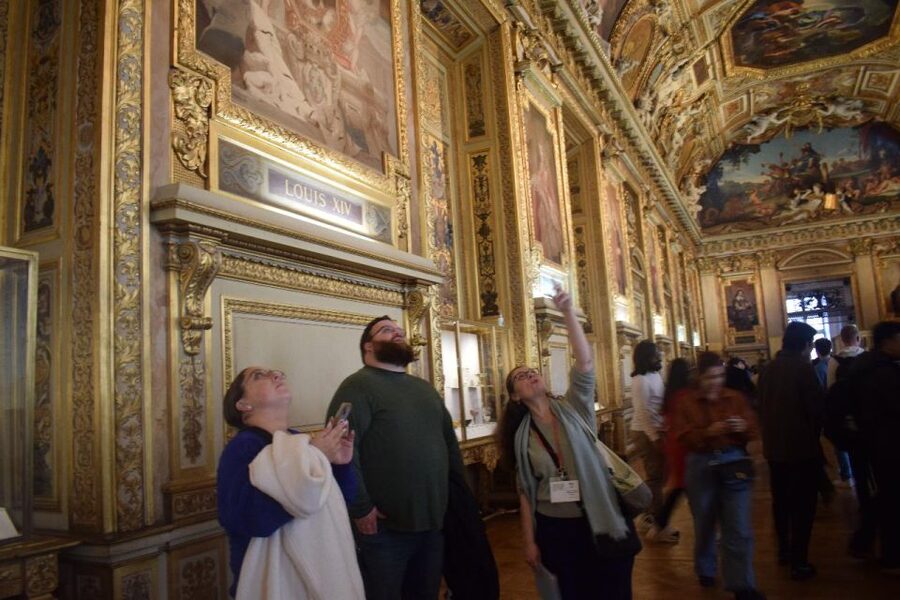
Napoleon’s apartments are a useful reminder that the Louvre was once a working palace, not only an art museum. Their lavish decoration offers a sharp contrast with the quieter display rooms. If you care about interiors and French political history, tell your guide early so the route can give these rooms proper attention.
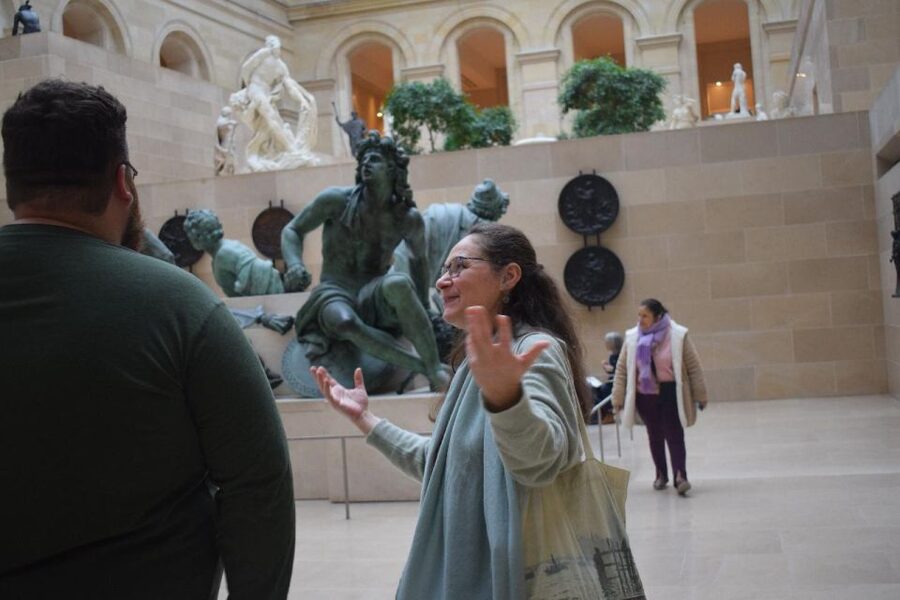
The same applies to sculpture. Ancient Greek works help balance the painting-heavy expectations many people bring to the Louvre. You may find that the sculptures become one of the tour’s most memorable parts, particularly after several rooms of framed art.
The route is not a guarantee of every department or every famous object. Museum rooms can close, crowds can change the order, and two hours requires choices. That is why the guide’s judgment matters more than a rigid checklist.
What the pace feels like
This is a brisk tour. The route has to cover the building’s story, several famous works, and enough background to make the visit meaningful. One family described it as a whirlwind, but still found it useful and engaging for a 14-year-old.
Families with children can make it work because the route has clear goals and does not ask you to spend all day in galleries. The two-hour length also gives you a natural stopping point. Still, young children may tire from walking and standing, particularly during crowded periods.
You should wear comfortable shoes. The museum is large, and the tour involves steady movement through rooms and galleries. The small size helps the group stay together, but you should not expect a slow, chair-by-chair art class.
Some guides use audio devices so you can hear more clearly in crowded rooms. This matters when groups gather near popular works, although you should expect the sound and space around you to vary.
Crowds and the limits of skip-the-line entry
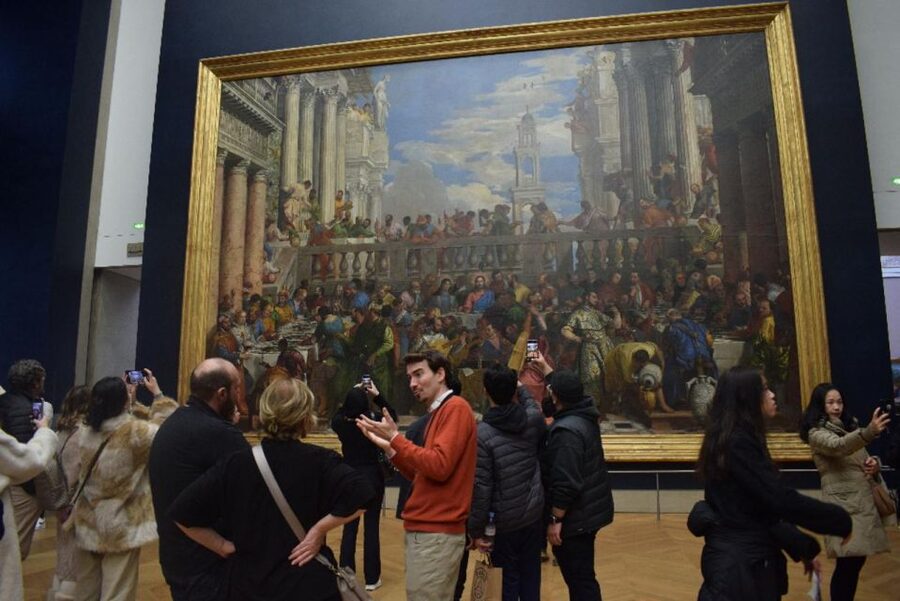
The separate entrance and timed ticket remove one major source of stress, but they do not create a quiet Louvre. The museum can be packed even near closing, and the Mona Lisa area is often the most demanding part of the route.
A guide helps in two ways. First, the guide knows where the main works are and can avoid wasted turns. Second, the guide keeps the group together when corridors and galleries become crowded.
That practical help was one of the strongest parts of this experience for me. A guide such as Zack, Jerome, Marine, or Flo is not only explaining art. The guide is also watching the clock, checking the group, and making sure the route remains workable.
You should arrive ready for some standing and limited personal space. If you want to linger at every painting, the pace may feel rushed. If you want a sensible first look at the Louvre, the movement is a fair trade.
The January 2026 re-entry change
The ticketing rules now deserve special attention. As of January 2026, the Louvre no longer allows you to re-enter after the guided tour is over.
This changes how you should plan the day. Do not assume you can finish the tour, stop for coffee in the cafeteria, and then return to the galleries. That plan caused confusion for some people before the rule became clear.
If you want more museum time, schedule it before the tour only if your ticket and timing allow it, or plan to remain inside after the guided portion. Ask the provider or museum staff about the current arrangement before your visit, because the ticketing system has changed and you should not build your day around re-entry.
The tour is still useful as a first look, but the old idea of using the guide for two hours and returning later on the same ticket no longer applies.
Is $130 a fair price?
At $130 per person, this is not a bargain admission ticket. You are paying a premium for a timed museum entry, a guide, a small group capped at six, and a planned route through a difficult building.
The price makes the most sense when the Louvre is a major priority and your Paris schedule is tight. A strong guide can save you time, explain the art in plain terms, and show you where to return for a longer look. That can be worth more than wandering for hours and still missing key rooms.
The value is less clear if you already know the Louvre well or prefer to set your own pace. You may resent moving on from a work that interests you, and the tour cannot offer a private viewing of the Mona Lisa or a quiet museum.
For a first visit, I think the small-group format improves the calculation. You are not paying only for facts. You are paying for orientation, crowd navigation, and a manageable route. The guide quality is central, and the many strong guide names associated with the tour suggest that the experience depends on the person leading your group.
Who should book this Louvre tour?
Book it if you want the major sights without spending half a day working out the museum’s layout. It is especially well suited to first-time visitors, families, couples, and people who want art explained rather than simply displayed.
It also suits you if the Louvre feels intimidating. The guide gives you a framework, then leaves you with practical ideas for independent exploration. The tour is offered in English, French, German, Spanish, Italian, Arabic, and Chinese, with private and small-group options.
Think twice if you use a wheelchair, have a mobility impairment, or need to bring a stroller. The activity is not suitable for wheelchair users or people with mobility impairments, and baby strollers, backpacks, large bags, oversized luggage, and other large items are not allowed.
Bring a passport or ID card and wear comfortable shoes. Cancellation is free up to 24 hours before the start, and reserve-now, pay-later booking is available, which helps if your Paris plans are still shifting.
Should you book it?
I would book this tour if the Louvre is high on your Paris list and you want a strong first orientation rather than an all-day art study. The six-person limit, timed ticket, and guide-led route solve the museum’s biggest problems: scale, crowds, and uncertainty.
I would skip it if you prefer complete independence or already have a detailed Louvre plan. Two hours moves quickly, and the $130 price is hard to justify if you only want admission.
For most first-time visitors, this is a sensible way to meet the three famous ladies, see major paintings and sculptures, understand the palace’s transformation, and leave with a better plan for the rest of your museum time. Just remember the January 2026 rule: once the guided tour ends, you cannot count on going back in.
FAQ
How long is the Louvre guided tour?
The guided tour lasts two hours.
What works are included in the route?
The route includes the Mona Lisa, Venus de Milo, Winged Victory of Samothrace, and Napoleon’s coronation, along with French paintings, Greek sculptures, Italian Renaissance works, and pieces connected with artists such as da Vinci, Caravaggio, Botticelli, and Géricault.
Where is the meeting point?
Meet at Place Colette, between Le Kiosque des Noctambules and the Comédie Française. The guide will hold a sign marked Connecting France.
Is the Louvre ticket included?
Yes. The activity includes a pre-booked timed ticket and skip-the-line access through a separate entrance. You still need to pass through security.
Can I visit the Louvre again after the tour?
As of January 2026, you cannot re-enter the Louvre after the guided tour ends. Plan your extra museum time carefully.
What languages are available?
Live guides are available in English, French, German, Spanish, Italian, Arabic, and Chinese. Private and small-group options are available.
Recently reviewed around Paris
- Louvre Private Tour – The Essentials and More with Expert Guide★ 5.0 · 227 reviews
- 2CV tour by night★ 5.0 · 55 reviews
- Eiffel Tower Second or Summit Floor Access by Elevator with Views★ 3.5 · 161 reviews
- The only Paris Wine Tasting experience you need to do – 2 hours★ 5.0 · 265 reviews
- 2 Hour Street-art Walk and Space Invaders Hunt in Paris★ 5.0 · 27 reviews
- 2 hour outdoor group activity in Paris: SAINT GERMAIN★ 5.0 · 48 reviews
- Sainte-Chapelle, Conciergerie & Palais de Justice Private Tour★ 5.0 · 72 reviews
- Private 2 – Hour Paris Landmarks Tour by Golf Cart Mini Moke★ 5.0 · 38 reviews
Louvre Museum Tours, compared.


Louvre Guided Tour with Reserved Access & Boat Cruise
Read our review →
Louvre Museum Masterpieces Guided Tour with Access
Read our review →
Louvre Museum Entry Ticket With Host and River Cruise
Read our review →
Priority Access Louvre with Host -Direct to Mona Lisa
Read our review →
Mona Lisa & Louvre Masterpieces Tour with Reserved Access
Read our review →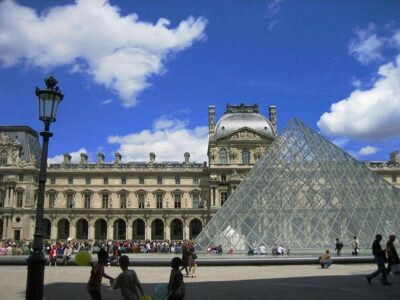
Louvre Museum – Exclusive Guided Tour (Entry Included)
Read our review →
Louvre Reserved Ticket and River Cruise Combo
Read our review →Browse the lists this tour appears in