
Reviewed · CYCLING TOURS
Strasbourg: Guided Bike Tour with a Local Guide
Strasbourg makes sense on two wheels. In 150 minutes, this guided ride links the half-timbered lanes of Petite France with the grand avenues of Neustadt and the modern European quarter. I like the way it shows you two very different sides of the city, and I like that guides such as Katarina, Joshua, and Vivienne add local stories rather than simply pointing at buildings. The main drawback is that some of the ride passes through the newer districts, so you get less medieval Strasbourg than you might expect.
The route is mostly easy and Strasbourg is flat, but you still need to feel comfortable riding near pedestrians and keeping up with a group. If you are confident on a bike, this is a smart way to get your bearings quickly. If you prefer a slow walking pace, the cycling sections may feel a little busy.
In This Review
- Key points at a glance
- Why a bike is the right way to see Strasbourg
- From Café Lové into the old city
- Petite France, covered bridges, and Vauban Dam
- The cathedral and the lanes around Place Saint Etienne
- Neustadt and the city’s German-era identity
- Europe in Strasbourg: Parliament and the Council of Europe
- Fresh air at Parc de l’Orangerie
- The old wall and the ride back to Place d’Austerlitz
- What the $46 price gets you
- Who will enjoy this ride most
- Should you book the Strasbourg bike tour?
- FAQ
- How long does the guided bike tour last?
- What areas of Strasbourg does the route visit?
- Which European institutions will I see?
- Is a bicycle included?
- Are helmets and baskets available?
- What languages are offered?
- Can I cancel the booking?
Key points at a glance
- Petite France and the covered bridges: See Strasbourg’s prettiest old quarter, the Vauban Dam, and the river defenses from the saddle.
- A useful citywide route: Connect the cathedral, Place Broglie, Neustadt, the European institutions, and Parc de l’Orangerie in one outing.
- Strong local guiding: Guides including Katarina, Joshua, and Vivienne are praised for clear explanations, patience, and a good sense of humor.
- A flat, manageable ride: The route includes regular stops for photographs and commentary, with bikes supplied.
- A look beyond the postcard center: Small streets near Place Saint Etienne, Stork Street, and part of the old city wall add detail many short city tours miss.
- Good flexibility: English, German, and Dutch tours are offered, with free cancellation up to 24 hours before departure.
Why a bike is the right way to see Strasbourg
Strasbourg’s center is compact, but its sights are spread across several distinct areas. On foot, you can spend a pleasant morning in Petite France and around the cathedral, then run out of time before reaching Neustadt or the European quarter. A bicycle lets you cover that ground without turning the day into a march.
I especially like the contrast built into the route. You begin with the older city, where canals, narrow lanes, stone bridges, and timber-framed buildings give Strasbourg its familiar look. Then you ride into Neustadt, the 19th-century district created during the period of German rule, before reaching the institutions that help define Strasbourg’s role in modern Europe.
This is not a race. The ride includes stops for explanations and pictures, and the total length is about two and a half hours. Past comments on the pace range from relaxed to easy to follow, though one useful caution comes through clearly: weaving around pedestrians can be daunting if you are not a steady cyclist.
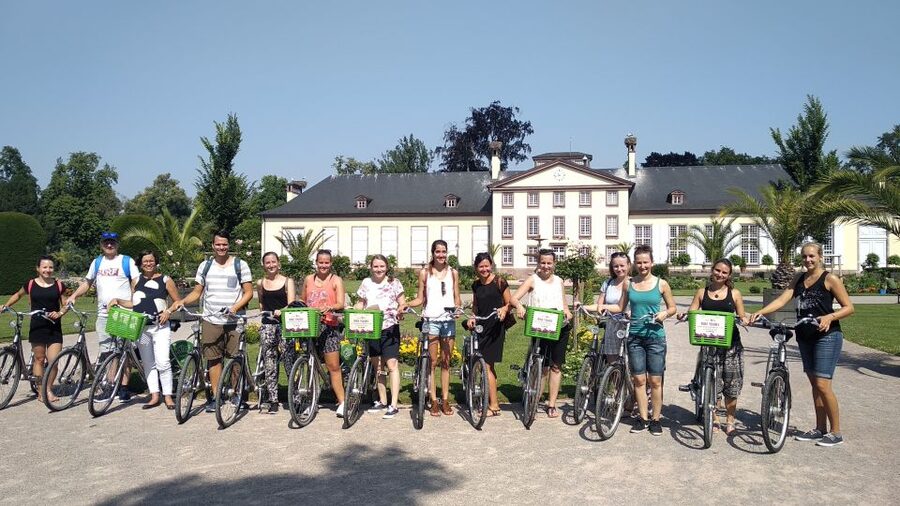
Bikes are included. Helmets are available, as are baskets for a small bag. The route is described as flat, which helps, but you should still wear practical clothing and shoes that let you control the bike comfortably.
More rides around Strasbourg & Alsace:
- Strasbourg: Bike Tour with a Guide bikes included
★ 4.4 · 153 reviews - Through Alsace Vineyards and Wine Villages Private Bike Tour
★ 5.0 · 47 reviews - Strasbourg: 1-Day Bike Rental
★ 4.1 · 45 reviews
From Café Lové into the old city
The meeting point depends on the option you book, with starting locations listed at Café Lové and La Pépinière. Check your confirmation carefully rather than assuming every departure leaves from the same place. The guide begins with a short introduction to Strasbourg, giving you a basic map of the city before the riding starts.
That opening matters. Strasbourg has French and German layers, and the tour is easier to follow once you understand how the districts fit together. The guide can then explain why an ornate German-era avenue feels so different from a medieval lane only a short ride away.
The route crosses the Pont du Corbeau and passes Gutenberg Place. These early sections help connect the old center to the main landmarks, and they also give you a chance to settle into the bicycle before the busiest parts of the ride.
Petite France, covered bridges, and Vauban Dam
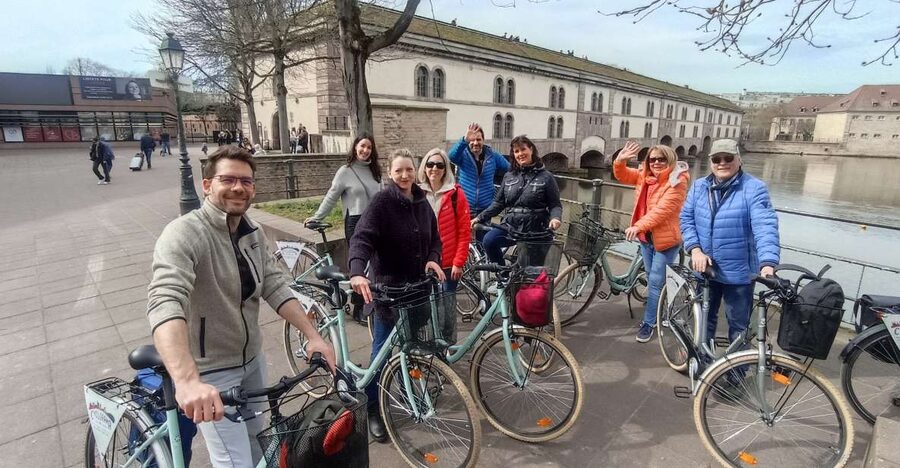
Petite France is the most instantly charming section of Strasbourg. Its narrow streets, canals, and old houses are made for looking around, but a bicycle gives you a wider sense of how the quarter sits within the city. You do not simply stop at one photogenic corner. You pass through the old quarter and connect it with the defensive works along the river.
The covered bridges are a major highlight. Despite the name, their roofs are gone today, but the bridges remain part of Strasbourg’s historic defenses. Nearby, the Vauban Dam shows how the city used water as part of its military system. From the bike, you can see these features in relation to the river and the surrounding neighborhoods, rather than treating each one as a separate stop.
This is also one of the places where traffic and pedestrians may slow the group. Keep your hands ready on the brakes and leave room in front of you. The guide leads the way, but you remain responsible for steering safely through shared streets.
The ride later returns to Petite France, so this area is not a quick glance before it disappears. You get an early introduction and another pass toward the end, useful if you want to remember where to return for a slower walk or meal.
The cathedral and the lanes around Place Saint Etienne
After crossing toward the central city, the route reaches Gutenberg Place and then the Notre Dame de Strasbourg Cathedral. This is one of the tour’s essential pauses. The cathedral dominates the center, and seeing it after the smaller scale of Petite France makes its size and detailed stonework even more striking.
The tour does not stop at the cathedral alone. You cycle along the small streets around it and explore less obvious corners near Place Saint Etienne. This is where a guide can add real value. On your own, you may admire the cathedral, take a few photographs, and move on. A local guide can point out architectural details, city symbols, and streets that are easy to miss when you are focused on the main monument.
The route also reaches the Opera House on Place Broglie. This gives you another change of scale, from medieval religious architecture to the formal urban planning and grand buildings associated with later Strasbourg. The mix helps explain why the city feels less like a single preserved old town and more like several eras placed side by side.
One practical point: this is sightseeing from a bicycle, not a cathedral interior tour. The supplied details describe seeing the cathedral from outside, so plan a separate visit if you want to go inside.
More Strasbourg & Alsace trips worth a second look
- Strasbourg: Euro Guided Tour by Segway
★ 4.7 · 808 reviews - Strasbourg: Walking Tour with a Local Guide
★ 4.3 · 607 reviews - Strasbourg: Walking Tour with Local Guide
★ 5.0 · 598 reviews - Strasbourg: 1.5-Hour Guided Segway Tour
★ 4.8 · 383 reviews
Neustadt and the city’s German-era identity
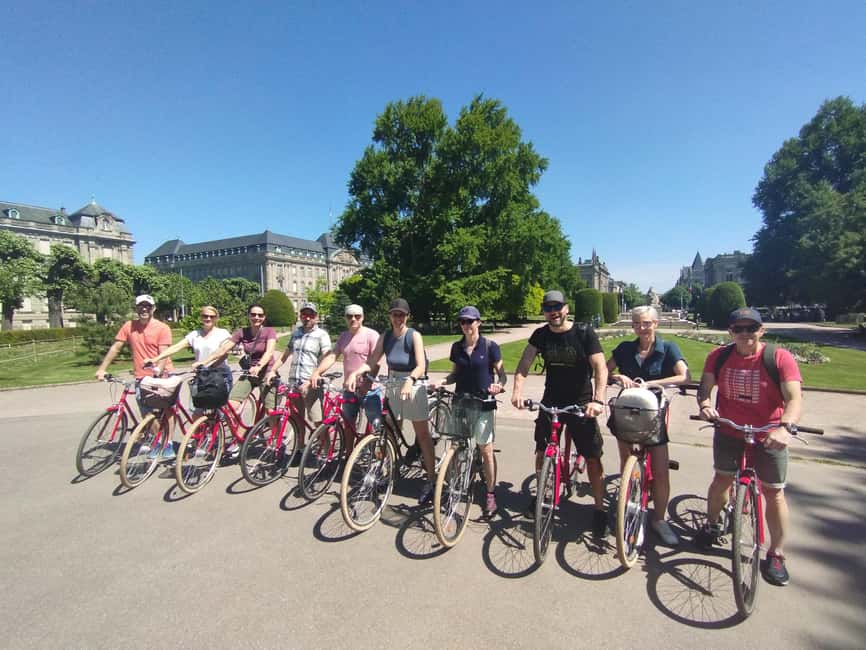
The move into Neustadt is one of the most interesting parts of the program, but it is also the section most likely to disappoint someone seeking only medieval streets. Neustadt was built in the 19th century during German rule, and its wider avenues and monumental buildings create a very different mood from Petite France.
I like having this district included because it gives Strasbourg needed context. The city’s story is not limited to timber-framed houses and canals. Neustadt shows how politics, administration, and urban planning reshaped Strasbourg. You see a city designed for a different age, with more room and a more formal layout.
At the same time, the balance of the tour means you should set your expectations correctly. One portion of the ride is spent in the newer area and around the European buildings. If your priority is medieval Strasbourg, you may wish the old town section were longer. If you want to understand the city as a whole, the detour is worthwhile.
Guides are a major part of how well this section works. Katarina is repeatedly described as attentive, friendly, and clear, while Joshua is praised for his historical explanations and ability to adjust when needed. Other guides, including Vivienne, Catherine, Barbara, and Jean, have also been singled out for warmth and useful stories. The exact guide depends on the date and language, but the strongest pattern is a personal, conversational approach.
Europe in Strasbourg: Parliament and the Council of Europe
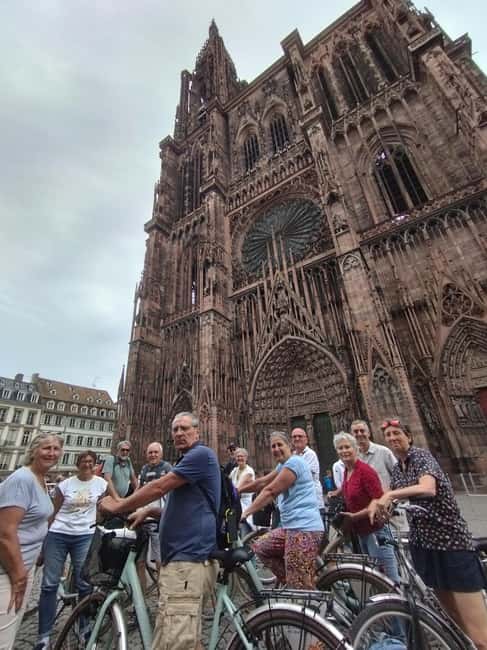
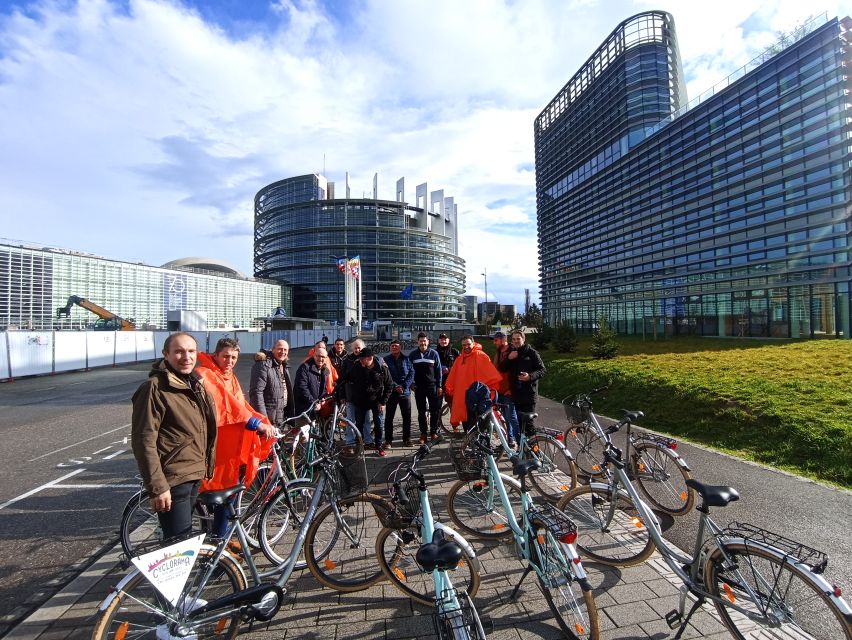
The route continues into the European district, where you see the European Parliament, the Council of Europe, and the European Court for Human Rights. These are not decorative monuments. They reflect Strasbourg’s role as a center of European cooperation and give the ride a modern political dimension.
This stop is especially useful if you have never visited the city before. The European buildings sit outside the postcard center, and you might not make the trip on your own during a short stay. Cycling here lets you place the institutions on your mental map without spending a separate half-day getting there.
The tradeoff is visual and historical. The buildings are important, but they do not have the same immediate charm as the cathedral or canals. Some people will find the contrast refreshing. Others may prefer more time among medieval streets and older monuments. I would think of this portion as city context rather than a classic sightseeing stop.
The guide’s explanation makes the difference. You are not simply riding past office buildings. You learn why these institutions matter to Strasbourg and how the city’s position between French and German cultures connects with its European role.
Fresh air at Parc de l’Orangerie
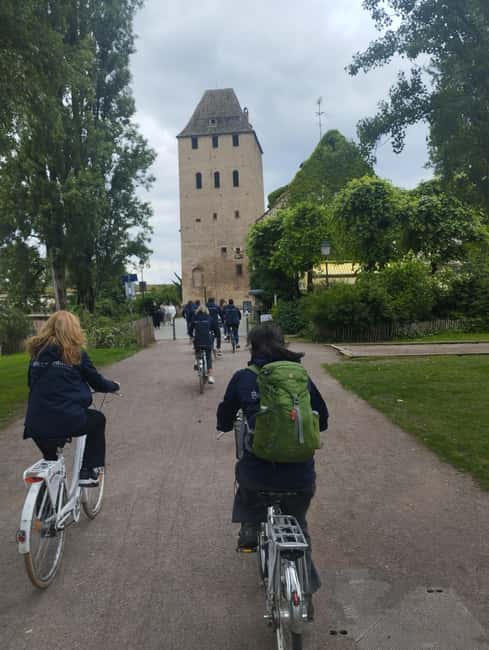
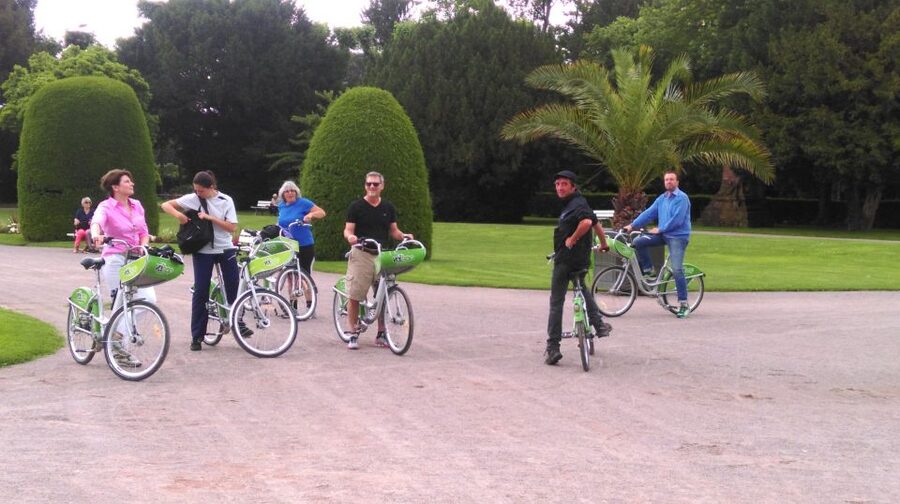
Parc de l’Orangerie provides a welcome change after the denser central streets and formal European district. The stop is brief, listed at about 10 minutes, but it gives you room to breathe and reset before the return ride.
The park also adds a softer side to the itinerary. After canals, defensive works, major civic buildings, and European institutions, open green space keeps the tour from becoming a long chain of architecture lectures. One guide was especially praised for including Stork Street and the park, areas that can be missed on a standard walk through the central island.
Do not expect a long park visit. This is a short guided stop within a larger circuit, not an extended break for a picnic or a full stroll. Still, it is well placed in the route and gives you a pleasant pause.
The old wall and the ride back to Place d’Austerlitz
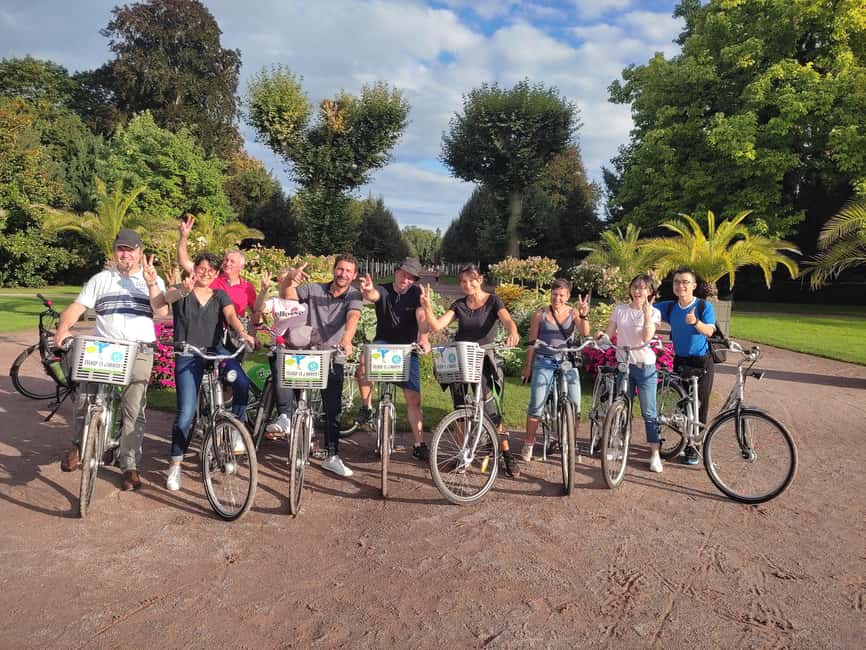
On the way back toward Place d’Austerlitz, the group follows a section of Strasbourg’s 14th-century wall. It is the sort of detail that can disappear in a standard city-center visit. You may not see a dramatic fortress, but the surviving section helps show the former shape of the city and how much Strasbourg has expanded beyond its old defenses.
The return also brings you back toward Petite France, with a final look at the covered bridges and Vauban Dam before the tour ends at one of the listed drop-off points. That circular design is useful. You see the old town at different stages of the ride instead of spending the whole tour moving in one direction and retracing the same streets.
Regular pauses keep the outing from feeling like a workout. One rider described the route as a good mix of riding and stops, while another appreciated having time for photographs and questions. The length is also well judged for a first look: long enough to reach the outer districts, but not so long that the bicycle becomes the main event.
What the $46 price gets you
At $46 per person, the value depends on how you use the tour. You receive a bicycle and a live multilingual guide for 150 minutes. That is a reasonable price for a guided orientation that reaches several districts you might not connect efficiently on your own.
The real value is the route planning. You could rent a bike and visit Petite France, the cathedral, Neustadt, and Parc de l’Orangerie independently, but you would need to work out the sequence and supply your own background. Here, the guide ties the city’s French, German, medieval, and European chapters together.
The price is less compelling if you want long stops inside monuments or a detailed walking tour of the old center. This is a broad survey. You trade depth at individual sights for range across the city.
The booking terms are helpful for a short trip. You can reserve now and pay later, and cancellation is free up to 24 hours before departure for a full refund. Starting times vary, so availability needs to be checked for your date.
Who will enjoy this ride most
I would choose this tour early in a Strasbourg stay. It gives you a working map, shows you areas beyond the center, and helps you decide where to return for a longer visit. It suits couples, solo visitors, families with older children, and anyone with only a day or two in town. A 16-year-old rider was reported to have particularly enjoyed it, which suggests the mix of movement and stories works better for many teenagers than a long walking lecture.
It is also a good option if you have already taken a boat ride or walked the central island. The route reaches places those activities may not cover, especially Neustadt, the European quarter, Stork Street, the park, and the old wall.
I would hesitate if you lack confidence on a bicycle or dislike riding around pedestrians. The route is generally easy and flat, but it is still a city ride. You need to listen to the guide, watch the road, and stay with the group.
Should you book the Strasbourg bike tour?
Book it if you want a smart first overview of Strasbourg rather than a slow, monument-by-monument visit. The combination of Petite France, the cathedral, Neustadt, the European institutions, Parc de l’Orangerie, and the old wall gives you a much wider picture than a short stroll through the center.
Skip it if your only goal is more time in medieval Petite France. You will spend a meaningful part of the ride in newer districts and around European buildings. For a confident cyclist, though, the $46 fee buys a well-planned route, a supplied bike, and the kind of local explanation that helps the city make sense.
FAQ
How long does the guided bike tour last?
The tour lasts 150 minutes, or two and a half hours.
What areas of Strasbourg does the route visit?
The route includes Petite France, the Old Town, the 19th-century Neustadt district, the European district, Parc de l’Orangerie, Place Broglie, the area around Notre Dame de Strasbourg Cathedral, and part of the 14th-century city wall.
Which European institutions will I see?
You will see the European Parliament, the Council of Europe, and the European Court for Human Rights.
Is a bicycle included?
Yes. A bicycle is included in the activity price.
Are helmets and baskets available?
Helmets are available, and baskets can hold a small bag.
What languages are offered?
The live guide can conduct the tour in English, German, or Dutch.
Can I cancel the booking?
Yes. You can cancel up to 24 hours before departure for a full refund. You can also reserve now and pay later.
Recently reviewed around Strasbourg & Alsace
- Guided tour of Nancy, Great History and Little Anecdotes★ 5.0 · 89 reviews
- Guided Tour “Unusual Nancy”★ 5.0 · 36 reviews
- Alsace villages half day tour from Colmar★ 5.0 · 186 reviews
- The Emblematic: visit of villages, Haut-Koenigsbourg, Wine tasting★ 5.0 · 81 reviews
- Segway Tours 2h in Colmar★ 5.0 · 116 reviews
- Alsace’s Gems Small Group Day Tour from Colmar★ 5.0 · 84 reviews
- Private and customizable: Alsace Wine Route HIGHLIGHTS in 3 hours★ 5.0 · 63 reviews
- ICONICS Tour: 1/2 day on the Wine Route, visit of 2 Villages + Tasting.★ 5.0 · 159 reviews
Cycling Tours, compared.
Versailles Bike Tour w/ Palace, Gardens, & Picnic
Read our review →
Paris Local Districts and Stories Off the Beaten Track Guided Bike Tour
Read our review →
Highlights of Paris Bike Tour w/ a Local Guide (English or Dutch)
Read our review →
Versailles Bike Tour with Market, Gardens & Guided Palace Tour
Read our review →Browse the lists this tour appears in