
Reviewed · LILLE TOURS
1 day Canadian WW1 private tour including Vimy Ridge
Canada’s First World War story comes sharply into focus on this private tour through Vimy Ridge and the Somme. You’ll walk through preserved trench systems, cross the former no man’s land, and pause at cemeteries where the names and dates make the scale of the fighting painfully clear. Vimy Ridge is the emotional center, but Beaumont-Hamel and Courcelette give the day a wider frame.
I like the small size, limited to three people, and the way Olivier uses historical maps on the vehicle’s GPS screen to explain troop movements as you drive. I also like the mix of major memorials and quieter stops, especially Givenchy Road Canadian Cemetery, where 108 Canadians killed during the opening days of the Battle of Arras are buried.
The main drawback is the long driving involved in covering Arras, Vimy Ridge, and the Somme sector in about seven hours. Lunch is not included, and the Grange Tunnel visit depends on attendance, so this tour suits people who want a concentrated military history day rather than a slow visit to one site.
In This Review
- Key points to know before booking
- Why Vimy Ridge is only the beginning
- Givenchy Road Cemetery keeps the scale personal
- A practical lunch stop around Pozières
- Beaumont-Hamel preserves the trench system
- Courcelette connects Canada to the first tanks
- Olivier’s maps make the drive count
- What the $372.43 price really buys you
- Pickup, timing, and comfort
- Who will get the most from this Canadian battlefield day
- Should you book this Vimy and Somme tour?
- FAQ
- How long is the Canadian WWI tour?
- Where can pickup be arranged?
- How many people can join the private tour?
- Is lunch included?
- Is the Grange Tunnel visit guaranteed?
- What is included in the tour price?
Key points to know before booking
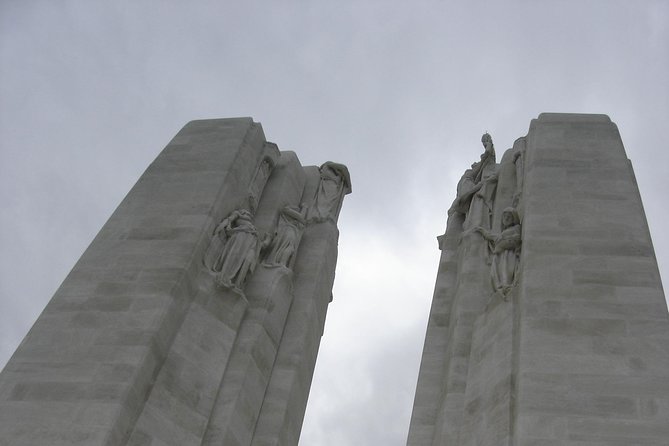
- Vimy Ridge comes first: Visit the visitor centre, walk through trench lines, and see Walter Seymour Allward’s Canadian National Vimy Memorial.
- The tour is genuinely private: Your party has the vehicle, guide, and commentary to itself, with a maximum of three people.
- Olivier shapes the day around your interests: His explanations connect the Canadian positions, German lines, troop movements, and later battles.
- Beaumont-Hamel adds a Newfoundland focus: Preserved trenches, the Caribou Memorial, and the Danger Tree make this one of the day’s most affecting stops.
- Lunch is a paid break: You’ll stop at a café or restaurant in La Boisselle or Pozières, with Le Tommy mentioned as a possible choice.
- Pickup is flexible but regional: Collection can be arranged at a hotel, bed-and-breakfast, or station in the Amiens, Arras, or Saint-Quentin areas, not Paris.
Why Vimy Ridge is only the beginning
Many Canadian visitors arrive expecting Vimy Ridge to be the whole story. This tour makes a stronger case for seeing Vimy as one part of a connected Canadian route through northern France.
The day begins around 9:30 am and moves first toward the Vimy Ridge visitor centre. Depending on attendance, you may be able to visit the Grange Tunnel. That detail matters because the tunnel offers a closer look at the underground and trench side of the war, while the memorial itself is a grand place of remembrance.
You’ll then cross the former Canadian line through no man’s land and enter the German trench system facing the Canadian positions. The exact condition and access of trench areas can affect what you see, but the point is clear: this is not only a photo stop beside a monument. You are given a physical sense of how close the opposing lines were and how narrow the ground could be between them.
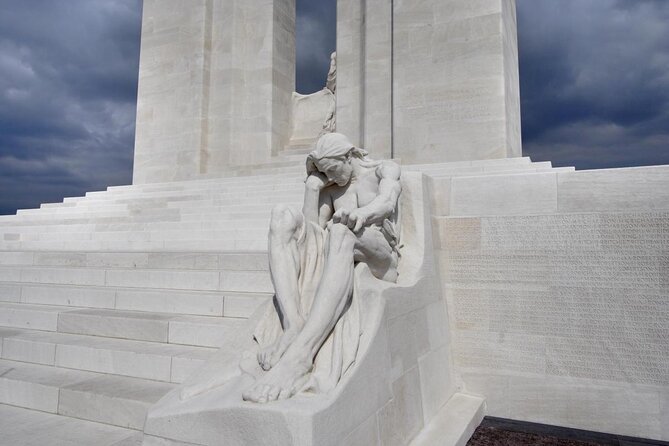
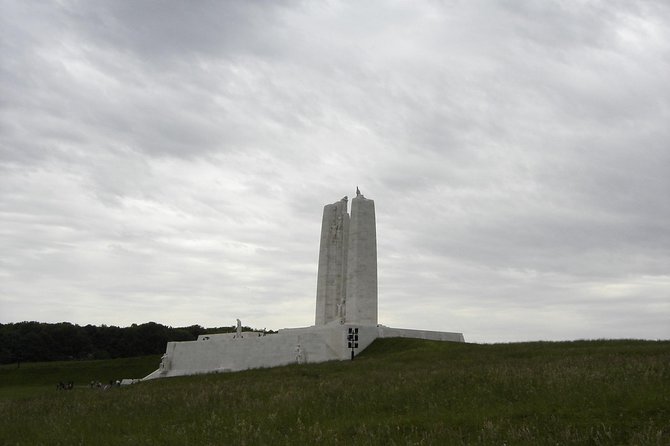
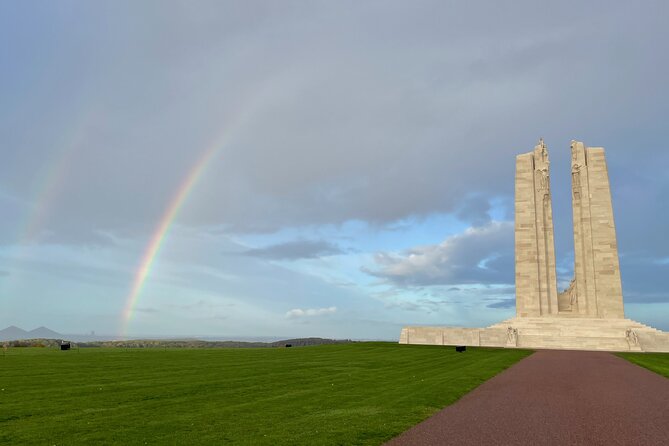
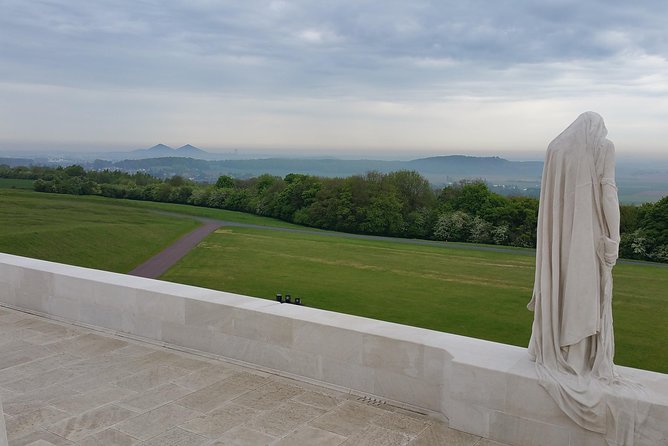
The Canadian National Vimy Memorial follows. Designed by Walter Seymour Allward and fully refurbished in 2007, it is the largest and most recognizable memorial on this route. You have time to look beyond the architecture and consider the reason it was placed here: the ridge is tied directly to Canada’s April 1917 battle experience.
The guide’s role is especially useful at Vimy. A monument can be powerful but hard to read without context. Olivier’s use of battlefield maps and photographs helps place the Canadian and German positions in relation to each other, so you can better understand what the ground meant during the attack.
More Lille trips worth a second look
- Disneyland® Paris 1-Day Ticket
★ 4.6 · 49,412 reviews - Normandy D-Day Sites & Cemetery Day Trip from Paris with Lunch
★ 5.0 · 6,877 reviews - From Nice: French Riviera in One Day
★ 4.5 · 5,215 reviews
Givenchy Road Cemetery keeps the scale personal
Before the route turns toward the Somme sector, the tour stops at Givenchy Road Canadian Cemetery for about 15 minutes.
This is a short visit, but I would not treat it as filler. The cemetery contains the graves of 108 Canadians who fell on April 9 and in the days that followed during the Battle of Arras. After the broad design of the Vimy memorial, the cemetery brings your attention back to individual burials.
You may find the stop especially useful if you want time for quiet reflection rather than another long explanation. The brief timing also helps keep the full route within one day, though anyone wanting extensive cemetery research may wish for more time here.
A practical lunch stop around Pozières
The route continues into the Somme sector, with a 45-minute lunch break at a local café or restaurant in La Boisselle or Pozières. Lunch is not included, so bring a card or cash appropriate for the meal you choose.
One possible stop is Le Tommy, a café and war museum that has been singled out as a particularly enjoyable part of the day. Its displays include wartime objects that you can examine at close range. It gives the lunch break a clear connection to the subject instead of making it feel like a pause in the middle of a busy sightseeing schedule.
Still, keep your expectations practical. Forty-five minutes is enough for a meal and a quick look around, not a long museum visit. The exact restaurant may vary, so do not book this tour solely for a particular lunch venue.
Pozières is also more than a convenient place to eat. It places you in the Somme battle area, where the tour shifts from the Canadian action at Vimy and Arras to the 1916 fighting farther south.
Beaumont-Hamel preserves the trench system
After lunch, you’ll visit Newfoundland Park at Beaumont-Hamel for about an hour. This is one of the strongest parts of the route, particularly if your family connection is to Newfoundland.
The Newfoundland Regiment suffered the second-worst casualty level of any regiment on the first day of the Battle of the Somme. The preserved trenches make the site valuable because they allow you to see the physical setting alongside the story. You can walk through the trench system, look toward the former German army line, and picture why the terrain mattered so much to the men who fought there.
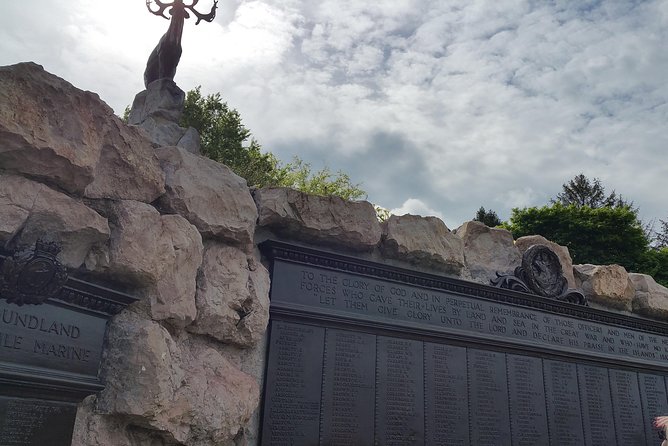
The Caribou Memorial and the Danger Tree are key points within the park. They face toward the German line and give the visit a strong visual focus. The Caribou is also a direct link to Newfoundland’s wartime service, making this stop more than a general Somme battlefield visit.
I would tell you to protect the full hour here. The stop can feel rushed if you are trying to take photographs, read signs, walk through the trenches, and listen to the guide at the same time. If you have Newfoundland family ties, tell Olivier before or during the tour. He has adjusted the emphasis for visitors from Newfoundland, allowing more time at Beaumont-Hamel when possible.
The hour is still limited, though. You will get a clear introduction and time to walk the principal areas, but not an exhaustive examination of every feature.
A different way to spend the day, same corner of France:
- Entrance Ticket Nausicaa, the biggest aquarium in Europe
★ 3.5 · 1,135 reviews - Lille Driving Tour by Convertible Citroen 2CV
★ 4.9 · 711 reviews - Nausicaá National Sea Center: Full-Day Entry Ticket
★ 4.5 · 541 reviews - Unique Tour of Lille by Convertible 2CV – 1h00
★ 5.0 · 470 reviews
Courcelette connects Canada to the first tanks
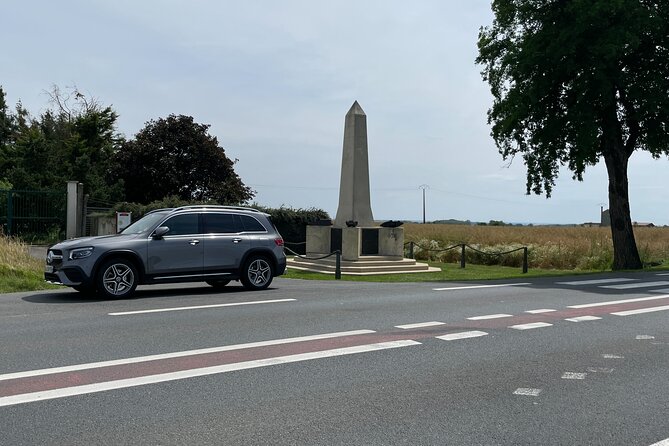
The last listed stop is the Courcelette Canadian Memorial, with about 15 minutes at the site.
Courcelette was captured by Canadian forces in mid-September 1916, on the same day tanks were used for the first time in history. That fact gives the memorial a different character from Vimy. Instead of focusing only on the symbolic importance of a national memorial, the stop places you at a specific moment in the changing methods of the war.
Fifteen minutes is enough to see the memorial and hear the main explanation, but it will not satisfy someone seeking a long walk through the village or a detailed study of the entire Somme offensive. Its value is in the sequence: after Vimy and Beaumont-Hamel, Courcelette shows another chapter in Canada’s military role.
The route also benefits from the order of the stops. Vimy introduces the Canadian front in 1917. Givenchy Road ties that fighting to named Canadian dead. Beaumont-Hamel shifts attention to Newfoundland and the first day of the Somme. Courcelette brings in the Canadian advance of 1916 and the first battlefield use of tanks.
Olivier’s maps make the drive count
A major strength of this tour is the amount of explanation provided between stops. The drive is not dead time. Olivier uses historical maps displayed through the vehicle’s GPS system to show how the front lines moved and how the battles related to one another.
That is useful in this part of France because modern roads and fields can look calm and ordinary. Without a map, it can be hard to understand why a particular ridge, village, road, or cemetery matters. The moving vehicle becomes a place to connect the sites instead of simply a way to get from one attraction to the next.
Olivier is also able to focus on Canadian participation rather than giving you a broad, general lecture on the entire First World War. His explanations cover troop movements, battlefield tactics, the Canadian and British positions, and the relationship between the Arras and Somme sectors.
The private format makes a difference here. With only your group of up to three people, you can ask questions as they occur. If you want a family connection followed, or need a battle explained from a particular Canadian viewpoint, the day can be adjusted more easily than a large coach tour.
The guide can also help with the rail connection from Paris to Arras, according to the tour information. That does not make Paris a pickup point, but it can make the regional meeting arrangement easier for visitors staying in the capital.
What the $372.43 price really buys you
At $372.43 per person, this is not a budget excursion. The cost is easier to assess when you remember that it is a private tour for up to three people, not a seat on a large bus.
The price includes private transportation, a professional licensed local guide, live commentary, bottled water, and pickup arrangements within the stated regional areas. It does not include lunch or any separate food and drink costs.
For one person, the price is a substantial outlay. For two or three people sharing a private vehicle, it becomes easier to justify, especially if you value a flexible pickup and direct access to a guide who can answer detailed questions. Group discounts may also be available, though the exact amount is not specified.
I see the best value for couples, families, or small groups with a serious interest in Canadian military history. You are paying not only for transport, but also for the guide’s ability to interpret places that can otherwise seem disconnected. The historical maps, regional knowledge, and private format are the parts that distinguish this from simply hiring a car and visiting the memorials alone.
The tradeoff is time. Seven hours covers a lot of ground, but the itinerary has several short stops and plenty of driving. If you prefer to spend half a day at Vimy alone, read every panel, or research family names at length, this will feel too compressed.
Pickup, timing, and comfort
Pickup can be arranged at a preferred location such as a train station, hotel, or bed-and-breakfast in Amiens, Arras, or Saint-Quentin. You should contact the operator with your preferred address after booking, rather than assuming every lodging location is automatically covered.
Paris is not an available starting point because the driving distance would take too much of the tour day. The practical choice is to reach one of the regional cities by train and begin from there.
The tour is offered in English. Children can participate, but they must be accompanied by an adult. Most people can take part, though you should expect some walking through trench areas and memorial grounds. The tour is near public transportation at its regional starting points, but the battlefield sites themselves are visited by private vehicle.
Confirmation is sent within 48 hours, subject to availability. Since the experience is often booked well ahead, with an average booking point of about 76 days in advance, I would reserve early if your dates are fixed.
The vehicle includes bottled water and is described as comfortable. The small group limit means you avoid the noise and waiting time of a large bus, but the ride still covers a broad area. Wear practical shoes and bring a layer suitable for open memorial grounds. Those are simple precautions for a day spent moving between fields, cemeteries, visitor facilities, and trench paths.
Who will get the most from this Canadian battlefield day
I would recommend this tour most strongly to:
- Canadians tracing a family connection to the First World War
- Visitors from Newfoundland who want Beaumont-Hamel given proper attention
- People who want Canadian participation to be the main subject
- First-time battlefield visitors who need maps and clear explanations
- Couples or small groups willing to pay more for private transport and discussion
- History-focused visitors who prefer cemeteries, trenches, and memorials to general sightseeing
You do not need to be a military specialist. Olivier’s explanations are designed to connect the places and events, not assume that you already know every regiment or date.
I would hesitate if your priority is a leisurely day with long stays at each stop. The tour covers Vimy, Arras, and the Somme in one outing, so its strength is the connection between sites. It is less suitable if you want a single-location visit or a broad tour of nonmilitary attractions around northern France.
The tone is also serious. Vimy Ridge, Givenchy Road, Beaumont-Hamel, and Courcelette are places of loss. The memorials are beautiful, but this is not a light sightseeing day.
Should you book this Vimy and Somme tour?
Book it if you want a focused Canadian First World War route with a private guide who can explain what you are seeing as the vehicle moves from one battlefield sector to the next. The strongest reasons are Olivier’s map-based commentary, the small group size, and the balance between famous places and a quieter cemetery stop.
For the best experience, arrive in Arras, Amiens, or Saint-Quentin rather than trying to start in Paris. Tell the operator if you have Canadian or Newfoundland family connections, and protect your time at Beaumont-Hamel. Also budget separately for lunch.
Skip it if you want a slow, self-guided visit with hours at Vimy alone. But if your aim is to understand how Vimy Ridge, Arras, the Somme, Beaumont-Hamel, and Courcelette fit together, this seven-hour private tour offers a strong and personal way to do it.
FAQ
How long is the Canadian WWI tour?
The tour lasts approximately seven hours and begins at 9:30 am.
Where can pickup be arranged?
Pickup can be arranged at a preferred location such as a train station, hotel, or bed-and-breakfast in the Amiens, Arras, and Saint-Quentin areas. The tour cannot originate from Paris.
How many people can join the private tour?
The private tour is limited to your group, with up to three participants.
Is lunch included?
No. The tour includes bottled water, but lunch is not included. A 45-minute break is planned at a local café or restaurant in La Boisselle or Pozières.
Is the Grange Tunnel visit guaranteed?
No. The Grange Tunnel visit is added depending on attendance.
What is included in the tour price?
The price includes a driver-guide, private transportation, live commentary, a professional licensed local guide, bottled water, and the small-group private format.
Recently reviewed around Lille
- Lille Old Town Walking Tour With A Guide★ 4.5 · 40 reviews
- 1 Hour Private Lille Tour by Convertible 2CV with a Local Products Tasting★ 5.0 · 78 reviews
- Private Lille Tour by Classic Convertible 2CV with Champagne★ 5.0 · 49 reviews
- 30-Minutes Private Guided Tour of Lille by Convertible 2CV★ 5.0 · 79 reviews
- Rallye “Discoveries and Surprises”★ 5.0 · 52 reviews
- Lille Scavenger Hunt and City Highlights Walking Tour★ 4.5 · 47 reviews
- Lille Scavenger Hunt and Highlights Self Guided Audio Tour★ 4.0 · 32 reviews
- Private battle of Dunkirk Operation Dynamo Tour★ 5.0 · 99 reviews
Lille Tours, compared.

Entrance Ticket Nausicaa, the biggest aquarium in Europe
Read our review →

Nausicaá National Sea Center: Full-Day Entry Ticket
Read our review →
24, 48 or 72-Hour City Pass & 24-Hour Transportation
Read our review →
Pierrefonds: Château de Pierrefonds Entrance Ticket
Read our review →
Browse the lists this tour appears in