
Reviewed · MONTMARTRE TOURS
Hidden Montmartre: Paris’ Secret Streets Walking Tour
Montmartre’s best moments are often found away from the main steps of Sacré-Coeur. This two-hour walk takes you from the Moulin Rouge through quiet cobbled lanes, old artist quarters, a working urban vineyard, and viewpoints that many first-time visitors miss. I especially like the fresh croissant stop and the way guides such as Max and Cecilia connect the streets with the artists who lived here.
I also like the small maximum group of 14, which makes it easier to ask questions and keep a steady pace. The main consideration is the hill itself: the route covers about 2 kilometers, with stairs and steep inclines, so comfortable shoes and a little stamina matter.
In This Review
- Key points to know before booking
- Why this Montmartre walk feels different
- Place Blanche and the Moulin Rouge
- The croissant stop is more than a snack
- The Wall of Love and Picasso’s Montmartre
- Windmills, expensive houses, and a secret passage
- The vineyard and Au Lapin Agile
- Sacré-Coeur and the final Paris view
- How much value do you get for $44.44?
- Walking conditions, timing, and group size
- Who should book this experience?
- Should you book the Hidden Montmartre walk?
- FAQ
- Where does the Hidden Montmartre tour start?
- Where does the tour end?
- How long is the walking tour?
- Is the croissant included?
- Is the tour suitable for children?
- What is the cancellation policy?
Key points to know before booking
- Start at the Moulin Rouge: Begin at Place Blanche, opposite the famous red windmill, then climb toward the hilltop.
- A proper bakery stop: The croissant tasting is included and comes from a highly awarded Paris bakery.
- The artistic Montmartre: Hear stories about Picasso, Van Gogh, Renoir, Dalida, and the area’s struggling painters.
- A vineyard in the city: See Montmartre’s remaining vineyard and hear the strange tale of the painting donkey Lolo.
- A quieter route uphill: The walk uses side streets, passages, and less familiar viewpoints rather than only the standard tourist path.
- Finish by Sacré-Coeur: The tour ends at the basilica, with a final Paris panorama and time to ask your guide for further ideas.
Why this Montmartre walk feels different
Montmartre is easy to visit badly. You can ride the funicular, climb the broad steps to Sacré-Coeur, take a few photographs, and leave without understanding why this hill became such a magnet for painters, poets, cabaret performers, and political rebels.
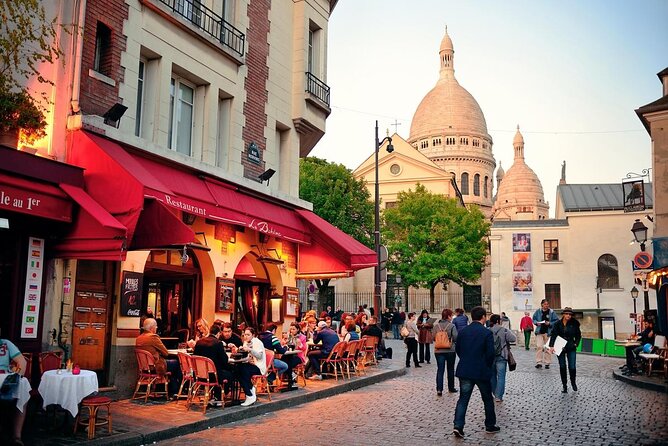
This tour gives you the slower version. Starting at Place Blanche, you work uphill through the old village district rather than being dropped at the basilica. The route links famous names with ordinary streets, private houses, old windmills, artists’ former homes, and tucked-away corners.
That matters because Montmartre’s appeal is not just one monument. It is the contrast between grand Paris below and the village-like lanes above. The walk helps you see how the district changed from a working neighborhood into one of the city’s most visited areas.
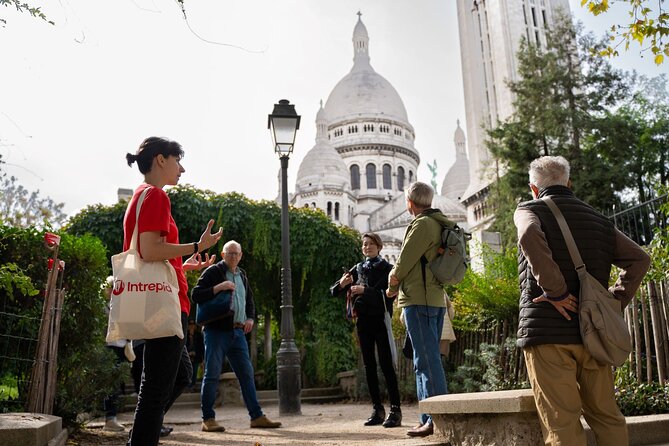
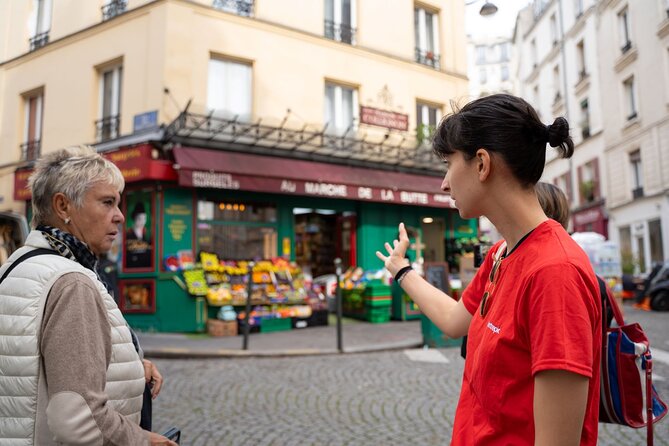
The English-speaking guides bring different strengths. Max is an artist and has a strong feel for the painters who lived and worked here. Cecilia brings an art historian’s eye and adds details about local life. Benjamin is especially good at political and cultural background. Other guides named in the feedback include Sarah, Hugo, Silvana, Camilla, and Benoît.
Because the guide can adjust the emphasis, your experience may lean more toward art, politics, local stories, or practical Paris advice. That variety is useful, though it also means the exact storytelling style depends on who leads your walk.
More Walking Tours in Paris
- Paris Top Sights Half Day Walking Tour with a Fun Guide
★ 5.0 · 2,893 reviews - Montmartre Hidden Gems and Scenic Highlights Walking Tour
★ 5.0 · 2,684 reviews - Montmartre Hill French Gourmet Food and Wine Tasting Walking Tour
★ 5.0 · 2,588 reviews
Place Blanche and the Moulin Rouge
The meeting point is Place Blanche, directly opposite the Moulin Rouge. This is a lively, highly recognizable place to begin, and the windmill gives you an easy landmark while you gather with the group.
The Moulin Rouge itself is not part of the ticket. You will see the exterior and learn about its place in Montmartre’s cabaret world, but the evening show is separate. This tour is a neighborhood walk, not a Moulin Rouge performance package.
From here, the guide starts the climb. Along the way, you may pass the café associated with the film Amélie and see the house where Van Gogh lived. These are quick outdoor stops, but they help set the tone: Montmartre is a place where film, painting, music, and daily life overlap on the same few streets.
The guide’s storytelling is important here. A plaque or doorway means little on its own. A good explanation gives you a reason to notice the building, the street angle, or the view beyond it. Max, Cecilia, and Benjamin received especially strong praise for making history easy to follow and keeping children and older family members involved.
The croissant stop is more than a snack
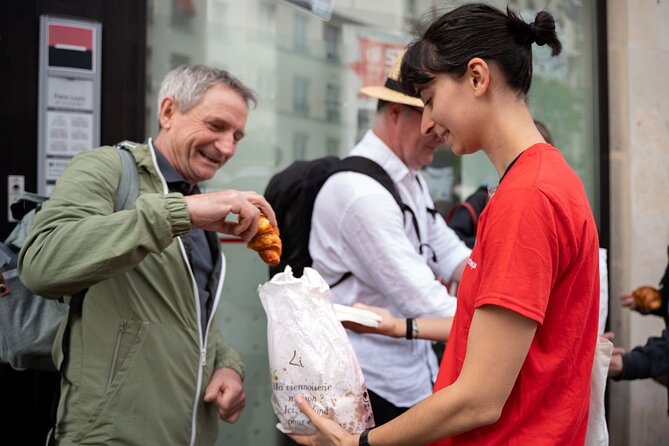
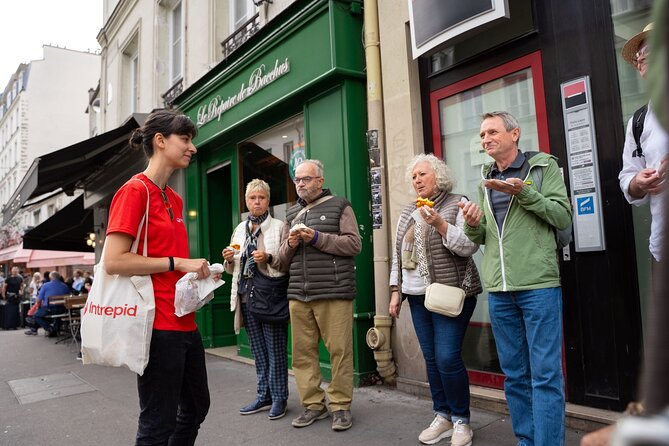
One of the strongest features is the bakery visit. The group stops at a Paris bakery known for prize-winning bread and pastries, where you taste a buttery croissant.
This is a small inclusion, but it improves the walk in two ways. First, you get a genuine French food moment rather than a generic refreshment. Second, the stop gives the uphill route a pleasant rhythm. You are not listening to two straight hours of facts while climbing stairs.
The croissant is included, but additional food and drinks are not. Vegetarian dietary needs can be accommodated. No other dietary requirements are specified, so you should ask before booking if you need something beyond vegetarian options.
The timing of the bakery visit may change on public holidays because some shops used on the usual route can close. If the bakery stop matters greatly to you, keep that possibility in mind. The tour remains focused on Montmartre’s streets and stories, but the food portion may be adjusted.
The Wall of Love and Picasso’s Montmartre
The next section leads to Le Mur des Je t’aime, or the Wall of Love. The wall presents the phrase I love you in 250 languages. It is a simple, photogenic stop, but the guide adds a local legend involving Montmartre’s first Parisian bishop.
From there, the route climbs a little farther to one of Montmartre’s attractive squares and the former home of Pablo Picasso. This is where the tour shifts from famous sights to the harder side of the artists’ story.
Montmartre was not always a polished postcard district. Many artists came because life here allowed them to work with little money. The guide explains the struggles they faced before finding recognition and wealth. That context keeps the art history from becoming a parade of famous names.
Cecilia is particularly well suited to this portion because she works as an artist and art historian. Max also brings personal artistic insight to the area. If you care about how artists lived, worked, and developed their methods, this is likely to be one of the most useful parts of the morning or afternoon.
Families can manage the route, but children need to stay engaged through stories rather than expecting a museum-style presentation. One guide was praised for keeping both a 7-year-old child and an 83-year-old family member comfortable and interested. That suggests a flexible pace, though the hills remain real.
More Paris walks with a guide:
- Paris Île de la Cité and Notre-Dame Walking Tour With Crypt
★ 5.0 · 2,272 reviews - Paris: Montmartre Cheese, Wine & Pastry Guided Walking Tour
★ 4.8 · 2,255 reviews - Paris in a Day: Louvre or Orsay, Eiffel Tower, City Walk & Cruise
★ 5.0 · 1,956 reviews - Paris: Montmartre Highlights Walking Tour with a Local Guide
★ 4.9 · 1,668 reviews
Windmills, expensive houses, and a secret passage
Montmartre still has a few traces of its rural past. The walk passes the Moulin de la Galette, one of the last remaining windmills in Paris. The windmill is privately owned, so this is an exterior sight rather than an indoor visit.
You then walk along what the guide presents as Montmartre’s Champs-Élysées, a street lined with some of the capital’s most expensive homes. The contrast is worth noticing. A district once associated with cheap rooms and working artists now contains some very desirable real estate.
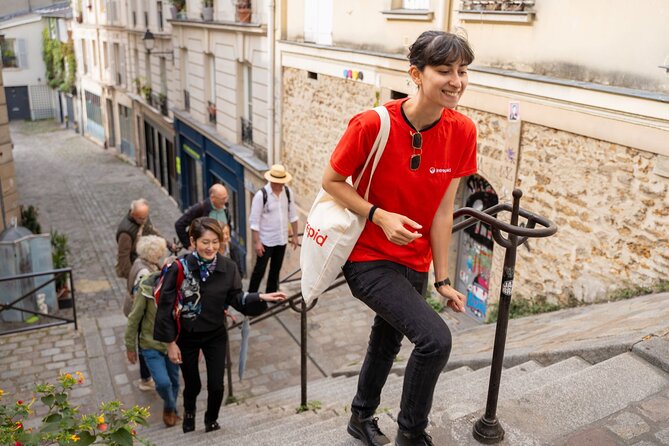
The most enjoyable part of this stretch is the passage into a quieter lane. The route reveals a broad view over Paris and a particularly charming cobbled street. This is exactly the sort of place that is easy to miss when you follow only the main road to Sacré-Coeur.
Do not expect every moment to be completely empty. Montmartre is one of Paris’ most visited districts, and conditions change by hour and season. Still, the route is designed to avoid much of the busiest pedestrian flow. One guide managed to avoid most of the crowds even on an afternoon walk.
The vineyard and Au Lapin Agile
Near the top of the hill, you reach Montmartre’s vineyard. This small patch of vines produces red wine and overlooks the suburbs of Paris. It is a surprising sight in a capital city, especially after walking through busy streets below.
The vineyard is viewed from outside. The tour does not include a wine tasting, and additional drinks are not included. Its value is in the story and the setting: Montmartre still holds onto a little piece of its village identity.
Across from the vines is Au Lapin Agile, one of the area’s famous cabarets. The guide tells the tale of Lolo, the painting donkey. It is an odd and memorable story, exactly the sort of local detail that helps the neighborhood stick in your mind.
This stop also brings together several sides of Montmartre: cabaret, art, rural remnants, and eccentric local characters. You get a stronger sense of the district as a community rather than simply a collection of famous addresses.
Sacré-Coeur and the final Paris view
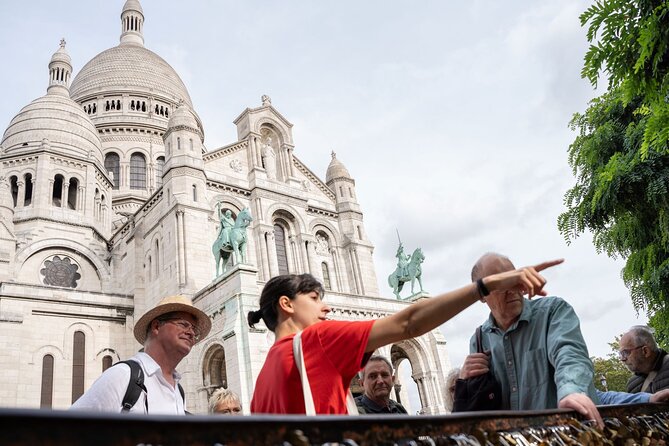
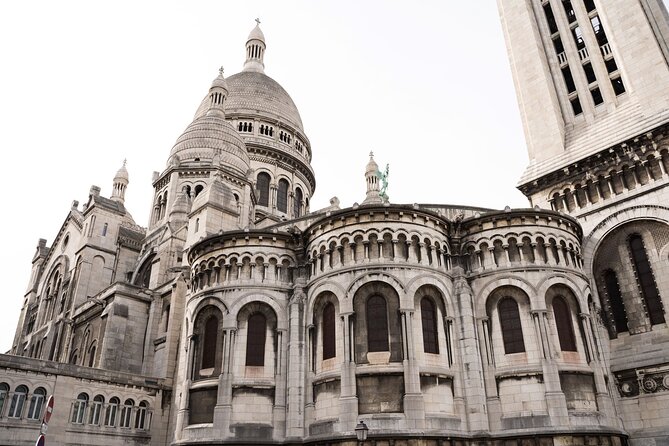
The tour finishes at the Basilique du Sacré-Coeur de Montmartre, at 35 Rue du Chevalier de la Barre. You do not spend the full tour inside the basilica. Instead, the guide shows you a less familiar angle for viewing the church before leading you to another broad panorama over Paris.
That ending works well. You arrive at the basilica with a better understanding of the streets below, the artists who lived nearby, and the hill’s changing identity. The final view also gives you a chance to pause after the uphill walk.
The basilica itself is free to visit, and the usual entry line is described as moving quickly. The tour does not include a special interior visit or reserved access, so plan to return later if you want more time inside.
Try to ask your guide about practical plans before leaving. Guides such as Max, Cecilia, and Benjamin have offered suggestions for restaurants, bookstores, art, and other Paris sights. This can be especially useful early in your stay, when you are still deciding how to use your time.
How much value do you get for $44.44?
At $44.44 per person, this is not the cheapest way to walk around Montmartre. You can visit the basilica and wander the streets without paying an admission fee.
The price makes more sense if you want the neighborhood explained rather than simply photographed. You are paying for an English-speaking local guide, a planned route, the croissant tasting, and access to lanes and viewpoints you might not identify on your own. The small group limit of 14 also matters. Some departures may be smaller, and one couple ended up with a near-private experience.
A private tour is available if you want more control over pace and questions. It will cost more than the stated group price, but it may suit a family or small party with specific interests.
The tour is particularly good value for a first or second day in Paris. You get an orientation to the northern part of the city, ideas for food and books, and a better sense of how Montmartre fits into Parisian art and culture.
For repeat visitors, the value depends on your curiosity. Even people who had lived in Paris or returned often found unfamiliar lanes and viewpoints, especially when Max led the route. If you already know Montmartre street by street, the guide’s art and political stories may still justify the cost.
Walking conditions, timing, and group size
The route covers about 2 kilometers, but distance does not tell the whole story. Montmartre is a hill, and the walk includes steep inclines and stairs. Wear shoes with a firm grip and avoid treating this as a flat stroll.
Most people can take part, and service animals are allowed. The tour is child-friendly, but you should tell the provider if you are bringing a child under 12. The guide can help keep a mixed-age group together, though each person needs to be comfortable with the climb.
The experience lasts about two hours. That is enough time for the main stops without turning the walk into an all-day commitment. Leave room around it if you want to linger at Sacré-Coeur, eat afterward, or explore the nearby streets independently.
The starting point is close to public transportation. The finish at Sacré-Coeur puts you high on the hill, not back at Place Blanche, so remember that the tour is a one-way walk. That is convenient if you want to continue exploring the basilica and upper Montmartre, but less convenient if you need to return immediately to your starting point.
The maximum group size is 14. That is small enough for questions and street-side explanations, while still keeping the price below that of a fully private outing.
Who should book this experience?
I would choose this walk if you want more than the standard Moulin Rouge and Sacré-Coeur circuit. It suits first-time Paris visitors who want a clear introduction to Montmartre, as well as repeat visitors looking for quieter streets and stronger local context.
Art lovers will get the most from the stories about Picasso, Van Gogh, Renoir, and other artists. Food-minded visitors will appreciate the bakery stop. Families can enjoy it if children are happy with a walking tour and the adults allow extra patience on the slopes.
It is less suitable if you have difficulty with stairs or steep hills, want a museum-heavy experience, or expect a full tour of the Moulin Rouge and Sacré-Coeur interiors. It is also not a wine tour, despite the vineyard stop.
The guide makes a real difference. Max is a strong choice for art and the neighborhood’s creative past. Cecilia offers art history and local anecdotes. Benjamin adds political and cultural background. Since guides can vary, it is worth checking who is scheduled if that information is available when you book.
Free cancellation is available if you cancel at least 24 hours before the local start time. Changes or cancellations inside that window are not accepted for a refund.
Should you book the Hidden Montmartre walk?
Book it if you want Montmartre told as a real neighborhood, not just a hill with a famous church on top. The croissant, vineyard, artists’ homes, cabaret stories, and quiet viewpoints give the walk plenty of character.
The $44.44 price is fair when you value a good guide and a small group. You can explore the streets for free, but you will likely miss the connections between the buildings and the people who shaped the district.
Skip it only if steep streets are a serious problem, you prefer exploring alone, or your main goal is an evening show at the Moulin Rouge. For most people who want art, food, views, and a more personal side of Paris, this is a smart two-hour introduction.
FAQ
Where does the Hidden Montmartre tour start?
The tour starts at Place Blanche, opposite the Moulin Rouge in Paris.
Where does the tour end?
It ends at the Basilique du Sacré-Coeur de Montmartre, at 35 Rue du Chevalier de la Barre, 75018 Paris.
How long is the walking tour?
The tour lasts approximately two hours and covers about 2 kilometers, or 1.2 miles.
Is the croissant included?
Yes. The tour includes a taste of a butter croissant from a highly awarded bakery. Additional food and drinks are not included.
Is the tour suitable for children?
Yes, it is child-friendly. You should inform the provider if you are bringing a child under 12.
What is the cancellation policy?
You can cancel at least 24 hours before the experience start time for a full refund. Cancellations or changes made less than 24 hours before the start time are not accepted for a refund.
Recently reviewed around Paris
- Louvre Private Tour – The Essentials and More with Expert Guide★ 5.0 · 227 reviews
- 2CV tour by night★ 5.0 · 55 reviews
- Eiffel Tower Second or Summit Floor Access by Elevator with Views★ 3.5 · 161 reviews
- The only Paris Wine Tasting experience you need to do – 2 hours★ 5.0 · 265 reviews
- 2 Hour Street-art Walk and Space Invaders Hunt in Paris★ 5.0 · 27 reviews
- 2 hour outdoor group activity in Paris: SAINT GERMAIN★ 5.0 · 48 reviews
- Private 2 – Hour Paris Landmarks Tour by Golf Cart Mini Moke★ 5.0 · 38 reviews
- Orsay Museum Private or Small-Group Guided Tour★ 4.0 · 381 reviews
Montmartre Tours, compared.

Montmartre Hidden Gems and Scenic Highlights Walking Tour
Read our review →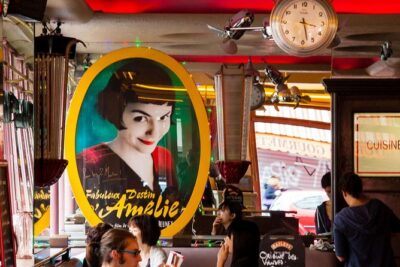
Montmartre Hill French Gourmet Food and Wine Tasting Walking Tour
Read our review →
Montmartre Cheese, Wine & Pastry Guided Walking Tour
Read our review →
Montmartre Highlights Walking Tour with a Local Guide
Read our review →
Sacré-Coeur and Montmartre Tour with Expert Guide
Read our review →
Private Montmartre Food Tour with Wine, Cheese & Pastries
Read our review →
Paris Montmartre Food Tour – A Full French Meal by Do Eat Better
Read our review →
Paris Montmartre Food & Wine Tour with Eating Europe
Read our review →Browse the lists this tour appears in