
Reviewed · TOULOUSE TOURS
Narbonne: visit the Archbishops’ Palace and Cathedral
Narbonne’s story comes together around one compact square: the former Archbishop’s Palace, the cathedral, and the ancient Via Domitia all meet at today’s Place de l’Hôtel de Ville. I like the way this tour links Roman, medieval, and everyday modern Narbonne without asking you to cross the city. I also like the access to the palace courtyards, cloister, archbishop’s garden, and Les Halles, places that can be easy to miss on your own.
The main consideration is language. The tour is offered in French and Sangro, and some content is presented in its original language, so check that this suits your group before booking. The cathedral visit also focuses on the building and selected works, while the Donjon, town art collection, and Treasure Room require a separate €12 admission.
In This Review
- Five details worth knowing before you book
- Why Narbonne’s center works so well on foot
- Starting with the Via Domitia
- Reading the Archbishop’s Palace façade
- Inside the courtyard and up the Grand Staircase
- Crossing the cloister beneath the gargoyles
- Saint-Juste and Saint-Pasteur Cathedral
- The organ and two very different altarpieces
- The archbishop’s garden and the change of mood
- Along the Promenade des Barques to Pont des Marchands
- Les Halles, Narbonne’s everyday meeting place
- Marion Quart’s guiding style
- Is $23 good value for two hours?
- Who should book this walk?
- Practical details for a smooth visit
- Should you book the Narbonne palace and cathedral tour?
- FAQ
- How long does the Narbonne tour last?
- How much does the experience cost?
- Where is the meeting point?
- How will I recognize the guide?
- Who leads the tour?
- What languages are available?
- Is the tour private?
- Is the tour wheelchair accessible?
- Are the Donjon, art collection, and Treasure Room included?
Five details worth knowing before you book
- The tour begins at Les Halles: Meet near the war memorial at the main entrance, where the guide wears a green neckerchief and carries a professional card.
- The Roman Via Domitia is part of the walk: You get a clear starting point for understanding Narbonne’s ancient role.
- The Archbishop’s Palace is more than a façade: The route includes the exterior, interior courtyards, main courtyard, and Grand Staircase.
- The cathedral visit includes the cloister: Look up for the gargoyles before entering Saint-Juste and Saint-Pasteur Cathedral.
- The final stretch is local and lively: The walk ends along the Promenade des Barques, Pont des Marchands, and Les Halles.
- Marion Quart leads the experience: Her approach is described as warm, clear, humorous, and packed with historical detail.
Why Narbonne’s center works so well on foot
I like this tour because it uses a small area to explain a very large story. Narbonne has ancient Roman roots, a powerful medieval church, and a lively present-day market district. The route does not treat these as isolated sights. Instead, you move from the road that brought Roman influence into the city, to the palace that housed its archbishops, to the cathedral that expressed their power, and finally to the market and riverfront where local life continues.
The two-hour length is useful. You get enough time for explanation and close looking, but the walk does not take over an entire day in the South of France. If you are planning a longer visit, this makes a sensible first activity because it gives you a map of Narbonne’s central sights and helps you decide where to return.
The private-group format also matters. You are not being folded into a large crowd with a fixed script. Marion Quart can present the material directly to your group, and the strong response to her style points to a guide who uses enthusiasm, humor, and simple explanations rather than delivering a dry list of dates.
Other Toulouse days travellers weigh against this one:
- The “Break in Prison” room
★ 5.0 · 609 reviews - Toulouse: Carcassonne Day Trip by Coach with Audioguide
★ 4.4 · 580 reviews - Toulouse Food & History Tour with a Chef (in English)
★ 5.0 · 503 reviews
Starting with the Via Domitia
The Via Domitia gives the tour its oldest layer. This Roman road is included near the beginning, before the palace and cathedral, so you can picture Narbonne as a place shaped by movement, trade, and imperial power long before the medieval buildings appeared.
I find this a better way to begin than starting with church architecture alone. A road explains why a settlement mattered. It also gives you a physical trace of the past, not just a story told indoors. Your guide can place the later buildings in a much wider sequence, helping you see Narbonne as a city that changed hands, functions, and appearance over many centuries.
Do not expect a long archaeological visit here. The Via Domitia is one part of a walking route, not the entire focus. Its value comes from the context Marion provides and from the way it connects to the rest of the historic center.
Reading the Archbishop’s Palace façade
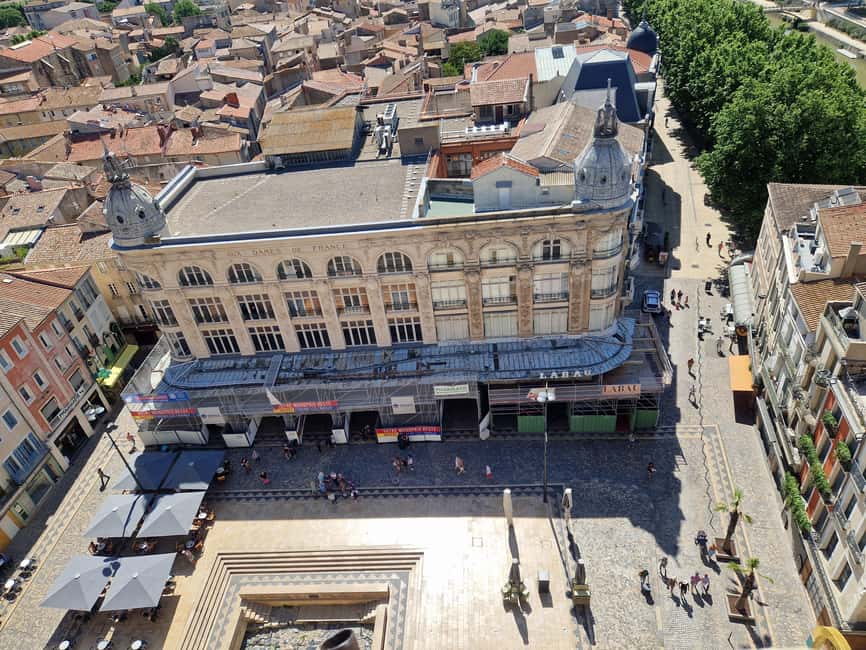
At Place de l’Hôtel de Ville, the former Archbishop’s Palace takes center stage. The façade has details that reward a slow look, and the tour uses it as a visual introduction to the people who governed and lived in this part of Narbonne.
The palace is important because it was not simply a religious building. It was also a seat of authority, with a public face and working spaces behind it. A guide helps you read the façade as a record of power, design, and changing use. Look for the details Marion points out rather than trying to absorb the entire front at once.
The setting makes the explanation easy to follow. The palace is on the same square as the cathedral complex, so you can see how closely religious and civic life were tied together. Place de l’Hôtel de Ville is also the former location of the city’s central settlement, giving the stop a strong sense of continuity.
Inside the courtyard and up the Grand Staircase
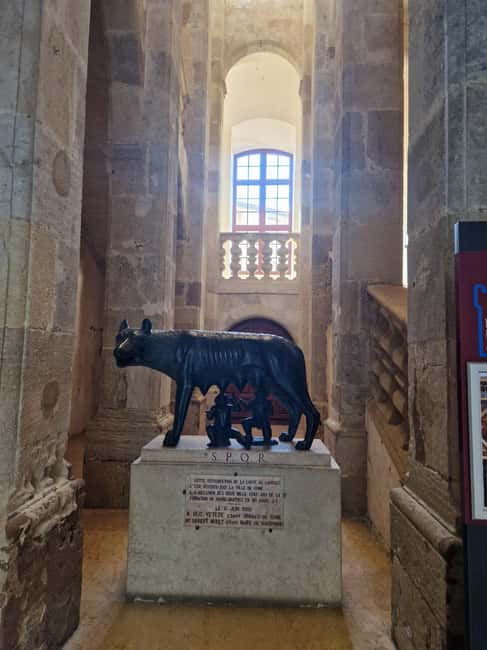
The tour continues into the palace’s main courtyard and includes its interior and exterior courtyards. This is a real advantage over a quick exterior photo stop. Courtyards show how a grand building functioned from the inside, where movement, access, and ceremony mattered.
The Grand Staircase is one of the route’s main visual points. You will follow the path associated with the archbishops and get a better feel for the scale of the complex. Staircases are often overlooked in self-guided sightseeing, yet they can reveal how a building was organized and how important people moved through it.
The palace access included here does not cover everything in the complex. Admission to the Donjon, the town’s art collection, and the Treasure Room is not part of the $23 tour. Those areas can be entered with a separate €12 admission ticket, so budget for that only if you want to add them.
A different way to spend the day, same corner of France:
- Toulouse: Albi and Cordes/Ciel Day Trip with Audio Guides
★ 4.5 · 486 reviews - Toulouse Victor Hugo Market Small Group Tasting Tour
★ 5.0 · 337 reviews - Toulouse: Electric Tuk-Tuk Tour with Photo Stops and Audio
★ 4.8 · 138 reviews - Carcassonne During World War 2
★ 5.0 · 127 reviews
Crossing the cloister beneath the gargoyles
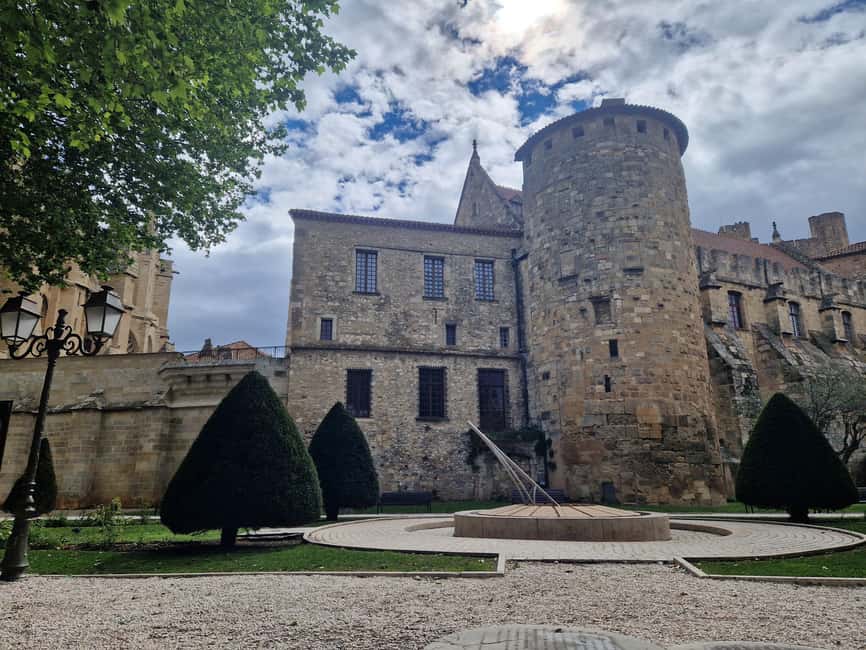
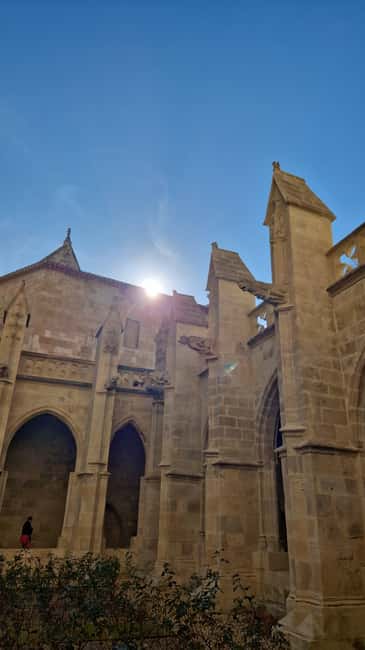
From the palace, the route follows the archbishops toward Narbonne Cathedral and crosses the cloister. This is one of the most atmospheric parts of the visit, thanks to the gargoyles above you.
The cloister creates a quieter pause between the palace and cathedral. Its covered passages frame the open space and make you look upward, where the stone figures have a practical and decorative role. The gargoyles are not merely spooky ornaments. They are part of the building’s drainage system, while also giving the architecture a memorable character.
I would keep your pace slow here. The cloister is the kind of place where the best details can be above eye level. A live guide is especially helpful because you can ask about what you are seeing instead of guessing at the purpose of each carved element.
Saint-Juste and Saint-Pasteur Cathedral
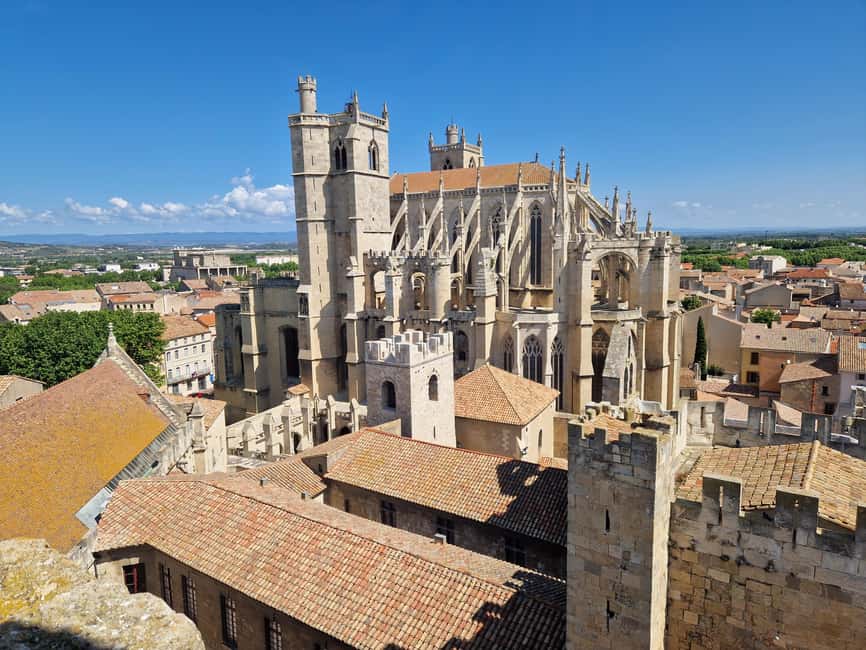
The cathedral is the architectural high point of the tour. Saint-Juste and Saint-Pasteur Cathedral is known for its 14th-century Gothic design, and the first thing you notice inside is likely the height of the vaulted ceiling.
That height is not an empty trick. Gothic architecture uses vertical space to create a strong sense of lift, and the cathedral’s proportions make the effect clear. You can look from the floor to the vaults and understand why the building has such a powerful presence, even before examining individual objects.
The tour includes both the cathedral exterior and interior. That balance helps you see how the building works as a complete structure. Outside, you can take in its scale and stonework. Inside, the emphasis shifts to the ceiling, organ, altarpieces, and the feeling of the space.
The organ and two very different altarpieces
The interior visit includes a monumental organ, a 17th-century altarpiece, and a 14th-century sculpted altarpiece. These stops give you more than one way to read the cathedral.
The organ makes a strong visual statement, while the altarpieces show how art and worship changed over time. The 17th-century work belongs to a later period than the Gothic structure, so you can compare the building’s medieval framework with later religious decoration. The 14th-century sculpted altarpiece works almost like a picture book, with carved scenes that reward close attention.
This part of the visit is best for people who like details but do not want to study a museum catalogue. Marion can point out what matters and explain the story behind the objects in plain language. The tour does not include the separate Treasure Room, so the focus remains on the cathedral’s main interior and its most notable works.
The archbishop’s garden and the change of mood
The archbishop’s garden adds another side to the palace complex. After the height and formal power of the cathedral, a garden offers a softer space and a chance to see the archbishops’ world beyond grand ceremonial rooms.
The information provided does not specify the garden’s size or individual plantings, so I would treat this as a short atmospheric part of the walk rather than a standalone garden visit. Its value is in showing the range of spaces connected with the palace and in giving your eyes a break from stone walls and carved details.
This is also a good moment to ask questions. The tour is designed around the story of the site, and the guide’s role is most useful when you want to connect architecture with the people who used it.
Along the Promenade des Barques to Pont des Marchands
The final walk follows the Promenade des Barques toward Pont des Marchands. This gives the tour a pleasant change of pace after the palace and cathedral.
Pont des Marchands is one of Narbonne’s signature sights, and its inclusion helps bring the city’s waterways and movement back into the story. The route does not finish with a final church interior or a museum shop. Instead, it ends in the public heart of the city, where the historic center opens toward food, shopping, and daily life.
A riverside promenade also gives you time to process what you have seen. You can compare the city’s Roman road, medieval religious center, and later public spaces as parts of one place rather than separate attractions.
Les Halles, Narbonne’s everyday meeting place
The tour finishes at Les Halles, the emblematic meeting place of Narbonne. This is a smart ending because it shifts from history told through monuments to culture experienced through ordinary local activity.
The visit includes access to Les Halles, but the supplied details do not promise a food tasting or guided market tour. Think of it as an introduction to the building and its role in Narbonnais life. You can continue exploring after the two-hour visit, making this a practical place to end your morning or afternoon.
If you want to eat afterward, finishing at the market gives you options, although the tour price does not include food. The market also makes a useful meeting point because it is easy to find, and the tour starts in front of its main entrance near the war memorial.
Marion Quart’s guiding style
The guide can make or break a history walk, and Marion Quart receives unusually consistent praise for her delivery. Her strongest qualities are enthusiasm, clear explanations, humor, and the ability to keep a two-hour visit interesting without making it feel like a lecture.
I would expect a guide who gives you detail but also knows how to make it accessible. Her approach is described as passionate and professional, with information offered in a simple, friendly way. That combination suits Narbonne, where a visitor can quickly be buried under Roman, medieval, and religious dates.
The tour is conducted in French and Sangro. Some content is shown in its original language, so you should be comfortable following the guide in one of those languages. The experience is private, which may make the language choice easier for your own group to manage, but the listing does not provide an English-language option.
Is $23 good value for two hours?
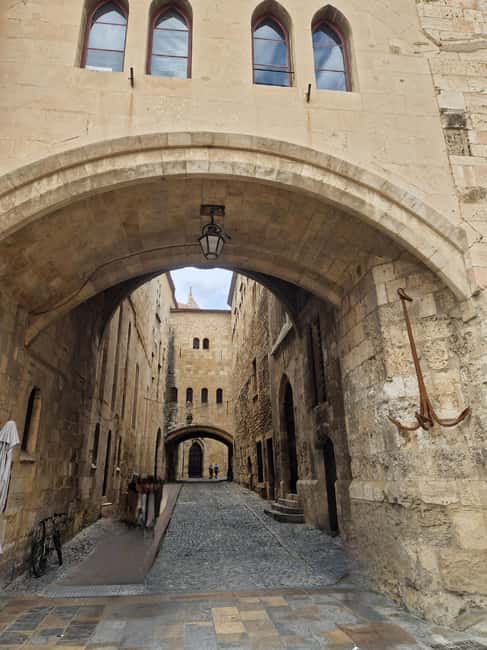
At $23 per person, the tour offers good value if you want guided access to Narbonne’s central historic sights. The price covers a private two-hour walk with the Via Domitia, palace courtyards, Grand Staircase, Passage de l’Ancre, cloister, cathedral, archbishop’s garden, Promenade des Barques, Pont des Marchands, and Les Halles.
The value is not just the number of stops. It is the connection between them. On your own, you could walk past the palace, cathedral, and market without understanding how they fit together. A guide gives you the sequence and the visual clues that turn a sightseeing stroll into a readable story.
Keep the additional €12 admission in mind if you want the Donjon, town art collection, or Treasure Room. Those are optional extras, not hidden additions to the tour price. The basic experience remains a focused historic-center walk.
Who should book this walk?
I would recommend it to first-time visitors who want a clear introduction to Narbonne, history lovers who enjoy architectural detail, and anyone who prefers a private group over a large scheduled tour. It also suits you if you have only a few hours and want to see the city’s main historic sights without wasting time finding the route.
The experience is wheelchair accessible, which is useful information for planning. The supplied details do not describe the surfaces, slopes, or restroom arrangements, so you should confirm any specific mobility needs before booking.
I would be more cautious if you want a self-guided visit in English, a long museum session, or extensive time inside the Donjon and Treasure Room. Those are not part of the main route, and the language information is limited to French and Sangro.
Practical details for a smooth visit
Meet in front of the main entrance to Les Halles de Narbonne, near the war memorial. Marion wears a green neckerchief and carries her professional card, which should make her easier to identify in the meeting area.
The activity lasts two hours, and you should check the available starting times when choosing a date. Since the tour moves between outdoor streets, courtyards, the cloister, and indoor cathedral spaces, comfortable walking shoes are sensible.
You can cancel up to 24 hours in advance for a full refund, and the reserve-now, pay-later option lets you hold a place without paying immediately. Those policies are useful if your South of France plans are still changing.
Should you book the Narbonne palace and cathedral tour?
Book this experience if you want Narbonne explained through its most important buildings and public spaces, rather than simply photographed. The Via Domitia, Archbishop’s Palace, cloister, cathedral, riverfront, and Les Halles create a strong two-hour route, and Marion Quart’s warm, detailed style appears to be the main reason the experience works so well.
Skip it if you need an English tour or want the Donjon, art collection, or Treasure Room included in the price. For French or Sangro speakers, though, $23 is a fair cost for a private introduction to Narbonne that mixes major architecture with the city’s everyday market life.
FAQ
How long does the Narbonne tour last?
The tour lasts two hours.
How much does the experience cost?
The price is $23 per person.
Where is the meeting point?
Meet in front of the main entrance to Les Halles de Narbonne, near the war memorial.
How will I recognize the guide?
Marion Quart will be wearing a green neckerchief and carrying her professional card.
Who leads the tour?
The experience provider and guide is Marion Quart.
What languages are available?
The tour is offered in French and Sangro. Some content is shown in its original language.
Is the tour private?
Yes. It is offered as a private-group experience.
Is the tour wheelchair accessible?
Yes, the activity is listed as wheelchair accessible.
Are the Donjon, art collection, and Treasure Room included?
No. These admissions are not included in the tour. You can access them with a separate €12 admission ticket.
Recently reviewed around Toulouse
- Carcassonne ‘s Medieval Walls: A Self-Guided Tour★ 4.5 · 43 reviews
- Medieval Carcassonne: Interactive Ghost Story & City Game★ 3.5 · 33 reviews
- Carcassonne During World War 2★ 5.0 · 127 reviews
- Cité de Carcassonne Guided Walking tour. Private tour.★ 5.0 · 42 reviews
- Private guided tour of the city of Carcassonne★ 5.0 · 58 reviews
- Toulouse Food & History Tour with a Chef (in English)★ 5.0 · 59 reviews
- Welcome to Toulouse: Private Walking Tour with a Local★ 4.2 · 47 reviews
- Toulouse: Electric Tuk-Tuk Tour with Photo Stops and Audio★ 4.8 · 138 reviews
Toulouse Tours, compared.


Toulouse Food & History Tour with a Chef (in English)
Read our review →
Albi and Cordes/Ciel Day Trip with Audio Guides
Read our review →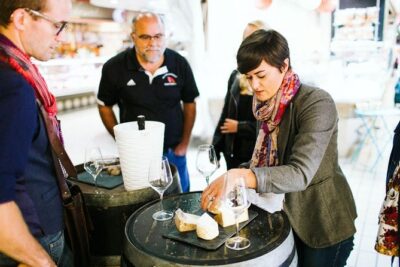
Toulouse Victor Hugo Market Small Group Tasting Tour
Read our review →


Browse the lists this tour appears in