
Reviewed · SELF-GUIDED TOURS
Carcassonne ‘s Medieval Walls: A Self-Guided Tour
Carcassonne’s walls make the city’s military story easy to see. As you walk from Lady Carcas to the great gates, towers, castle, and basilica, the audio explains where attackers would have been exposed and why each defense mattered. Medieval warfare is the star of this walk, not just pretty stonework.
I like the freedom to stop, restart, and move at your own speed. I also like the practical offline access, since you do not need to depend on a mobile signal once the tour is loaded. The main drawback is that this is an audio walk, not a personal guide, and it does not include entry to the castle, museums, or other attractions.
- Lady Carcas begins the story: Hear how the legendary figure supposedly saved the city from Charlemagne.
- Narbonne Gate sets the route: Follow the fortified circuit from one of the Cité’s grandest entrances.
- Cathars and crusades add difficult context: The walk explains the religious conflict and sieges tied to Carcassonne.
- Kill zones become visible: Learn how walls, gates, and defensive spaces worked together against attackers.
- Château Comtal and Saint Nazaire anchor the route: See the castle defenses and the Church of Saints Nazaire and Celse.
- VoiceMap keeps the walk flexible: Use the app’s geolocation, maps, audio, and route data offline.
In This Review
- Start with Lady Carcas and a useful legend
- Narbonne Gate reveals how the fortress controlled entry
- Cathars, crusades, and the harder side of Carcassonne
- Find the defensive traps around the walls
- Château Comtal links the castle to the city wall
- Saint Nazaire Basilica brings the city indoors
- Jean Pierre Cros Mayrevieille and the rescue of the Cité
- How the VoiceMap format works on the ground
- Plan two to three hours for the full circuit
- Who will get the most from this audio walk
- Cancellation, access, and small practical details
- Should you book Carcassonne’s medieval walls tour?
- FAQ
- How long does the Carcassonne medieval walls audio tour take?
- What language is the tour offered in?
- Where does the tour start?
- Where does the tour end?
- What is included in the tour?
- Do I need to pay for the castle or museums separately?
- Can I cancel the tour for a refund?
Start with Lady Carcas and a useful legend
The tour begins at the Buste de Dame Carcas, the sculpture of Lady Carcas near the Cité. This is a smart starting point because the legend gives you a memorable way into Carcassonne’s past before the walk turns to stone walls and military design.
The story tells how Lady Carcas saved the city from Charlemagne. Treat it as legend rather than a literal military report, but enjoy it for what it does well: it gives a human face to the fortress and explains the name Carcassonne through a story of defiance.
From here, the audio tour leads you toward Porte Narbonnaise, or Narbonne Gate. The stated route takes roughly two to three hours, with about two hours of walking content. Your pace matters. If you stop for photographs, pause to read signs, or enter an attraction, allow extra time.
The meeting information lists the Lady Carcas sculpture as the start and Narbonne Gate as the end. That makes the route easy to understand, though the walking instructions also take you around the old city and through several gates. Load the tour before you set off, then let the app guide you from one chapter to the next.
Narbonne Gate reveals how the fortress controlled entry
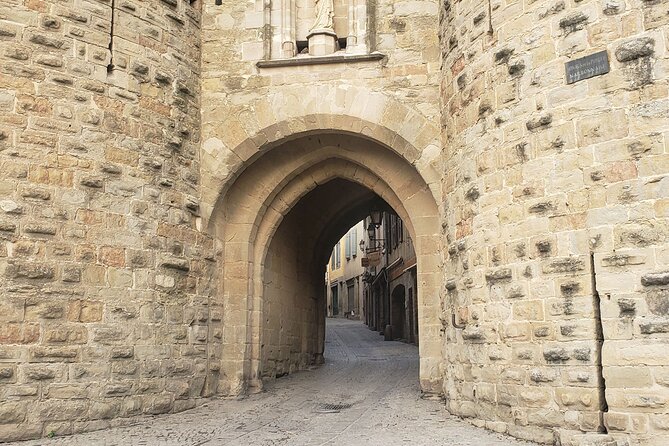
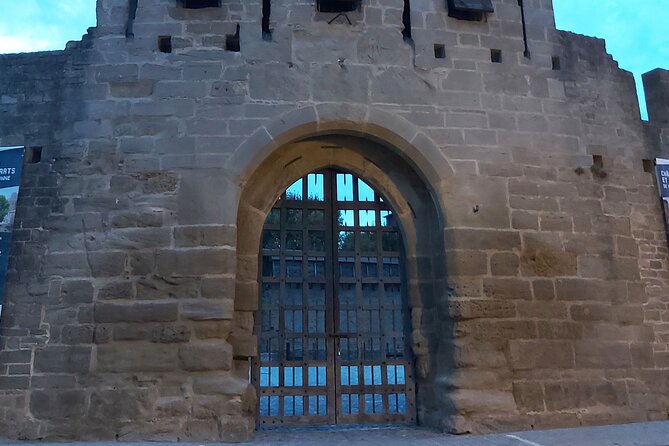
Porte Narbonnaise is one of the most impressive points on the route. This is where the audio turns your attention from legend to defense. You will begin following the wall that circles the medieval Cité, while the commentary explains how access, gates, and fortified approaches shaped daily life and warfare.
The gate is not just a grand photo stop. It represents controlled movement. In a fortified city, every entrance was a problem to solve. Attackers needed to approach, pass through defenses, and avoid being trapped in exposed spaces. The tour’s focus on kill zones helps you see the walls as a working system rather than a decorative border.
That military focus is one of the best reasons to choose this walk. You are not simply told that Carcassonne had strong defenses. You are encouraged to identify where an enemy might have been caught between walls, gates, and firing positions.
The route includes the Aude, Nazaire, and Toulouse Gates as well. Seeing several entrances helps you compare the city’s defensive logic. The audio also takes you into the center of the Cité, so this is not only a rampart circuit with no contact with the streets inside.
More Toulouse trips worth a second look
- Toulouse: Albi and Cordes/Ciel Day Trip with Audio Guides
★ 4.5 · 486 reviews - Toulouse: Electric Tuk-Tuk Tour with Photo Stops and Audio
★ 4.8 · 138 reviews - From Paris: Giverny Day Trip with Audio Guide or Live Guide
★ 4.3 · 2,372 reviews
Cathars, crusades, and the harder side of Carcassonne
Carcassonne is often presented as a romantic medieval city, but the tour does not leave the story at towers and fairytale walls. It explains the Cathars, who flourished in the region during the twelfth century, and the crusade launched against them.
That section gives the fortifications a sharper meaning. These walls were not built for a stage set. They belonged to a place caught up in religious conflict, political pressure, and military campaigns. The commentary also covers sieges that affected the city, helping you connect the events to the defenses in front of you.
I would choose this tour before visiting the Château Comtal. The explanation of medieval warfare gives you a useful frame for the castle and walls. Once you understand what defenders needed to watch, protect, and control, the castle visit becomes easier to read.
The limits are clear. The tour gives you a broad introduction to the Cathars and the crusade, but it is not presented as a specialist course in theology, politics, or social life. If you want a close look at how ordinary people lived inside the walls, this walk may leave you wanting more.
Find the defensive traps around the walls
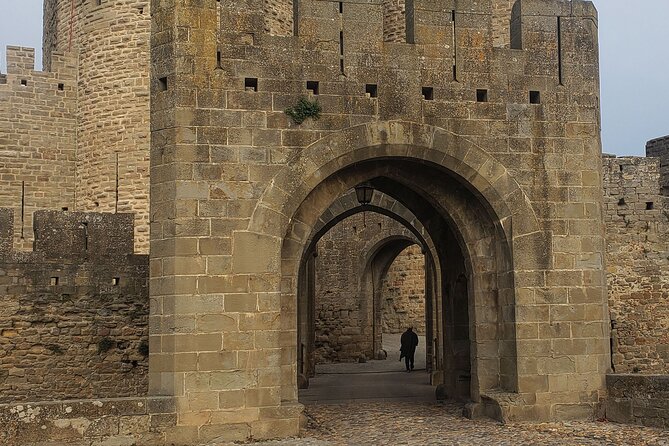
The central feature of the walk is its attention to medieval defense. As you follow the circuit, the audio points out the places where an attacking force might have been exposed or trapped. These are the so-called kill zones, areas designed to make an assault dangerous.
This approach gives you something to do at each stop. Instead of listening passively, look at the relationship between the wall, the gate, the open ground, and the next defensive barrier. The route asks you to imagine the pressure on an attacking army and the advantage held by defenders above.
You will also learn how the various sections of the defenses worked together during a siege. The exact experience will depend on which parts are open on the day. One section of the site may be closed for restoration, and the audio allows you to skip ahead to the next chapter and return later if access changes.
That flexibility matters. A fixed walking tour can become awkward when a barrier blocks the planned route. With VoiceMap, you can move to the next chapter rather than abandon the whole experience. Still, the route data cannot remove a physical obstruction, so you may need to make a small detour.
Château Comtal links the castle to the city wall
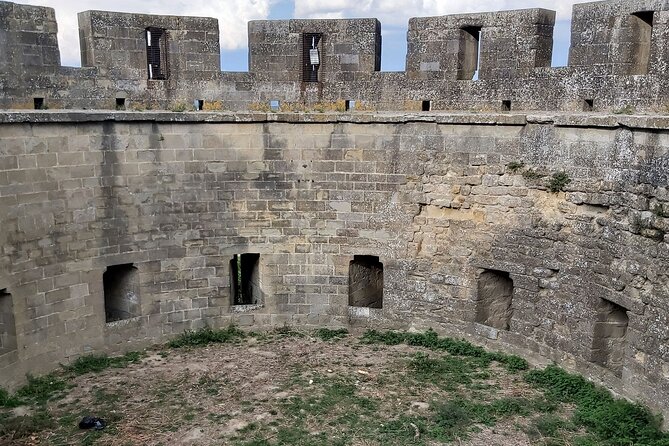
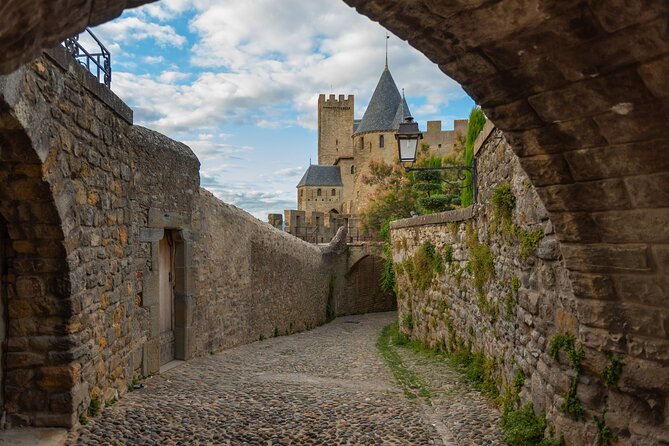
The Château Comtal is one of the major sights along the route. The audio draws your attention to the point where the castle meets the wall and the surrounding defenses. That connection matters because the castle was not an isolated building. It formed part of the wider system protecting the Cité.
You can take in the scale of the Château et Remparts de la Cité de Carcassonne from the walking route. The commentary helps explain its place within the defenses, especially after you have heard about sieges and attacking forces.
Keep one practical point in mind: the audio tour does not guide you through the château itself. If you choose to enter, you pay for that separately. The same applies to museums and other attractions along the way.
For the best use of your time, I would listen to the wall commentary first, then visit the castle if you have a separate ticket or plan to buy one. The tour’s military background can make the interior visit more meaningful, but the audio is not a replacement for an on-site castle tour.
A different way to spend the day, same corner of France:
- The “Break in Prison” room
★ 5.0 · 609 reviews - Toulouse: Carcassonne Day Trip by Coach with Audioguide
★ 4.4 · 580 reviews - Toulouse Food & History Tour with a Chef (in English)
★ 5.0 · 503 reviews - Toulouse Victor Hugo Market Small Group Tasting Tour
★ 5.0 · 337 reviews
Saint Nazaire Basilica brings the city indoors
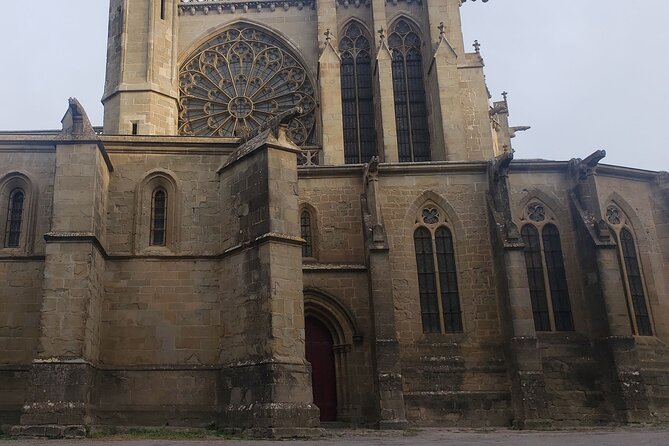
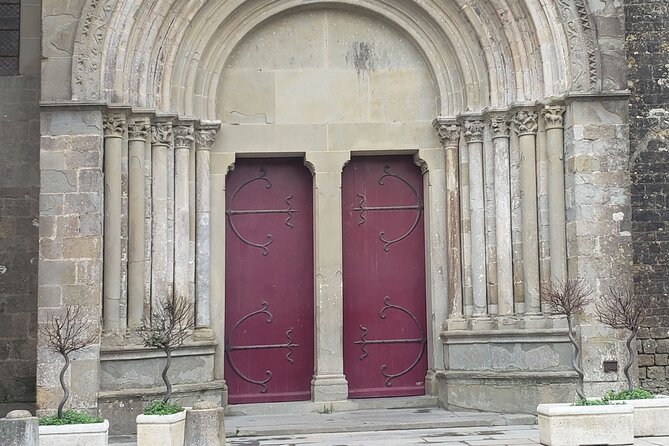
The Church of Saints Nazaire and Celse, also called Saint Nazaire Basilica, gives the route a change of mood. After so much attention to walls, gates, and attacks, the church shows another side of the Cité.
The tour takes you through the center of the city and points out the basilica as one of its key landmarks. It helps you see Carcassonne as more than a military stronghold. Religious buildings, civic spaces, gates, and defensive works all occupied the same compact urban setting.
The basilica is also a useful orientation point during the walk. If you pause here, you can take a break from the audio, look around, and restart when ready. The stop-and-start format suits the Cité, where you may want to pause often for photographs or to examine the buildings.
Again, entrance fees are not included. The tour points out the church, but it does not promise a guided visit inside any attraction.
Jean Pierre Cros Mayrevieille and the rescue of the Cité
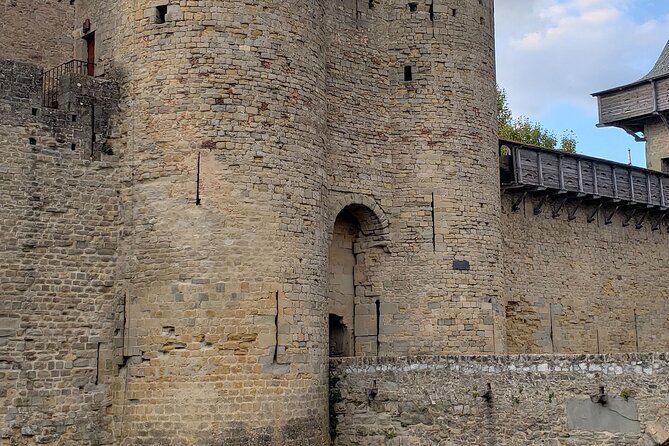
Another important stop is the monument to Jean Pierre Cros Mayrevieille. He was a doctor of law, historian, and Inspector of Historic Monuments who helped save Carcassonne from ruin.
This stop gives the tour a modern chapter. The city’s medieval appearance was not simply left untouched for centuries. It had to be valued, studied, and preserved. Mayrevieille’s role reminds you that what you see today is also the result of later efforts to protect the site.
That is useful context for any historic place. The walls may look permanent, but their survival was not automatic. Restoration can also affect your route, which is why the ability to skip an audio chapter is helpful when a section is closed.
The tour does not turn this into a long architectural study. Instead, it uses the monument to explain why the Cité survived in a form that still allows you to follow its defenses today.
How the VoiceMap format works on the ground
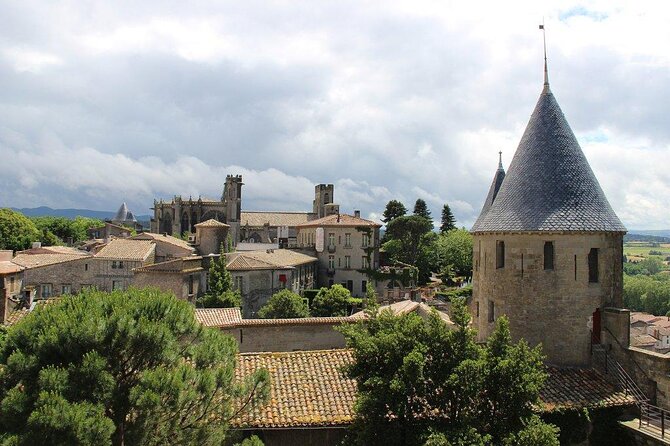
You need your own smartphone and headphones. The tour includes access to the VoiceMap app for Android and iOS, with audio, maps, and geodata available offline. Downloading the material before arrival is the sensible move.
The geolocation feature is designed to trigger the right commentary as you move. You can walk at your own pace, pause the tour, restart it, or skip to another chapter when necessary. That is especially useful in a busy historic site where you may need to wait, step aside, or change direction.
The route is offered in English only. If everyone in your group is comfortable with English, the private format means you can share the experience without joining a larger group. The price is $24.99 per person, so the value depends on your group size.
For one person, the cost is modest compared with a traditional guided tour. A larger group should compare the total price, since each person pays separately. The benefit is that you are buying flexibility and lifetime access rather than a single scheduled departure.
You also avoid transportation costs because the experience takes place around the Cité. Food, drinks, museum tickets, castle admission, and other entrance fees are not included, so budget for those separately if you want a fuller day.
Plan two to three hours for the full circuit
The tour is advertised as about two to three hours. A fast walker who listens without many stops may finish nearer the shorter estimate. If you take photographs, pause at the basilica, wait at a busy gate, or add an attraction, the longer estimate is more realistic.
The Cité can be busy, particularly around the streets, château, and ramparts. The audio route can help you keep moving and steer your attention away from the thickest groups, but it cannot guarantee an empty path. You still need to watch for other people and respect any barriers.
The tour operates at any time, with the supplied opening hours listed as 24 hours a day from March 3, 2023, through March 2, 2027. That means you have broad freedom in choosing your start time, but access to individual buildings and attractions may not match the all-day availability of the outdoor route.
I would avoid treating the schedule as a promise that every part of the Cité will be open at every hour. The audio walk is flexible, while admission sites and restoration work can change what you can enter or see.
Who will get the most from this audio walk
This experience suits you if you want history without a fixed group schedule. It is particularly useful if you like to stop for photos, move slowly, or listen again to a section you missed.
It is also a good match for anyone interested in medieval warfare and fortifications. The focus on siege tactics, gates, and kill zones gives the walk a clear purpose. You will not simply circle the walls without knowing what to look for.
The route can work well for older participants too, since the audio can be paused and restarted. You should still expect a walk around a historic fortified city, with possible barriers or route changes. The material does not promise a fully step-free route.
Choose something else if you want a live guide who can answer questions on the spot. You may also prefer a different experience if your main interest is daily life, art, economics, religion, or the social world behind the walls. Those subjects receive less attention than defense and military history.
Cancellation, access, and small practical details
You receive confirmation when booking, and most people can take part. This is a private activity in the sense that only your group uses the tour, but there is no live guide accompanying you.
Free cancellation is available if you cancel at least 24 hours before the local start time. Cancellations or changes made inside that period are not refunded or accepted.
Bring a charged phone and headphones. Since the app includes offline maps and audio, you can prepare before setting out rather than trying to download material beside the gate. If a chapter does not match the route because of restoration or a barrier, skip forward and return to it when practical.
Should you book Carcassonne’s medieval walls tour?
Book it if you want a low-cost, flexible introduction to the Cité and prefer to explore independently. At $24.99 per person, it offers a solid way to understand Lady Carcas, the Cathars, the crusade, siege tactics, the city gates, Château Comtal, Saint Nazaire Basilica, and the later rescue of the monument.
I especially recommend doing it before entering the castle. The explanation of defensive design gives you a better way to read the walls and castle together.
Skip it if you want a personal conversation, a specialist guide, or a detailed account of everyday life inside medieval Carcassonne. Also remember that the price does not cover admission to museums, the château, or other sights.
For an English-speaking visitor who values freedom, offline access, and clear military context, this is a practical choice. Bring your own phone and headphones, allow up to three hours, and let the route set the pace.
FAQ
How long does the Carcassonne medieval walls audio tour take?
The tour takes approximately two to three hours. Your total time may be longer if you stop for photographs, enter attractions, or pause the audio.
What language is the tour offered in?
The tour is offered in English.
Where does the tour start?
The tour starts at the Buste de Dame Carcas, at 11000 Carcassonne, France.
Where does the tour end?
The tour ends at Porte Narbonnaise, also called Narbonne Gate, after following the medieval walls around the Cité de Carcassonne.
What is included in the tour?
You receive lifetime access in English, the VoiceMap app for Android and iOS, and offline access to the audio, maps, and geodata.
Do I need to pay for the castle or museums separately?
Yes. Tickets or entrance fees for museums, the château, and other attractions along the route are not included.
Can I cancel the tour for a refund?
Yes. You can receive a full refund by canceling at least 24 hours before the experience start time. Cancellations or changes made less than 24 hours beforehand are not accepted or refunded.
Recently reviewed around Toulouse
- Medieval Carcassonne: Interactive Ghost Story & City Game★ 3.5 · 33 reviews
- Carcassonne During World War 2★ 5.0 · 127 reviews
- Cité de Carcassonne Guided Walking tour. Private tour.★ 5.0 · 42 reviews
- Private guided tour of the city of Carcassonne★ 5.0 · 58 reviews
- Toulouse Food & History Tour with a Chef (in English)★ 5.0 · 59 reviews
- Welcome to Toulouse: Private Walking Tour with a Local★ 4.2 · 47 reviews
- Toulouse: Electric Tuk-Tuk Tour with Photo Stops and Audio★ 4.8 · 138 reviews
- Narbonne: visit the Archbishops’ Palace and Cathedral★ 4.9 · 43 reviews
Self-Guided Tours, compared.

Giverny Day Trip with Audio Guide or Live Guide
Read our review →
Giverny and Monet’s House Half Day Trip from Paris Guide or Audio
Read our review →
Catacombs Entry & Seine River Cruise with Audio Guide
Read our review →
Versailles Palace Self Guided & Gardens tickets
Read our review →
Catacombs, Audio Guide, and River Cruise Option
Read our review →
Openair Double Decker Bus Audio-Guided City Tour
Read our review →
Bruges Guided or Audio Trip with Canal Cruise Option from Paris
Read our review →
Albi and Cordes/Ciel Day Trip with Audio Guides
Read our review →Browse the lists this tour appears in