
Reviewed · CITY TOURS
Medieval Carcassonne: Interactive Ghost Story & City Game
Carcassonne’s medieval citadel becomes a puzzle board in this phone-based ghost story. You follow clues from Square Gambetta across the Aude and up toward Château Comtal, learning about Cathars, plague, royal power, and old city walls as you go. I like the private format and the chance to pause whenever you need. The price, about $6 per person, is also easy on a sightseeing budget.
I especially like that the route includes both the lower town and the fortified Cité, rather than keeping you inside the most crowded postcard streets. You also see Saint-Gimer Church, designed by Eugène Viollet-le-Duc, and the old Manufacture Royale building near the Pont-Vieux. The main caution is technical: getting the game started can be confusing, and a few players could not access it at all.
In This Review
- Key points to know before you book
- What this Carcassonne city game is really like
- Starting across the river at Square Gambetta
- Notre Dame de la Santé and the Pont-Vieux
- The old cloth factory near the river
- Saint-Gimer Church by Eugène Viollet-le-Duc
- Entering through Porte de l’Aude
- The Inquisition Museum and Carcassonne’s darker past
- The cathedral and Château Comtal finish
- How much history do you actually get?
- The app setup is the main weakness
- Is $6 per person good value?
- Who should choose this activity?
- My verdict: book it if you want a flexible puzzle walk
- FAQ
- Where does the Carcassonne city game start?
- Where does the activity end?
- How long does the experience take?
- How many puzzles are included?
- Is the experience guided by a person?
- Can I pause and resume the game?
- Is the activity available in languages other than English?
- Are monument entry tickets included?
- What is the cancellation policy?
Key points to know before you book
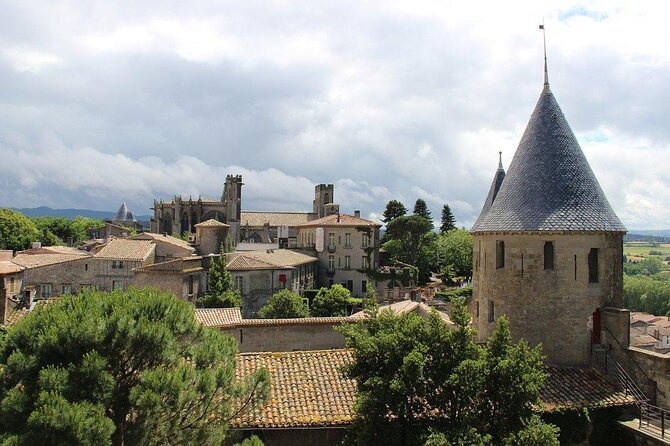
- Ten puzzles over roughly 3 kilometers: You solve challenges at seven historic locations while walking from Square Gambetta to Château Comtal.
- A self-guided English experience: There is no physical guide or live group. The Questo app gives you directions and story prompts.
- A useful lower-town route: The game begins across the river, helping you see La Bastide de Saint Louis before reaching the famous walled Cité.
- Pause and resume whenever you like: You can stop for food, sightseeing, or a low phone battery, then continue later.
- History with a darker edge: Expect stories linked to persecution, plague, the Inquisition, torture, and medieval power struggles.
- Good value, with a small risk: The low price suits independent visitors, but you should allow time to install and start the app before setting off.
What this Carcassonne city game is really like
This is not a conventional guided walk and not an audio guide. It is a private city game played on your phone, with the app sending you from one location to the next and asking you to find answers in your surroundings.
The route covers about 3 kilometers and takes around 1 hour 40 minutes if you keep moving. In practice, you may take longer if you stop for photographs, look inside open churches, pause the game, or visit monuments along the way.
The ghost-story theme gives the walk a slightly theatrical feel, but the substance is local history and architecture. You are not simply following a blue line on a map. At each stop, you look closely at a building, gate, plaque, or architectural detail, then enter your answer to continue.
That makes this a better fit for people who enjoy noticing details. If you want a guide to explain every stone in person, this will feel thin. If you like a little structure while exploring independently, it gives your walk a clear purpose.
More Toulouse trips worth a second look
- Private guided tour of the city of Carcassonne
★ 5.0 · 58 reviews - Marseille: City Sightseeing Hop-On Hop-Off Bus Tour
★ 3.8 · 2,820 reviews - Eiffel Tower Summit Option with Seine River Cruise and City Tour
★ 3.5 · 2,176 reviews
Starting across the river at Square Gambetta
The game begins at Square Gambetta, on the other side of the Aude from the famous fortified Cité. This is a smart starting point because it introduces La Bastide de Saint Louis, the old lower town built under King Louis IX of France.
Many first-time visitors hurry straight toward the walls. Starting here gives you a different order to the city. You begin with the later urban center, then cross toward the medieval citadel. That contrast helps explain that Carcassonne is not only its turreted hilltop fortress.
Your first task is to examine the square and find the answer to a challenge. This opening puzzle may take a little patience. The app’s instructions are not perfectly clear for everyone, and some people have lost time trying to figure out how to begin.
I suggest downloading the required app and checking your booking access before you walk to the square. The experience is sold as a mobile ticket, and the confirmation arrives at booking. Give yourself a few spare minutes at the start rather than arriving with a restaurant reservation waiting at the other end.
Notre Dame de la Santé and the Pont-Vieux
The route next brings you to the little chapel of Notre Dame de la Santé, near the Pont-Vieux. Its location matters. It sits in a narrow passage between fortified buildings, a strategic point between the lower town and the Cité.
The chapel was built in 1527 with money left by Jean de Saix. It served as a hospital for people suffering from the plague. That fact gives the ghost-story theme some weight, though you should not expect a full medical history or a long lecture on epidemics.
Here the game asks you to inspect the setting for a detail that answers the next puzzle. This is one of the better uses of the format. You are encouraged to look at the place in front of you, not just read text on a screen.
The Pont-Vieux itself is an important part of the experience. From here, you can appreciate the separation between Carcassonne’s lower town and its fortified upper city. The crossing also provides some of the most useful orientation on the route.
The old cloth factory near the river
Near the foot of the Pont-Vieux, on the right bank of the Aude, you encounter a building tied to Carcassonne’s later commercial past. It was once the home of a noble local family. In 1694, it was purchased by a person connected with Jean-Baptiste Colbert, the powerful minister of Louis XIV.
A cloth factory was founded there and received the title Manufacture Royale in 1696. The building still visible today is the former owners’ residence. Its design has similarities to buildings from the 18th-century lower town.
This stop is useful because it widens the story beyond knights and battlements. Carcassonne’s identity also grew through trade and textile production. The game lets you connect the river, industry, wealth, and urban architecture without requiring admission to a museum.
As with every stop, the challenge depends on spotting the right detail. The format can be rewarding for a curious adult or older child, but younger children may lose interest while you study walls and façades.
A different way to spend the day, same corner of France:
- The “Break in Prison” room
★ 5.0 · 609 reviews - Toulouse: Carcassonne Day Trip by Coach with Audioguide
★ 4.4 · 580 reviews - Toulouse Food & History Tour with a Chef (in English)
★ 5.0 · 503 reviews - Toulouse: Albi and Cordes/Ciel Day Trip with Audio Guides
★ 4.5 · 486 reviews
Saint-Gimer Church by Eugène Viollet-le-Duc
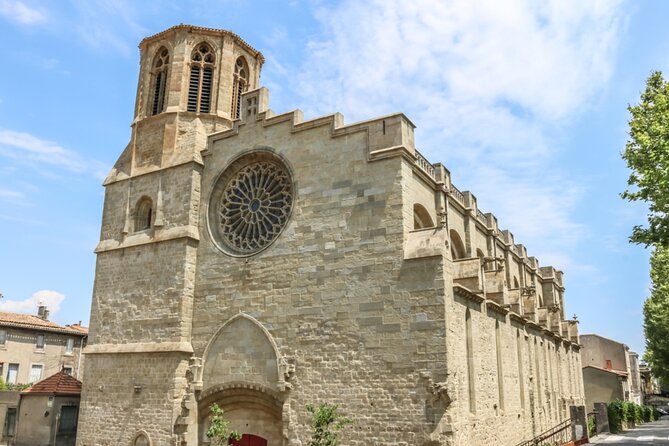
Saint-Gimer Church is one of the most distinctive stops because it belongs to a much later period. Eugène Viollet-le-Duc built it between 1854 and 1859. He is best known for his major work restoring Carcassonne’s medieval citadel, so this small church offers another way to understand his ideas.
Modesty was one of the church’s stated aims. The building has a nave, two aisles, a polygonal apse, two vestries, and a porch at the front. It is not a huge cathedral designed to overwhelm you. Its compact plan makes it easier to read as a piece of architecture.
The challenge here asks you to look carefully at the church and use what you see. This is a strong stop for anyone interested in buildings, especially if you already know that Viollet-le-Duc worked on the Cité.
You should keep your expectations in check. This is not a guided architectural lesson, and the app’s history sections are short. The game points your attention in the right direction, but you will need to supply your own curiosity.
Entering through Porte de l’Aude
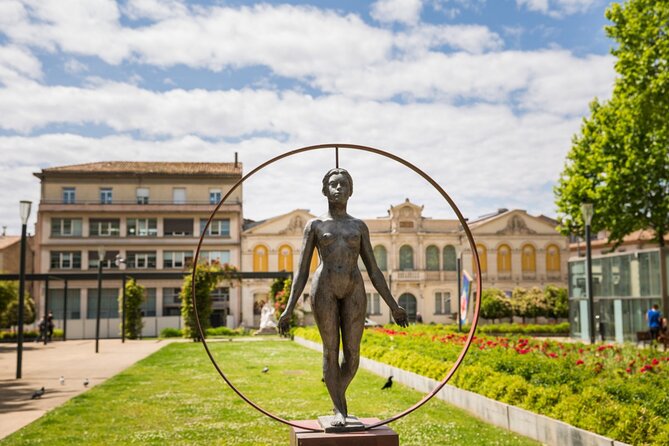
Porte de l’Aude is one of the classic entrances into the preserved medieval city. It overlooks the river and forms part of the fortified walls that make Carcassonne so recognizable.
The approach gives the route a sense of progress. You have moved from the lower town, across the river, past later buildings and a 19th-century church, and now reach the medieval defenses. The gate feels more meaningful because you have approached it as part of the city’s wider structure.
The puzzle requires you to inspect the gate and its surroundings. This is where the game’s mechanics can work well. A guide might point out the answer immediately, but the app makes you search first.
Porte de l’Aude can also be a busy place. Take care with your phone while looking up at the walls, and do not expect a perfectly quiet setting for every puzzle. You are exploring a major attraction, not a closed museum after hours.
The Inquisition Museum and Carcassonne’s darker past
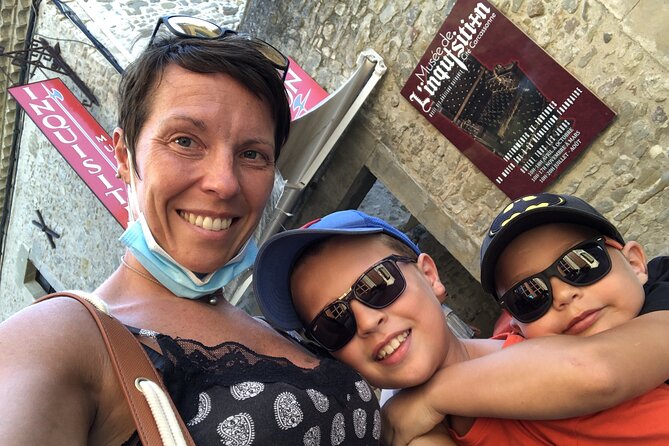
The Inquisition Museum occupies a large 17th-century building. Its displays cover instruments of torture from the 12th century through the French Revolution, along with biographies of figures connected to the period.
The museum also deals with Cathar castles, the Inquisition, and regional history. The city game uses this setting to bring its darker themes into the route. You learn about persecution and religious conflict as part of Carcassonne’s past.
Admission to the museum is not included. The game takes you to the location, but you must buy a separate entry ticket if you want to go inside. That distinction matters when you are working out your total budget.
The stop may not suit every family. The subject is grim, and the museum’s focus on torture can be upsetting for some children. The game itself is intended as a family-friendly activity, but the surrounding attraction has adult themes.
Also note that the game does not replace the museum’s exhibits. If the Inquisition is a main interest, plan time for a proper visit. If you only want the outdoor route, you can treat this as a historical waypoint.
The cathedral and Château Comtal finish
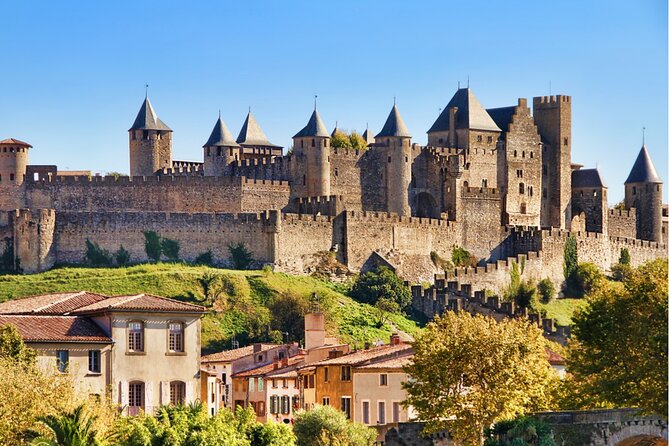
The final section brings you toward the medieval heart of Carcassonne. The present Romanesque cathedral began construction in June 1096. A Lady Chapel was added in the early 15th century, next to an infirmary and chapel built in the 1260s by Bishop Radulph.
The route ends at Château Comtal. Bernard Aton Trencavel built the castle in the 12th century over the western section of the Roman walls. This is the natural climax of the walk, and the app guides you there step by step.
Entry to Château Comtal is not part of the $6 price. If you want to tour the castle and its walls, buy a separate ticket. The game ends at the castle rather than taking you through its interior.
That arrangement can be either a strength or a weakness. It keeps the activity cheap and flexible, but you need to plan your monument visits separately. I would reserve extra time after the game if Château Comtal is high on your list.
The finish also works well for visitors who want to continue exploring the Cité on their own. You arrive with some context about the city’s defenses and religious buildings, then can decide how much more time to spend inside.
How much history do you actually get?
The game covers a wide span of time: Roman foundations, medieval fortifications, Cathar conflict, the Inquisition, plague, royal power, textile manufacture, and 19th-century restoration.
That breadth is useful, but it comes in short pieces. You get local stories and legends at each stop, tied to the place where you are standing. You do not get the sustained explanation of a specialist guide.
The treatment of disease is a good example. The plague hospital at Notre Dame de la Santé is part of the route, but the activity does not offer a long account of plague medicine or public health. If that is your chief interest, you may find the coverage limited.
The same applies to the medieval persecutions. They are part of the story, but the game is designed around puzzles and movement. Think of it as an introduction that gives you context, not a complete course in Cathar history.
For many people, that balance is right. You learn enough to make the buildings more interesting, then keep moving. You are less likely to get stuck in a long lecture, but you will need another source if you want serious historical detail.
The app setup is the main weakness
The largest practical risk is not the route. It is getting access to the quest and understanding the starting instructions.
Several problems have been reported with downloading the app, adding other players, entering the QR code, or reaching the correct start point. In one case, only two of three people managed to access the game. Others spent close to an hour trying to start and could not play.
The provider offers help through in-app chat and email support at [email protected]. That support is available around the clock, according to the supplied information, and the provider has offered help with starting problems and possible refunds.
Still, support is not a substitute for a smooth start. Check the confirmation email before leaving your accommodation. Make sure your phone has enough battery, especially since one player had to stop and resume more than 24 hours later because the battery was running low.
You need only one phone to play the route, according to the practical experience provided. That can make the advertised per-person price feel less attractive for a small group, since one handset may be enough for everyone to read the clues and enter answers.
Is $6 per person good value?
At about $6 per person, this is inexpensive by guided-tour standards. You receive a private experience, a roughly 3-kilometer route, 10 interactive puzzles, local stories, and unlimited access to pause and resume.
The value is strongest if you want a bit of entertainment while finding your way around Carcassonne. It gives structure to a walk that you might otherwise make on your own, and it includes the lower town as well as the Cité.
The value is weaker if you expect an audio guide, a live historian, or entrance to the castle and museum. There is no physical guide, and no attraction admission is included. One phone may also serve a whole group, so larger groups should think about the price as a charge for access rather than for separate equipment.
Group discounts are available. Groups larger than 15 should make multiple bookings. The activity is private, so you do not join strangers or have to keep pace with another party.
Who should choose this activity?
I would consider it for independent visitors who like puzzles, walking, and short historical stories. It can work well for a couple, a small group of friends, or a family that enjoys looking closely at buildings.
It is less suitable if you want a polished, no-fuss start. The technical complaints are too frequent to ignore. It is also not ideal for someone who wants French or Spanish content, since the offered language is English and some players have had to rely on translation tools.
Families should think about the age and patience of their children. The clues require attention, and younger children may want to run ahead or focus on other things. Older children who enjoy challenges may find the format more engaging than a standard walk.
The route is described as suitable for most people, with service animals allowed and public transportation nearby. The stated access window is from 6:00 AM to 11:30 PM, Monday through Sunday, during the listed operating period. Even so, your ability to examine places will depend on what is open and how busy the area is.
My verdict: book it if you want a flexible puzzle walk
I would book Medieval Carcassonne: Interactive Ghost Story & City Game if I wanted a low-cost way to connect the lower town, river crossing, fortified gate, and Château Comtal. The pause feature is genuinely useful, and the route includes more than the standard fortress views.
I would not book it as my only historical introduction to Carcassonne. You receive clues and compact explanations, not a live guide or a full audio tour. I would also prepare carefully for the app setup and contact Questo quickly if the access code fails.
At $6, this is a reasonable add-on for a curious, phone-ready visitor. Go in expecting a self-guided game with historical flavor, not a fully narrated tour. If that sounds right, it can turn a familiar sightseeing route into an active search through one of France’s most memorable fortified cities.
FAQ
Where does the Carcassonne city game start?
It starts at Square Gambetta, at Sq. Gambetta, 11000 Carcassonne, France, across the river Aude from the famous Cité.
Where does the activity end?
The route ends at Château Comtal. The Questo app guides you there step by step.
How long does the experience take?
The activity lasts approximately 1 hour 40 minutes and follows a route of about 3 kilometers.
How many puzzles are included?
You solve 10 interactive puzzles at locations along the route.
Is the experience guided by a person?
No. There is no physical guide. You play privately with instructions, puzzles, and stories delivered through the Questo app.
Can I pause and resume the game?
Yes. You can start at any hour, pause whenever you like, and resume later. The game offers unlimited access for this purpose.
Is the activity available in languages other than English?
The offered language is English. The provided information does not list French, Spanish, or any other language option.
Are monument entry tickets included?
No. Entry tickets to Château Comtal, the Inquisition Museum, and other attractions are not included in the activity price.
What is the cancellation policy?
You can cancel for a full refund up to 24 hours before the experience start time. Cancellations or changes made within 24 hours are not accepted for a refund.
Recently reviewed around Toulouse
- Carcassonne ‘s Medieval Walls: A Self-Guided Tour★ 4.5 · 43 reviews
- Carcassonne During World War 2★ 5.0 · 127 reviews
- Cité de Carcassonne Guided Walking tour. Private tour.★ 5.0 · 42 reviews
- Private guided tour of the city of Carcassonne★ 5.0 · 58 reviews
- Toulouse Food & History Tour with a Chef (in English)★ 5.0 · 59 reviews
- Welcome to Toulouse: Private Walking Tour with a Local★ 4.2 · 47 reviews
- Toulouse: Electric Tuk-Tuk Tour with Photo Stops and Audio★ 4.8 · 138 reviews
- Narbonne: visit the Archbishops’ Palace and Cathedral★ 4.9 · 43 reviews
City Tours, compared.

Eiffel Tower Summit Option with Seine River Cruise and City Tour
Read our review →
Paris in a Day: Louvre or Orsay, Eiffel Tower, City Walk & Cruise
Read our review →

Eiffel Tower Hosted Tour, Seine Cruise and City Tour
Read our review →

City and River Seine Tour on an Amphibious Bus
Read our review →

Eiffel Tower and City Tour by Bus with Seine River Cruise Option
Read our review →Browse the lists this tour appears in