
Reviewed · WORKSHOPS
Paris: Croissant Baking Class with a Chef
The best part of this Paris class is that you do not simply watch a chef make croissants. You work the dough yourself, learning why butter temperature, folding, resting, and proofing matter. Chef Léo leads the listed class, while some sessions feature Chef Maria, and both bring a friendly, hands-on style to the kitchen.
I like the small group of eight because the chef can correct your rolling and shaping before a minor mistake ruins the layers. I also like the generous result: you make about eight pastries, often four plain croissants and four pain au chocolat, then eat one warm and take the rest with you. The main consideration is physical effort. Rolling laminated dough takes arm strength, and the class is not suitable for children under 15.
In This Review
- Key points at a glance
- What happens during the three-hour class
- Rolling and folding the dough
- Resting time and the science of flaky layers
- Shaping croissants and pain au chocolat
- Fresh pastries, drinks, and what you take home
- The optional bi-colour croissant class
- Is $140 a fair price?
- Who will enjoy this most?
- Getting to Studio Pâtisserie
- A few practical tips before you book
- Should you book this croissant class?
- FAQ
- How long is the croissant baking class?
- Where does the class meet?
- Which Metro stations are closest?
- What language is the class taught in?
- How many people are in the group?
- Is the class suitable for children?
- Do I need baking experience?
- What is included in the price?
- Can I cancel the booking?
Key points at a glance
- Hands-on from start to finish: You knead, roll, fold, cut, shape, and bake your own pastries.
- A real pastry lesson: The chef explains butter quality, proofing, resting time, and the science behind flaky layers.
- Small class, personal help: Groups are limited to eight people, allowing direct feedback at the worktable.
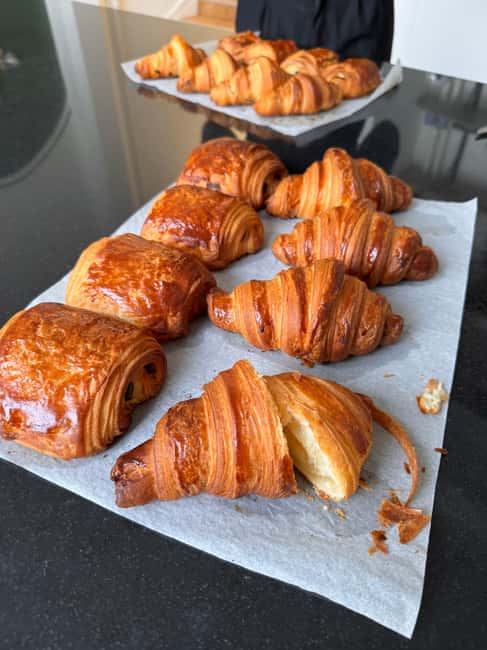
- A generous edible souvenir: You can make four butter croissants and four chocolate pastries per person.
- Easy Paris location: Studio Pâtisserie has a gray storefront near Metro Rome and Villiers.
- Optional bi-colour class: On selected days, you can learn to add color to the croissant dough.
What happens during the three-hour class
Croissant making is a lesson in patience disguised as breakfast. The dough needs time to rest and rise, so the class moves in stages rather than as one nonstop cooking demonstration. That pacing is useful: while the dough rests, you get an explanation of what is happening instead of standing around wondering why the chef has disappeared.
You begin in the bakery kitchen at Studio Pâtisserie, gathering around a shared workstation. The setting is described as cosy, and the gray storefront makes the building easy to identify. You will want to allow time to reach the meeting point, especially if you are crossing Paris by Metro. The nearest stations are Rome on Line 2 and Villiers on Line 3.
The chef introduces the ingredients and the broad method. You will work with the dough, butter, and other ingredients needed for the pastries. The aim is not just to hand you a recipe and hope for the best. You learn the order of the work and the reason behind each stage.
More Paris trips worth a second look
- Fragonard Paris: Mini Perfume Workshop
★ 4.5 · 1,924 reviews - Paris Cooking Class and Lunch with Wine plus Market Visit Option
★ 5.0 · 1,024 reviews - Paris Croissant Small-Group Baking Class with a Chef
★ 5.0 · 910 reviews
Rolling and folding the dough
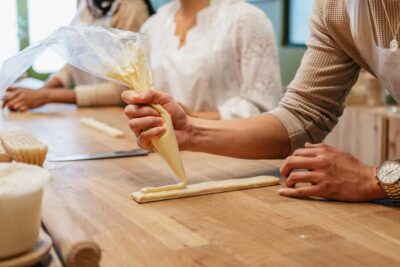
This is where the class earns its price. Croissant dough looks simple, but the layers depend on careful handling. You roll the dough out, work in the butter, and fold it in a set pattern. Each fold builds the layers that later separate into a crisp outside and soft interior.
You should expect to use your arms. Several participants specifically point out that kneading and rolling take strength, so this is not an entirely relaxed pastry demonstration. If your wrists, shoulders, or hands tire easily, tell the chef and work at a sensible pace.
The chef watches the process closely and gives individual corrections. That matters more than it may sound. A recipe can tell you to roll the dough to a certain thickness, but it cannot easily show you what the dough should feel like or how much pressure to use. Personal guidance helps you avoid overworking the dough or allowing the butter to behave badly.
The class also explains butter quality and temperature. These details can feel fussy at home, but they are central to the result. Butter that is too hard can tear the dough. Butter that is too soft can blend into it instead of forming distinct layers. The chef connects these technical points to the pastry you will later eat.
Resting time and the science of flaky layers
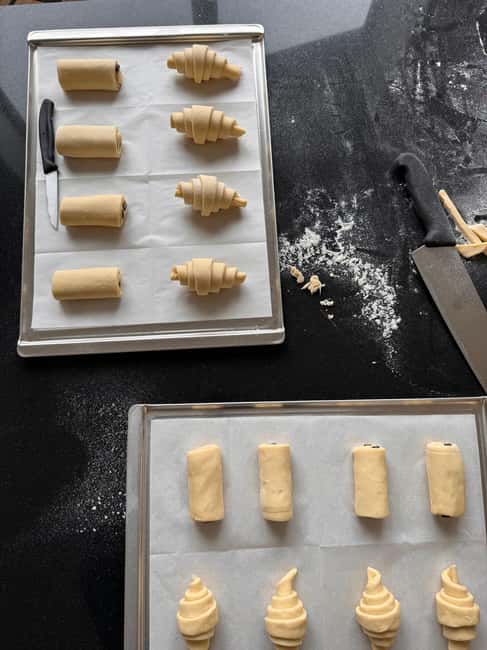
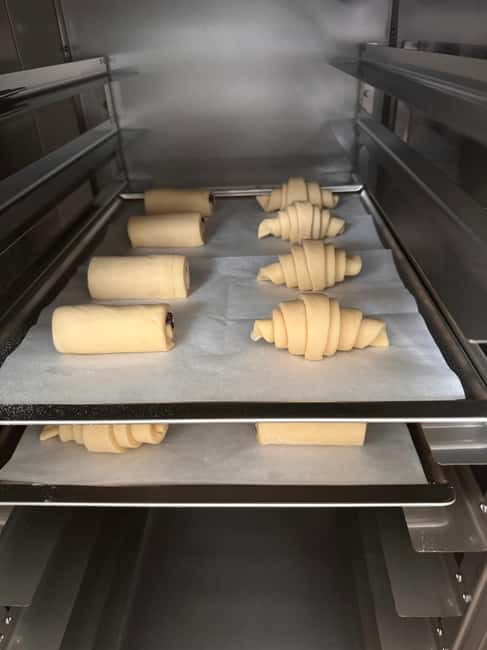
The pauses are part of the lesson. Dough needs to rest between folds so the gluten can relax and the butter can remain in the right condition. Later, the shaped pastries need time to proof before baking.
I appreciate this balance between theory and practice. You learn enough of the science to understand why the timetable matters, but you are not buried in a lecture. The chef remains available for questions, and the lighter atmosphere helps keep the technical work from feeling like a school exam.
Chef Léo is described as energetic, funny, and patient. Chef Maria is also presented as warm, clear, and good at explaining the reasons for each step. The tone seems well suited to beginners, yet experienced home bakers can still pick up useful tips about shaping, proofing, and texture.
One practical point: because resting periods break up the work, the three hours may feel less active than three hours of continuous cooking. That is not wasted time, but you should know what you are booking. This is a carefully paced pastry lesson, not a quick make-and-eat workshop.
Shaping croissants and pain au chocolat
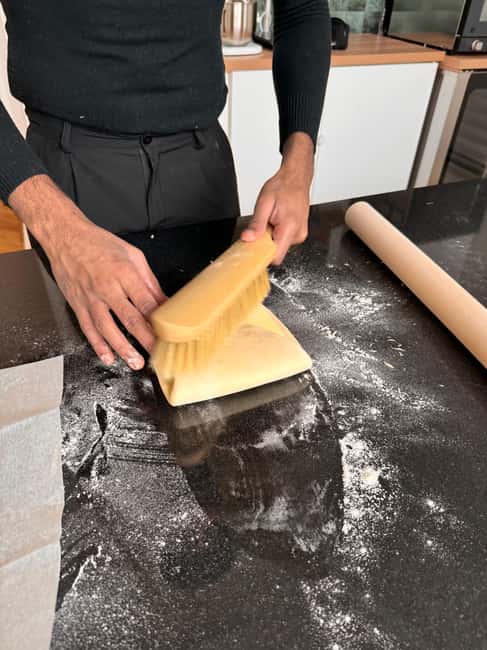
Once the dough is ready, you cut it into pieces and shape the pastries. For croissants, that means creating the familiar triangle and rolling it into a crescent. The shape affects how the pastry expands, so the chef checks your technique as you work.
The chocolate version gives the class a second style of pastry without changing the core lesson. Pain au chocolat uses the same laminated dough but offers a more straightforward shape. Many participants like the contrast between the plain butter croissant and the chocolate pastry, and making both gives you a better sense of how versatile the dough is.
The shaping stage is also where the class becomes especially social. Everyone is working at once, comparing forms and asking questions. You do not need baking experience to take part. The instruction is designed to make the process manageable for first-timers, and the chef helps you correct uneven shapes before they go into the oven.
Do not worry if your first croissant does not look like the pastry in a Paris bakery window. The important part is learning the method. With good rolling and proofing, even a slightly lopsided crescent can bake into a fine breakfast.
A different way to spend the day, same corner of France:
- Paris: Louvre Museum Timed-Entrance Ticket
★ 4.6 · 71,977 reviews - Disneyland® Paris 1-Day Ticket
★ 4.6 · 49,412 reviews - Paris: Versailles Palace and Gardens Full Access Ticket
★ 4.6 · 41,579 reviews - Paris: Evening River Cruise with Music
★ 4.4 · 22,721 reviews
Fresh pastries, drinks, and what you take home
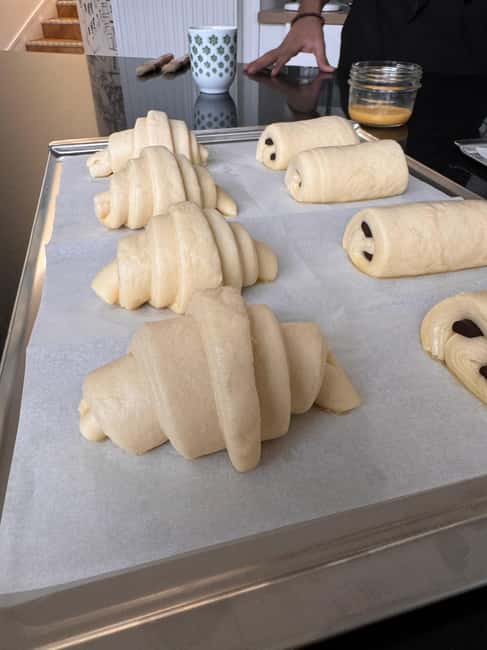
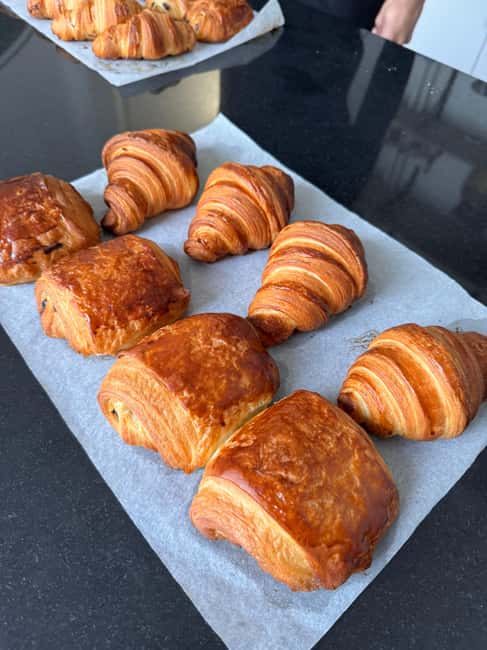
The reward comes when the pastries leave the oven. You get to sample what you made while it is still warm, and some sessions include a beverage to enjoy alongside it. That first bite gives you a quick lesson in texture: the crisp shell, the buttery layers, and the soft center are easier to understand when you made the dough yourself.
The quantity is generous. You can expect about eight pastries per person, commonly four butter croissants and four pain au chocolat. That is more than most people will want to eat in one sitting, particularly after three hours of tasting and working. Bring a bag or container suitable for carrying pastries back to your hotel. The provided information does not specify special packaging, so do not assume the pastries will remain perfect for a long journey across Paris.
You leave with a recipe as well as the baked goods. That is important because laminated dough is not the sort of thing most people can recreate from memory after one class. The take-home instructions give you a reference for trying again, and the chef’s practical tips help fill in the gaps that recipes often leave out.
Some people find the best souvenir is not the pastry itself but the confidence to attempt it at home. Croissants require time and planning, but the class shows that the process is not mysterious. It is a sequence of controlled steps.
The optional bi-colour croissant class
On selected days, you can book the bi-colour option. This adds colored dough to the croissant process, creating a more decorative pastry. It is aimed at experienced bakers and curious beginners who want something beyond the traditional golden crescent.
The bi-colour class includes the ingredients and instruction needed for that variation. Check the available date carefully before booking, since it is not offered at every session. If your goal is to master classic croissants first, the standard class is the clearer choice. If you have already baked laminated dough or want a more unusual result for photographs, the colored version adds flair.
The optional format also gives repeat visitors a reason to take another class at Studio Pâtisserie. The standard lesson teaches the foundation, while the bi-colour version lets you play with appearance without abandoning the underlying technique.
Is $140 a fair price?
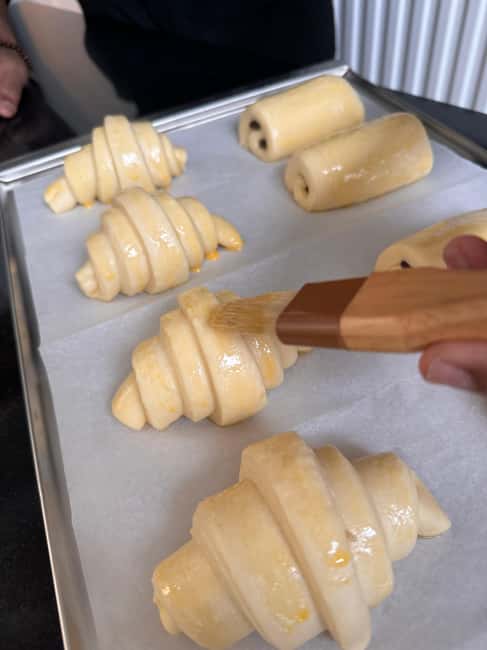
At $140 per person, this is not a cheap breakfast. You could buy several excellent croissants in Paris for far less. The value comes from the instruction, the professional kitchen, the ingredients, the small class size, and the amount of pastry you produce.
I would judge the price against other cooking activities rather than against a bakery purchase. You receive three hours of guided work, access to professional-grade equipment, a recipe, explanations of pastry history and science, and several pastries to eat or carry away. The class also gives you a skill you can use again, though success at home will depend on your oven, work surface, butter, and patience.
The eight-person limit is a real part of the value. In a large class, you might spend much of the session watching someone else roll dough. Here, the chef can move around the table and offer direct help. Several experiences also note that the class feels personal without becoming awkward, which is a good balance for solo visitors and couples.
I would book it if you want an activity rather than simply a food stop. If you only want to taste a classic croissant, spend the money at a respected bakery. If you want to understand how that croissant is made and leave with your own batch, the price is easier to justify.
Who will enjoy this most?
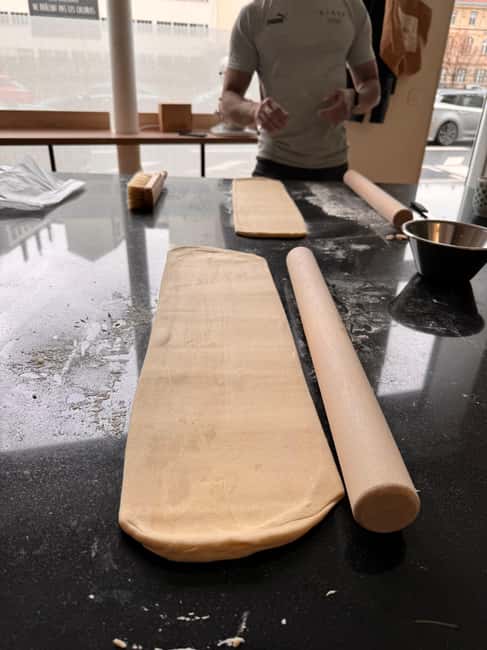
This class suits food lovers, home bakers, couples, families with older children, and anyone looking for a break from museums and monuments. It works particularly well on a rainy morning, when three hours indoors can become one of the more memorable parts of your Paris schedule.
You do not need prior baking experience. The instruction is designed for beginners, and the chef stays involved at every stage. At the same time, a person who already bakes can focus on the finer points, such as butter handling, dough thickness, proofing, and shaping.
It is also a good activity for a mother and daughter, a parent and teenager, or a small group of friends. The class has included solo participants, couples, and mixed-age groups. The social setting is friendly, but the small size keeps it from feeling like a crowded demonstration.
Children under 15 are not suitable for the class. Anyone under 17 must be accompanied by a paying adult. Since rolling dough requires effort, consider the age rule alongside the physical demand, not just the minimum age.
Getting to Studio Pâtisserie
The meeting point is Studio Pâtisserie, identified by its gray-colored storefront. The closest Metro stations are Rome on Line 2 and Villiers on Line 3, making the class practical to reach by public transport.
The location is described as easy to find, but Paris streets can still slow you down when you are unfamiliar with the area. Give yourself a little extra time. Arriving calm matters here because the class begins with hands-on preparation, not a long orientation.
The activity is conducted in English. That makes it a practical pick for English-speaking visitors who want detailed instruction without having to translate baking terms as they work.
You can cancel up to 24 hours before the start for a full refund, and the reserve-now, pay-later option keeps your schedule flexible. Starting times vary, so check the date and availability before building the rest of your day around it.
A few practical tips before you book
Come ready to work. The class requires kneading and rolling, so comfortable clothing and a willingness to use your arms will help. The supplied information does not list a dress code, so you should follow the studio’s instructions if any are sent after booking.
Do not plan a heavy meal immediately before class. You will sample warm pastries during the session and may leave with eight more. If you are sharing with a companion, plan how you will carry the extras.
Bring your phone if you want photos, but keep it out of the way during the active parts. One chef has been known to take photos and videos during the class, which is useful for preserving the experience without stopping your own work.
Pay close attention when the chef explains why a step matters. The recipe tells you what to do, but the reasons behind butter temperature, resting, and proofing are what help you recover when your home kitchen does not behave exactly like the studio.
Should you book this croissant class?
Book it if you want a distinctly Parisian activity with real participation, clear instruction, and a tasty result. The strongest reasons are the limited group size, the chef’s personal corrections, and the chance to make both butter croissants and pain au chocolat in one three-hour session.
Skip it if your Paris schedule is already packed or if you are looking only for the cheapest way to eat a croissant. The class takes time, costs $140, and demands physical effort. For anyone curious about French pastry, though, it offers more than a snack: you leave with practical skills, a recipe, and a bag of pastries made by your own hands.
FAQ
How long is the croissant baking class?
The class lasts three hours. Check the selected date for the available starting time.
Where does the class meet?
It meets at Studio Pâtisserie, in the building with the gray-colored storefront.
Which Metro stations are closest?
The nearest stations are Rome on Metro Line 2 and Villiers on Metro Line 3.
What language is the class taught in?
The class is taught in English.
How many people are in the group?
The class is limited to eight participants.
Is the class suitable for children?
Children under 15 are not suitable for the class. Children under 17 must be accompanied by a paying adult.
Do I need baking experience?
No prior baking experience is required. The chef guides you through the dough, folding, shaping, and baking stages.
What is included in the price?
The price includes chef instruction, ingredients, professional-grade kitchen tools and equipment, a recipe to take home, pastry samples, and information about the history and science of croissant making. Bi-colour ingredients and instruction are included if you select that option.
Can I cancel the booking?
You can cancel up to 24 hours in advance for a full refund. You can also reserve now and pay later, subject to the booking terms.
Recently reviewed around Paris
- Louvre Private Tour – The Essentials and More with Expert Guide★ 5.0 · 227 reviews
- 2CV tour by night★ 5.0 · 55 reviews
- Eiffel Tower Second or Summit Floor Access by Elevator with Views★ 3.5 · 161 reviews
- The only Paris Wine Tasting experience you need to do – 2 hours★ 5.0 · 265 reviews
- 2 Hour Street-art Walk and Space Invaders Hunt in Paris★ 5.0 · 27 reviews
- 2 hour outdoor group activity in Paris: SAINT GERMAIN★ 5.0 · 48 reviews
- Sainte-Chapelle, Conciergerie & Palais de Justice Private Tour★ 5.0 · 72 reviews
- Private 2 – Hour Paris Landmarks Tour by Golf Cart Mini Moke★ 5.0 · 38 reviews
Workshops, compared.

Paris Cooking Class and Lunch with Wine plus Market Visit Option
Read our review →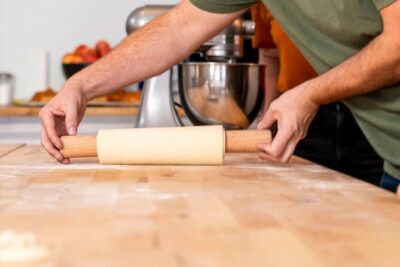
Paris Croissant Small-Group Baking Class with a Chef
Read our review →
Fragonard Eze: Perfume Making Class and Factory Tour
Read our review →

Perfume Making Class and Fragonard Factory Tour
Read our review →Browse the lists this tour appears in