
Reviewed · LATIN QUARTER TOURS
Paris – Latin Quarter Free Tour in English (Tip-Based)
Paris’s Latin Quarter packs Roman ruins, medieval churches, famous writers, grand monuments, and lively café streets into a small area. This two-hour English walking tour gives you a useful first look without charging a fixed admission price for the walk itself.
I like the route’s range: you move from the grand Fontaine Saint-Michel to narrow medieval streets, then on to the Panthéon and Hemingway’s old neighborhood. I also like the practical ending at Place de la Contrescarpe, where you can sit down for food or a drink. The main thing to consider is the group size, which can reach 50 people, so staying close to the guide may matter.
In This Review
- Key points to know before you go
- Why the Latin Quarter makes a smart first walk
- Starting at Fontaine Saint-Michel
- Old Paris on Rue de la Huchette
- Shakespeare and Company, then Notre-Dame
- The old tree and Saint-Julien-le-Pauvre
- Dali’s sundial and Saint-Séverin
- Roman Paris at the Thermes de Lutèce
- La Sorbonne and the making of the Latin Quarter
- The Panthéon, the tour’s grand centerpiece
- Saint-Étienne-du-Mont and Saint Genevieve
- Hemingway’s first Paris home and the finish
- Should you book the Latin Quarter walk?
- FAQ
- How much does the tour cost?
- How long does the walking tour last?
- What language is the tour offered in?
- Where does the tour begin?
- Where does the tour end?
- What sights are included in the walking route?
- Does the tour include admission tickets?
- How many people can join the tour?
- Can I cancel for a refund?
Key points to know before you go
- The route covers Roman, medieval, and modern Paris: You see the Thermes de Lutèce, old churches, the Sorbonne, the Panthéon, and literary landmarks in one walk.
- The advertised price is only the booking charge: Contributions are accepted by card or electronic payment, and VAT is added.
- The walk begins at Fontaine Saint-Michel: The meeting point is easy to identify at Place Saint-Michel in the 5th arrondissement.
- Guides include Bruce and Sanna: The guiding style centers on clear stories, French culture, and the people connected with the Latin Quarter.
- The finish is useful, not random: Place de la Contrescarpe puts you among restaurants, bars, and cafés for an easy next stop.
- Expect a full public group: The maximum is 50 people, and the walk lasts about two hours.
Why the Latin Quarter makes a smart first walk
The Latin Quarter is one of Paris’s best areas for understanding how the city grew. In a short distance, you can trace Paris from its Roman beginnings to the medieval church and university quarter, then into the world of modern writers and cafés.
That variety is the great strength of this tour. You are not spending two hours looking at one type of monument. One stop explains the reshaping of Paris under the Grand Reconstruction. Another points out a narrow old street. Later, you stand before the Panthéon and hear how a church became a national mausoleum.
The route also works well for a first day in Paris. You get familiar with the area around Saint-Michel, Île de la Cité, the Sorbonne, and the upper part of the Latin Quarter. Afterward, you can return to the places that caught your interest, perhaps for a museum visit or a slower walk.
This is a walking tour, not an attraction-entry tour. The listed stops are viewed from outside unless the guide takes the group into an open church. Admission is free at each scheduled stop, but that does not mean every interior is guaranteed to be open.
Other Paris days travellers weigh against this one:
- Paris: Louvre Museum Timed-Entrance Ticket
★ 4.6 · 71,977 reviews - Disneyland® Paris 1-Day Ticket
★ 4.6 · 49,412 reviews - Paris: Versailles Palace and Gardens Full Access Ticket
★ 4.6 · 41,579 reviews
Starting at Fontaine Saint-Michel
Meet at Fontaine Saint-Michel, at Place Saint-Michel in the 5th arrondissement. The fountain is an imposing starting point and a good place for a guide to explain how Paris changed from a medieval city into a modern European capital over roughly 70 years.
That opening gives the tour a useful frame. Instead of treating the Latin Quarter as a collection of pretty streets, the guide can show how large city planning changed the way Paris looked and functioned. It is a strong beginning because the fountain itself reflects that grand rebuilding period.
Allow a little extra time to locate the group. Place Saint-Michel is near public transportation, but it can be busy and confusing if you arrive at the last minute. The meeting point is precise, so check for Fontaine Saint-Michel rather than simply heading toward the Latin Quarter.
Old Paris on Rue de la Huchette
Rue de la Huchette is one of the oldest streets on the route. The walk here is brief, but it provides a sharp contrast with the broad avenues and formal squares associated with central Paris.
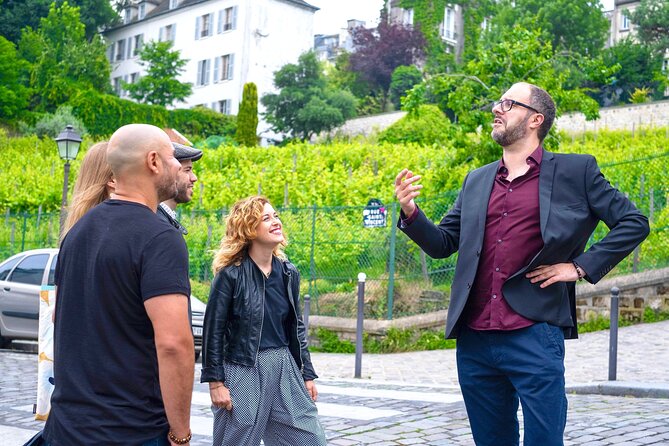
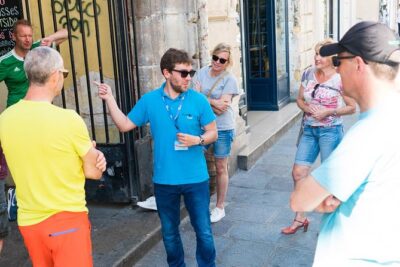
Your guide points out narrow streets and shares stories about old Paris. This is the sort of stop that works best with explanation. Without context, a narrow lane can look like just another photogenic street. With a guide, you get a better sense of how compact and enclosed parts of the medieval city once were.
Do not expect a long pause here. The scheduled time is about five minutes, so this is more of a quick orientation stop than a detailed architectural visit.
Shakespeare and Company, then Notre-Dame
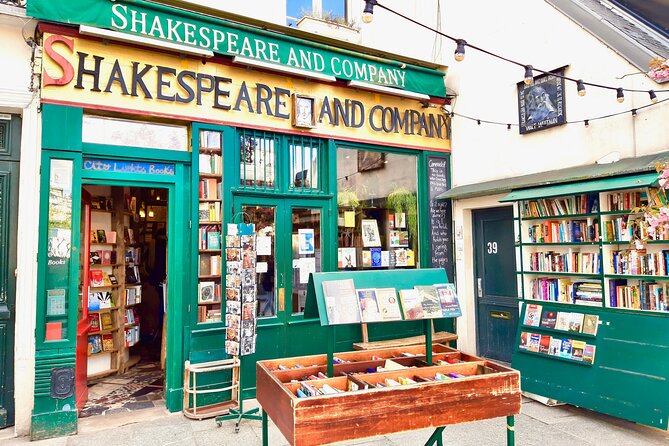
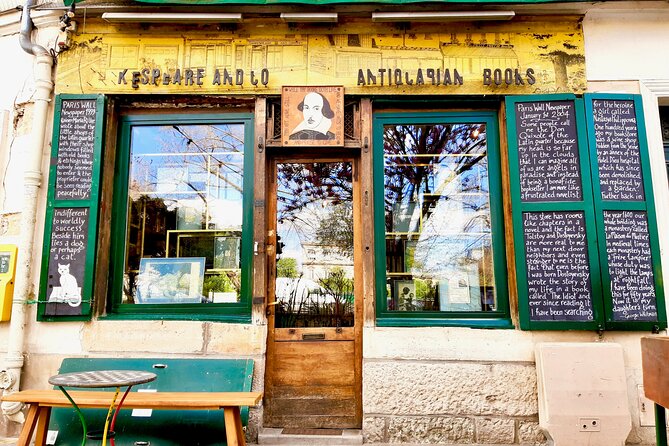
Shakespeare and Company is a major literary landmark near the Seine. The bookstore dates from the 1920s and is linked with writers of the Lost Generation, including Hemingway, James Joyce, and F. Scott Fitzgerald.
The tour uses the bookstore to connect the Latin Quarter with the literary life of 20th-century Paris. That connection helps explain why this neighborhood appealed to writers. You should expect an exterior introduction and stories about the people associated with the shop, rather than a dedicated shopping visit.
Next comes a view of Notre-Dame de Paris. The stop is short, about five minutes, but the cathedral gives the route one of its clearest visual moments. The guide can place Notre-Dame within the story of the surrounding district, which was tied to religion, learning, and the development of Paris.
Because the stop is brief, you will want to take your photographs promptly. If you hope to spend time inside the cathedral, plan that separately.
A different way to spend the day, same corner of France:
- Paris: Evening River Cruise with Music
★ 4.4 · 22,721 reviews - Paris: Eiffel Tower Entry Ticket with Optional Summit Access
★ 4.4 · 20,035 reviews - Paris: Eiffel Tower Summit or Second Floor Access
★ 4.3 · 17,248 reviews - Paris: Louvre Guided Tour with Reserved Access & Boat Cruise
★ 4.3 · 16,353 reviews
The old tree and Saint-Julien-le-Pauvre
The route includes Paris’s oldest tree, said to date from 1601. A local tradition invites you to touch its leaves and make a wish. It is a small detail, but it adds a bit of neighborhood character to a walk otherwise filled with major monuments.
This is a good reminder that the Latin Quarter is not only about famous buildings. Its appeal also comes from odd corners, old customs, and details you could easily pass without noticing.
At Église Saint-Julien-le-Pauvre, the focus turns back to medieval Paris. The church is one of the oldest buildings in the city and was once connected with education in the area, alongside Notre-Dame. The scheduled stop lasts about ten minutes.
The church is modest compared with the Panthéon or Notre-Dame, and that is precisely why it belongs on this route. It shows a smaller, older side of Paris. If you prefer grand interiors at every stop, this may feel less dramatic, but the building helps explain how religion and learning shaped the quarter.
Dali’s sundial and Saint-Séverin
The Salvador Dali sundial is one of the route’s more unusual sights. Dali had a strong connection with the Latin Quarter and gave the city this work, which represents the Camino de Santiago de Compostela.
This stop breaks up the church and university material with a modern artistic detail. It is also a reminder that the quarter continued to attract artists long after its medieval period.
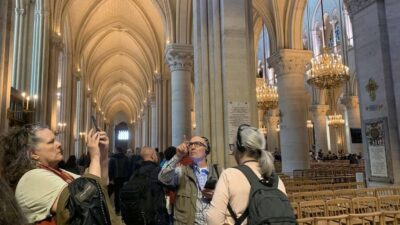
Église Saint-Séverin brings you back to Gothic Paris. The 13th-century church is known for its vaulted ceilings and palm-tree-like columns. You may also hear the pipe organ if it happens to be playing during the visit.
The wording matters here: the organ is a possibility, not a scheduled performance. Church access and quiet conditions can vary. Still, Saint-Séverin is one of the more rewarding stops for anyone who enjoys architecture, especially if you take a moment to look upward at the ceiling and columns.
Roman Paris at the Thermes de Lutèce
The Thermes de Lutèce are the remains of Roman baths built after the Roman conquest of Paris in 52 B.C. They belonged to a much larger complex that served the city’s population.
This stop gives the tour its oldest layer. By the time you reach the baths, you can see that Paris was not created in the medieval period. The city already had an organized Roman center, public facilities, and a place in the wider Roman world.
The visit is scheduled for about ten minutes. Do not expect a complete archaeological site spread across a large open area. The value comes from seeing surviving Roman remains in the middle of present-day Paris and understanding what they represent.
The nearby Musée de Cluny, now the Medieval Museum of Paris, adds another time period. Its ornate 15th-century building is filled with stories of Paris in the Middle Ages. The stop is listed at about five minutes, so the guide’s explanation is the main event rather than a full museum visit.
If the museum interests you, make a note to return with more time. A walking tour can point out the building and explain its role, but it cannot replace a proper museum visit.
La Sorbonne and the making of the Latin Quarter
La Sorbonne is the intellectual center of the route. The university dates to 1257, and the wider Latin Quarter has been associated with education and culture since the 11th century.
The guide uses the university to explain why the area became known as the Latin Quarter. This is more than a name on a map. For centuries, students and scholars shaped the streets, institutions, and public life here.
The stop lasts about ten minutes, enough for an overview of the university’s origins and importance. You will likely see the exterior and hear the story rather than enter the university buildings. That is still useful because the neighborhood makes more sense once you understand that learning was central to its identity.
I especially like this part of the route for first-time visitors. It links the Roman baths, medieval churches, and writers into one continuing story: Paris as a place where people came to study, argue, write, pray, and build careers.
The Panthéon, the tour’s grand centerpiece
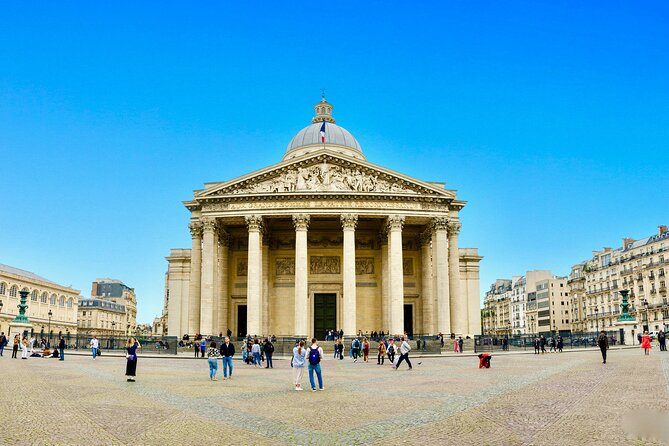
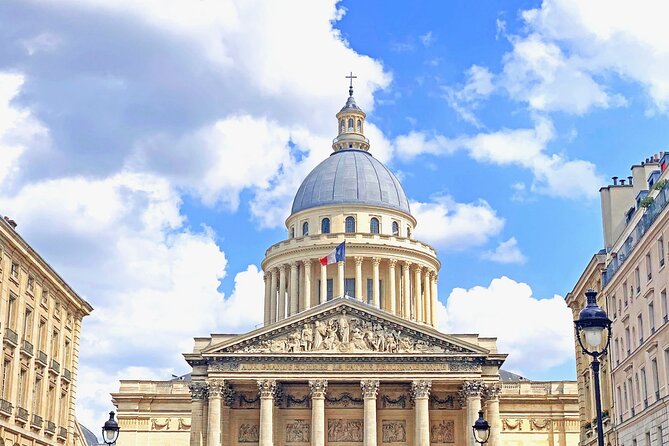
The Panthéon is the main event of the walk. Its name means all the gods, and its purpose changed over time. It began as one of France’s largest religious structures and later became a national mausoleum.
Inside are the tombs of major French figures, including Victor Hugo and Marie Curie. The guide explains how the building moved from religious use toward its role as a monument to national achievement.
The scheduled stop is about 15 minutes, the longest pause on the route. That makes sense. The Panthéon needs context, and its scale is difficult to appreciate from a quick glance.
The important practical point is that this tour does not include admission. You should expect to view the building and hear its story, not automatically enter the interior. If you want to see the tombs, domed interior, or other paid areas, arrange a separate visit.
Even from outside, the Panthéon gives the walk a strong sense of direction. The earlier stops explain how the quarter developed. Here, the focus shifts to the people France chose to honor.
Saint-Étienne-du-Mont and Saint Genevieve
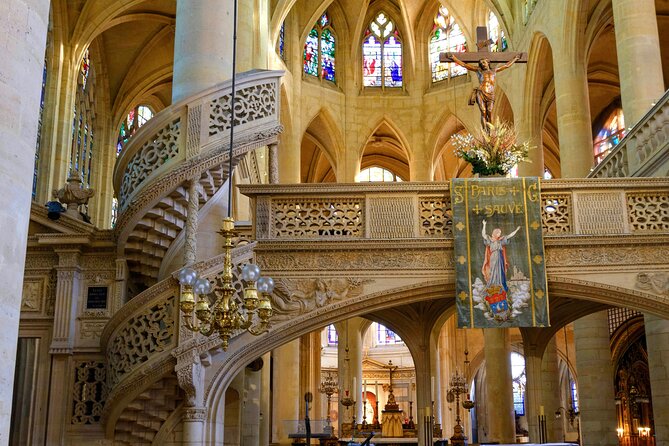
Saint-Étienne-du-Mont is a majestic 15th-century church with a very different mood from the Panthéon. Inside is the tomb and knuckle relic of Saint Genevieve, the patron saint of Paris.
The guide connects Genevieve with the takeover of Paris during the decline of the Roman Empire. Her story gives the church a role in the transition from Roman rule to early Christian Paris.
This stop can be especially appealing if you enjoy religious art, relics, and church interiors. It also shows how much sacred history is packed into a small section of the city.
As with Saint-Séverin, entry may depend on the church’s opening conditions and what is happening inside. The schedule allows about ten minutes, so the visit is an introduction rather than a full study of the building.
Hemingway’s first Paris home and the finish
The final major stop concerns Ernest Hemingway’s first apartment and home office in Paris. The guide uses his connection with the Latin Quarter to explain how the neighborhood shaped his early years in the city.
Hemingway’s affection for Paris is closely tied to the idea that the city stays with you after you leave. You do not need to be a literary specialist to enjoy this stop. It gives the route a personal ending after all the Roman, religious, and academic material.
The tour finishes at Place de la Contrescarpe, a lively square in the heart of the Latin Quarter. This is one of the smartest details in the whole experience. You are not dropped beside a highway or at an isolated monument. You finish in an area with restaurants, bars, and cafés, making it easy to continue your evening or stop for lunch.
Prices and the tip-based format
The advertised charge is $3.62 per group, for up to nine people. That figure should not be treated as the full cost of the experience. Tips are accepted only by credit card, debit card, or electronic payment, and VAT is added to contributions.
That format can be excellent value if you want a guided introduction without paying a large fixed tour price. You can decide what the experience was worth after the walk. It also means you should budget for a contribution and carry a working electronic payment method.
The value here comes from the guide’s explanations and the route, not from included admission tickets. Every listed stop is free to view, but the Panthéon, Musée de Cluny, and other attractions may require separate arrangements if you want to go inside.
Timing, group size, and who will enjoy it
The walk lasts about two hours and is offered in English. Morning and afternoon start times are available in the tour information, with an 11:00 a.m. start shown for this departure.
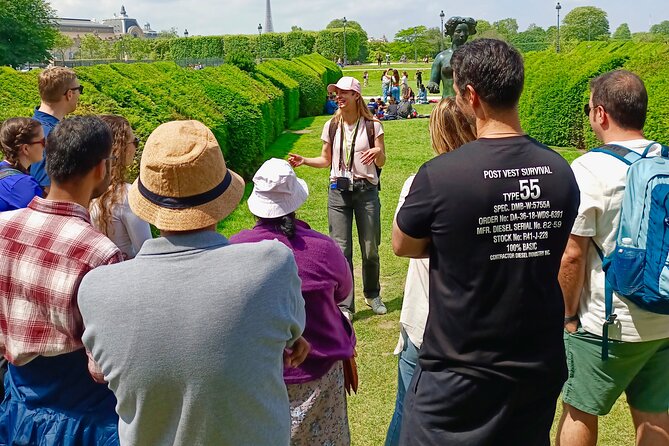
The maximum group size is 50. That is a fairly large public group for narrow Latin Quarter streets. A group of this size can make it harder to hear, especially near busy streets, so stay near the guide and arrive at the fountain before the scheduled start.
The tour suits you best if:
- You want a broad introduction to the Latin Quarter.
- You enjoy stories about writers, churches, universities, and city planning.
- You prefer walking past many sights rather than spending two hours inside one museum.
- You are comfortable paying a tip by card or electronic payment.
- You want to end near restaurants and cafés.
It may be less suitable if you want guaranteed interior access, a very small group, or a specialist tour devoted only to art, architecture, or literature.
Confirmation arrives at booking, service animals are allowed, and most people can participate. Free cancellation is available up to 24 hours before the start time. If you cancel later, the amount paid is not refunded, and changes are not accepted within that 24-hour window.
Should you book the Latin Quarter walk?
I would book this tour if you want a solid orientation to one of Paris’s most layered neighborhoods. The route is well chosen, the stops cover a wide sweep of time, and the ending at Place de la Contrescarpe makes your next move easy.
The strongest parts are the Panthéon, Saint-Séverin, the Roman baths, and the links between the Sorbonne and the quarter’s identity. Bruce and Sanna are among the guides associated with the experience, and their approach centers on clear stories and friendly explanations.
Choose another option if you need guaranteed access to major interiors or dislike large groups. Otherwise, the low upfront charge and broad route make this a sensible first walk, especially early in your Paris stay.
FAQ
How much does the tour cost?
The listed charge is $3.62 per group of up to nine people. Tips are accepted by credit card, debit card, or electronic payment, and VAT is added to contributions.
How long does the walking tour last?
The tour lasts approximately two hours.
What language is the tour offered in?
The tour is offered in English.
Where does the tour begin?
The meeting point is Fontaine Saint-Michel at Place Saint-Michel, 75005 Paris, France.
Where does the tour end?
The tour ends at Place de la Contrescarpe in the Latin Quarter. The square has restaurants, bars, and cafés.
What sights are included in the walking route?
The route includes Fontaine Saint-Michel, Rue de la Huchette, Shakespeare and Company, views of Notre-Dame, the oldest tree in Paris, Église Saint-Julien-le-Pauvre, the Salvador Dali sundial, Église Saint-Séverin, the Thermes de Lutèce, Musée de Cluny, La Sorbonne, the Panthéon, Saint-Étienne-du-Mont, and Hemingway’s first Paris home office.
Does the tour include admission tickets?
No admission tickets are included. The experience includes a certified expert guide and a historic walking tour.
How many people can join the tour?
The activity has a maximum of 50 participants.
Can I cancel for a refund?
Yes. You can cancel at least 24 hours before the local start time for a full refund. Cancellations and changes made less than 24 hours before the start are not accepted for a refund.
Recently reviewed around Paris
- Louvre Private Tour – The Essentials and More with Expert Guide★ 5.0 · 227 reviews
- 2CV tour by night★ 5.0 · 55 reviews
- Eiffel Tower Second or Summit Floor Access by Elevator with Views★ 3.5 · 161 reviews
- The only Paris Wine Tasting experience you need to do – 2 hours★ 5.0 · 265 reviews
- 2 Hour Street-art Walk and Space Invaders Hunt in Paris★ 5.0 · 27 reviews
- 2 hour outdoor group activity in Paris: SAINT GERMAIN★ 5.0 · 48 reviews
- Sainte-Chapelle, Conciergerie & Palais de Justice Private Tour★ 5.0 · 72 reviews
- Private 2 – Hour Paris Landmarks Tour by Golf Cart Mini Moke★ 5.0 · 38 reviews
Latin Quarter Tours, compared.
Paris Bike Tour Hidden Secrets in the Latin Quarter & Le Marais neighborhoods
Read our review →
Notre-Dame Cathedral Exterior & Latin Quarter Guided Tour
Read our review →
Latin Quarter and Saint Germain Guided Walking Tour
Read our review →

Latin Quarter Traditional Food Tour with Full Meal
Read our review →Browse the lists this tour appears in