
Reviewed · BURGUNDY TOURS
Skip the Line: Abbaye de Fontenay Admission Ticket
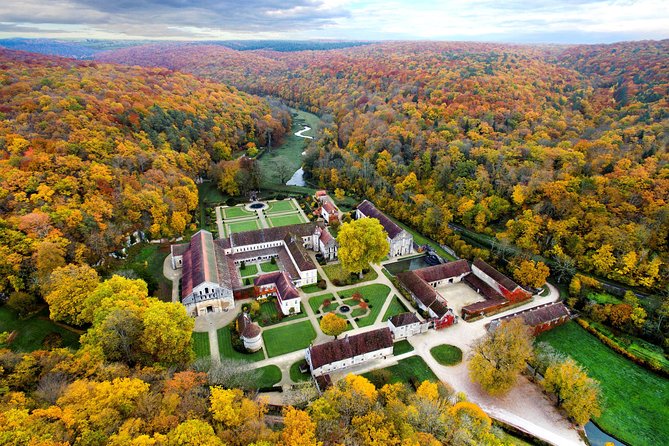
Fontenay Abbey gives you something rare in France: a preserved Cistercian complex where the Romanesque church, dormitory, cloister, and forge still form one quiet, complete setting. Founded by Saint Bernard of Clairvaux in 1118, it feels less like a single monument and more like an entire medieval world left in place.
I like the ticket’s simple value. At $13.91, it gives you access to the abbey, gardens, and lapidary museum, and the pre-booked paper ticket can make entry quick. I also like the chance to enjoy the site at a calm pace, especially in the church and dormitory, where silence is part of the experience. The main consideration is transport: this ticket gets you in, but it does not take you to the abbey or provide food, drinks, or a guide.
In This Review
- Key points to know
- Why Fontenay Abbey feels different from a standard monument
- The Abbey Church and the power of plain Romanesque design
- The dormitory shows the practical side of monastic life
- Cloister, chapter room, and common room
- The forge connects Fontenay with work and industry
- Gardens and the lapidary museum add variety
- What the $13.91 price really buys you
- Timing your visit around the opening hours
- Who will appreciate Fontenay most
- Practical details that can shape the visit
- Should you book the Fontenay Abbey ticket?
- FAQ
- What is included with the Fontenay Abbey ticket?
- How much does admission cost?
- How long should I allow for the visit?
- Is transportation to the abbey included?
- Are food and drinks included?
- What are the opening hours in winter?
- What are the opening hours from April through November?
- Can I cancel for a full refund?
Key points to know
- A preserved Cistercian complex: Fontenay is the oldest preserved Cistercian abbey in the world.
- Six major historic spaces: See the Abbey Church, dormitory, cloister, chapter room, common room, and forge.
- A private family heritage project: The same family has owned and cared for the abbey since 1820.
- Gardens included: Your admission covers the abbey grounds and the lapidary museum.
- A short, flexible visit: Plan on one to two hours, though the peaceful setting may encourage you to stay longer.
- Seasonal opening hours: Winter hours split the day into morning and afternoon sessions, while the warmer season runs continuously until 6 p.m.
Why Fontenay Abbey feels different from a standard monument
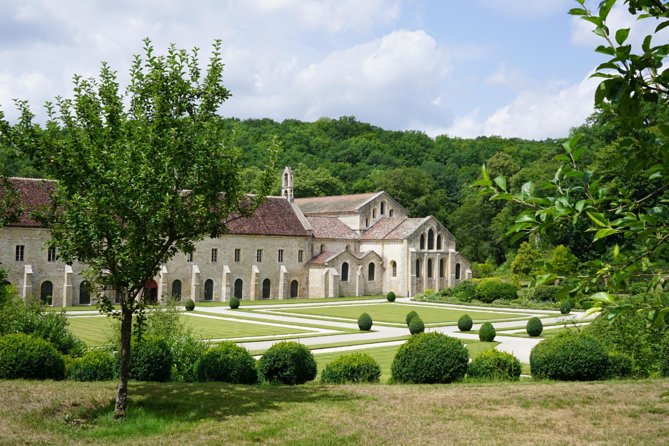
Many medieval abbeys survive as fragments. Fontenay gives you the bones of a working Cistercian community: places for worship, sleep, meetings, work, and daily life. That makes the visit easy to understand even if you arrive with only a basic grasp of monastic history.
Saint Bernard of Clairvaux founded the abbey in 1118. The Cistercians favored plain design, discipline, and a life separated from worldly distractions. You can see those values in the clean Romanesque lines and restrained decoration. The buildings do not depend on glittering art or grand theatrical effects. Their power comes from proportion, stone, light, and silence.
Fontenay was recognized as a French historic monument in 1862 and became a UNESCO World Heritage site in 1981. Those honors matter, but you do not need to study the formal designations to enjoy the place. The real reward is seeing an abbey where the main buildings still relate to each other as they once did.
The setting adds a great deal. The property occupies a preserved valley covering about 1,200 hectares in northern Burgundy. You are not simply stepping into a church in the middle of a modern town. The surrounding grounds help explain why monks chose this kind of remote location for prayer and work.
More Beaune trips worth a second look
- Versailles: Skip-the-Line Tour of Palace with Gardens Access
★ 4.7 · 9,778 reviews - Versailles: Skip-the-Line Guided Palace Tour and Full Access
★ 4.6 · 5,214 reviews - Louvre Museum: Skip-the-Line Small Group Guided Tour
★ 4.6 · 3,960 reviews
The Abbey Church and the power of plain Romanesque design
Begin with the Abbey Church. It is likely to be the emotional center of your visit, even if you know little about medieval architecture. The building’s restrained style gives you room to notice the shape of the space, the weight of the stone, and the way light enters the interior.
The church reflects the early Cistercian preference for simplicity. You will not find the crowded decoration associated with some later Gothic churches. Instead, Fontenay asks you to look closely at structure. The simplicity can feel severe at first, but after a few minutes it becomes calming.
This is one place where timing matters. The abbey welcomes large numbers of people over the course of a year, yet the buildings can feel wonderfully quiet at the right moment. If you arrive during a less busy period, you might have the church largely to yourself. That changes the experience. You hear the room rather than a stream of conversation, and the architecture has time to make its point.
There is no named guide included with this admission. You should think of the ticket as access rather than a formal guided visit. A passionate guide may sometimes be available through a separate visit arrangement, but that is not part of the stated admission package, so do not book this ticket expecting a scheduled commentary.
The dormitory shows the practical side of monastic life
The dormitory gives you a useful counterpoint to the church. Here, the abbey becomes less about worship and more about the daily rhythm of the community. Its scale helps you picture the monks living together under a shared rule.
The room is especially effective because it is not presented as an isolated museum object. It remains part of the larger abbey plan. After seeing the church, you can connect spiritual life with the ordinary pattern of sleeping, rising, working, and gathering.
The dormitory is also one of the spaces that benefits most from quiet. A German-speaking visitor described the church and dormitory as especially impressive when nearly empty, with the silence adding to the sense of contemplation. That is practical advice, not just poetic description: pause here instead of rushing through with your camera raised.
Allow yourself time to look up, across, and down the length of the room. The value is in the whole volume of the space. If you are visiting with children or anyone who prefers fast-moving attractions, this may feel slow. For anyone who enjoys old buildings and atmosphere, it is one of Fontenay’s strongest rooms.
Cloister, chapter room, and common room
The cloister links the main parts of the abbey and gives you the clearest sense of how the community functioned as a unit. Its covered walkways frame the central open area and create a natural pause between interiors.
Cloisters are often the place where a medieval complex becomes easiest to read. From here, you can understand the relationship between the church, living quarters, and work areas. Fontenay’s appeal is not based on one spectacular object. It comes from the way the parts fit together.
The chapter room was where the community gathered for important matters and readings. Its purpose makes the room feel more formal than a simple corridor, even when no activity is taking place. The common room offers another view of shared daily life, showing that the abbey was not only a place for private prayer.
You may find that the less famous rooms are just as rewarding as the church. They supply the human scale. The church explains the abbey’s spiritual purpose, while the chapter room and common room show how a community organized its life around that purpose.
A different way to spend the day, same corner of France:
- Burgundy Bike Tour with Wine Tasting from Beaune
★ 5.0 · 674 reviews - Beaune: Wine Tasting at Château de Pommard
★ 4.4 · 277 reviews - From Beaune: Burgundy Day Trip with 14 Wine Tastings
★ 4.8 · 248 reviews - Burgundy Grand Crus Route Day Tour – 14 Wines Tastings in Domains
★ 5.0 · 223 reviews
The forge connects Fontenay with work and industry
The forge is a particularly interesting part of the visit because it broadens the story beyond worship. Cistercian communities were connected to land, tools, water, farming, and skilled labor. The forge helps you remember that an abbey needed practical systems to survive.
After the French Revolution, the monks left Fontenay. The complex was then converted to industrial use. That change could have destroyed the medieval buildings, but the industrial period helped preserve the Romanesque structures, including the church, dormitory, cloister, chapter room, common room, and forge.
This later chapter gives Fontenay unusual depth. You are not seeing a site frozen in one moment. You are seeing a medieval religious foundation that passed through revolution, industrial use, private ownership, and modern heritage care.
The forge may appeal most to visitors who want more than a beautiful church. It shows the working side of the estate and helps explain how the abbey’s buildings survived. Give it proper attention instead of treating it as an extra room at the end.
Gardens and the lapidary museum add variety
Admission includes the gardens and lapidary museum. That matters because the visit is not limited to enclosed stone rooms. The gardens give you a chance to change pace, breathe, and see the abbey with its natural setting around it.
The garden was recognized as a Remarkable Garden by France’s National Council of Parks and Gardens in 2004. You should not expect a modern botanical attraction based on the information available. The appeal is the relationship between maintained grounds, old buildings, and the valley surrounding the property.
The gardens are a good reason to avoid scheduling Fontenay too tightly. The core architecture can be seen in about an hour, but the grounds may tempt you to stay longer. If you are planning a packed day in Burgundy, allow the full one to two hours rather than treating the abbey as a quick photo stop.
The lapidary museum adds another indoor element and gives you more to see if weather affects your time outside. Since both the gardens and museum are included, the ticket offers more than entry to the church alone.
What the $13.91 price really buys you
At $13.91 per person, this is a fairly easy admission fee to justify if you are interested in medieval architecture, religious history, gardens, or quiet places. You are paying for access to a large, preserved estate rather than a single room or viewing platform.
The price is strongest for visitors who take their time. If you rush in, photograph the church, and leave after 30 minutes, the value is less convincing. If you explore the main buildings, pause in the cloister, visit the forge and museum, and walk through the gardens, the fee feels more balanced.
The ticket does not include transportation, food, or drinks. That is important because the abbey is in a rural valley rather than a central Beaune street. You need to arrange your own way there and plan refreshments separately.
A paper ticket is provided, and pre-booking is intended to make admission more direct. The stated maximum for the activity is 15 people, though this is an admission arrangement rather than a guided group with a named leader. You should still think of the experience as independent sightseeing.
Timing your visit around the opening hours
From November 12, 2025, through March 31, 2026, the abbey opens daily from 10 a.m. to noon and from 2 p.m. to 5 p.m. That midday closure affects your planning. Do not arrive expecting continuous access between noon and 2 p.m.
From April 1 through November 11, 2026, the abbey is open daily from 10 a.m. to 6 p.m. The longer hours make it easier to fit Fontenay into a Burgundy day trip, especially if you want time for both the interiors and the gardens.
A morning arrival can give you a quieter visit, though no specific crowd level is guaranteed. The key point is to avoid squeezing the abbey between two fixed appointments. Its atmosphere rewards a slower pace, and the split winter hours require extra care.
The experience lasts about one to two hours. That estimate works well for a focused visit, but you might stay longer if you spend time outdoors or read closely about the buildings.
Who will appreciate Fontenay most
I would recommend this admission to you if you enjoy:
- Romanesque architecture and medieval buildings
- Religious history without a heavily theatrical presentation
- Quiet places where atmosphere matters as much as objects
- Gardens and rural settings
- Heritage sites preserved by long-term private care
- Independent sightseeing at your own pace
It is also a good choice for visitors based in Beaune who want a calmer counterpoint to busy wine towns and major city monuments. The abbey offers a different side of Burgundy, one shaped by stone, prayer, work, and open countryside.
You may want to reconsider if you need a guided explanation at every stop. The ticket itself does not include a guide, and English is listed as the language offered, but no specific English-speaking guide or tour schedule is provided. If historical interpretation is your main goal, check carefully what explanatory material is available before booking.
The site may also feel too quiet if you prefer interactive displays, lively demonstrations, or a fast succession of attractions. Fontenay asks you to observe rather than be entertained.
Practical details that can shape the visit
Confirmation is received at booking, and free cancellation is available until 24 hours before the experience start time. If you cancel less than 24 hours ahead, you do not receive a refund, and changes inside that same period are not accepted.
The abbey is near public transportation, according to the stated details, but transportation to and from the attraction is not included. You should treat the journey as your own responsibility and allow enough time for the rural setting.
Most people can take part. No special participation restriction is listed, but the information provided does not give detailed accessibility notes for every historic room or garden area. If you have specific mobility needs, confirm those details before booking.
The provider is Abbaye de Fontenay. The ticket is offered in English, but remember that this describes the booking option, not a promise of a live English-language guide.
Should you book the Fontenay Abbey ticket?
Book it if you want a peaceful, well-preserved medieval complex and you are happy to explore without a scheduled guide. The strongest parts are the church, dormitory, cloister, and the way the forge and gardens expand the story beyond religious architecture.
The $13.91 cost is sensible when you use the full admission: historic buildings, gardens, and lapidary museum. Plan one to two hours, check the seasonal opening schedule, and arrange transport and refreshments in advance.
Skip it only if your itinerary has no room for a quiet rural stop or if you need a guided tour included in the price. For everyone else, Fontenay offers a rare chance to experience a complete Cistercian abbey with its sense of order and silence still intact.
FAQ
What is included with the Fontenay Abbey ticket?
Admission to the Abbey of Fontenay is included, along with access to its gardens and lapidary museum.
How much does admission cost?
The listed price is $13.91 per person.
How long should I allow for the visit?
The visit takes approximately one to two hours.
Is transportation to the abbey included?
No. Transportation to and from the attraction is not included.
Are food and drinks included?
No. Food and drinks are not included with admission.
What are the opening hours in winter?
From November 12, 2025, through March 31, 2026, the abbey is open daily from 10 a.m. to noon and from 2 p.m. to 5 p.m.
What are the opening hours from April through November?
From April 1 through November 11, 2026, the abbey is open daily from 10 a.m. to 6 p.m.
Can I cancel for a full refund?
Yes. You can cancel for a full refund up to 24 hours before the experience start time. Cancellations or changes made less than 24 hours before the start time are not accepted for a refund.
Recently reviewed around Beaune
- Private Wine Tasting Tour – Burgundy Uncorked!!★ 5.0 · 74 reviews
- Visit of our 15th century cellars★ 5.0 · 57 reviews
- Private Tasting in Beaune : The Best of Burgundy Wines★ 5.0 · 66 reviews
- Discovery of the world of Truffles and tasting★ 4.5 · 66 reviews
- Private excursion to Côte de Beaune and Côte de Nuits (full day)★ 5.0 · 166 reviews
- Visit-Tasting-Sale★ 5.0 · 87 reviews
- Luxury Luxury Wine Tour Experience★ 5.0 · 69 reviews
- From Beaune: Full day the most of Burgundy, with lunch★ 4.5 · 30 reviews
Burgundy Tours, compared.
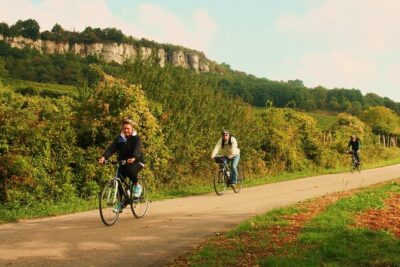
Burgundy Bike Tour with Wine Tasting from Beaune
Read our review →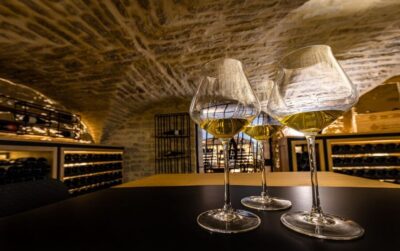
La Cave du Palais Burgundy Wine Tasting Experience
Read our review →
Small-Group Full-Day Tour of Côte de Nuits, Côte de Beaune Vineyards and Beaune Historical District
Read our review →
Burgundy Grand Crus Route Day Tour – 14 Wines Tastings in Domains
Read our review →
Maison Champy Guided Cellar Tour with Wine Tasting
Read our review →
Private excursion to Côte de Beaune and Côte de Nuits (full day)
Read our review →Browse the lists this tour appears in