
Reviewed · CHAMPAGNE TOURS
The Must-sees 3h30 from Epernay (Private Half day Champagne Tour)
The most memorable part of this half-day tour is the shift from grand Champagne names to small family growers. You begin among the imposing houses of Epernay, then visit the church where Dom Pérignon is buried and taste Champagne in the vineyards where the story took shape.
I like the private format, which lets your guide adjust the pace and answer your questions without a busload of strangers. I also like the mix of three Champagnes with Ratafia, Fine de la Marne, and Marc de Champagne. The main drawback is simple: if you want several producer visits and lots of Champagne, this three-and-a-half-hour tour may feel too short.
In This Review
- Key points to know before booking
- Why this private Epernay tour works so well
- Avenue de Champagne: Epernay’s grand opening
- Hautvillers and the real Dom Pérignon story
- The Hautvillers viewpoint and the family cellar
- Aÿ-Champagne and the old center of the trade
- Mareuil-sur-Aÿ and the Mont du Gruguet view
- Mutigny and the small villages between the big names
- Guides, vehicles, and the private format
- How much Champagne do you actually taste?
- Who should book this tour?
- Should you book this Epernay Champagne tour?
- FAQ
- How long does the private Champagne tour last?
- Where does pickup take place?
- Is the tour conducted in English?
- Is this a private tour?
- What Champagne tastings are included?
- Are other drinks included?
- Will the family producer visit always be in Hautvillers?
- What vehicles are used?
- Can I cancel for a full refund?
Key points to know before booking
- Avenue de Champagne: See Epernay’s grand mansions and famous Champagne houses above miles of underground cellars.
- Dom Pérignon’s resting place: Visit the church in Hautvillers and hear the real story behind the monk’s role in Champagne.
- Family grower visit: Tour a press, winery, and cellar, then taste three Grand Cru or Premier Cru Champagnes.
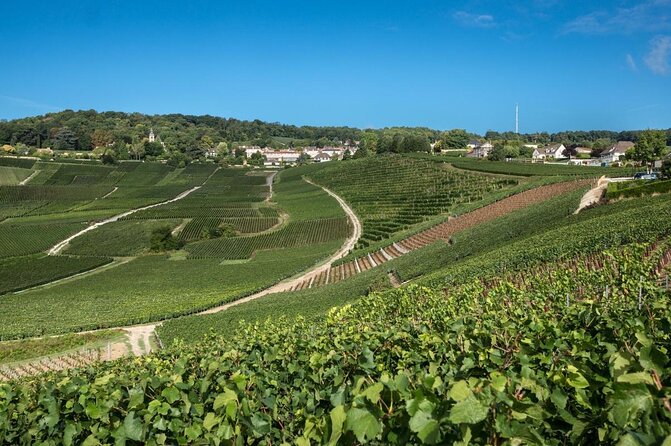
- UNESCO vineyard views: Stop at Hautvillers and Mont du Gruguet for wide views over the Marne Valley and Côte des Blancs.
- Local spirits: Taste Ratafia, Fine de la Marne, and Marc de Champagne from the historic Goyard Distillery.
- Flexible private guiding: Guides including Philippe, Lucie, Nina, Victoria, Charlotte, and Svetlana have led this route.
Why this private Epernay tour works so well
Champagne can be hard to grasp from a tasting room alone. You need the grand houses, the villages, the chalky hills, the vines, and the people who still make wine on a smaller scale. This tour ties those pieces together in a compact outing from Epernay.
You are not simply driven from one tasting to another. Your guide explains why Epernay became the center of the region, how the villages differ, and why Pinot Noir and Chardonnay matter here. You also get a close look at Champagne production through an independent grower rather than only through a famous international brand.
That balance is the tour’s strongest feature. You get polished history on the Avenue de Champagne, religious and local history in Hautvillers, vineyard views around Aÿ-Champagne and Mareuil-sur-Aÿ, and a personal look at production in a family cellar.
The tour costs about $293.14 per person, so it is not a budget outing. Its value depends on what you want. For a private group seeking a well-organized introduction to the area, the price covers a guide, transport, several scenic stops, a producer visit, Champagne tastings, and local spirits. If your main aim is to visit two or three Champagne houses and maximize the number of pours, another tour would suit you better.
More Epernay trips worth a second look
- From Reims: Champagne and Family-Run Wineries Tour
★ 4.8 · 671 reviews - The Essential Tour from Epernay with Champagne Tasting
★ 4.9 · 120 reviews - Champagne experience with a vintage van from Epernay – 3 hours
★ 5.0 · 108 reviews
Avenue de Champagne: Epernay’s grand opening
The tour begins with a commented passage along the Avenue de Champagne, Epernay’s best-known street. This is where the region’s grand houses put their wealth on display, with impressive mansions and production buildings linked to names such as Moët & Chandon, Perrier Jouët, and Pol Roger.
The road is famous for what lies below it as much as for what you see above ground. About 100 kilometers of cellars run beneath the avenue, holding an estimated 200 million bottles. Your guide puts those figures into context and explains how the Champagne houses shaped Epernay over the centuries.
This stop is more than a quick photo drive. The buildings show how Champagne became a global luxury product, while the later village visits show how much of the work still happens beyond these famous doors. That contrast gives you a useful frame for the rest of the afternoon.
Do not expect a full cellar tour at one of the major houses as part of this program. The avenue visit is a narrated introduction, not a large-house tasting. If you want to tour Moët & Chandon or another major producer inside, you would need to arrange that separately or choose a different excursion.
Hautvillers and the real Dom Pérignon story
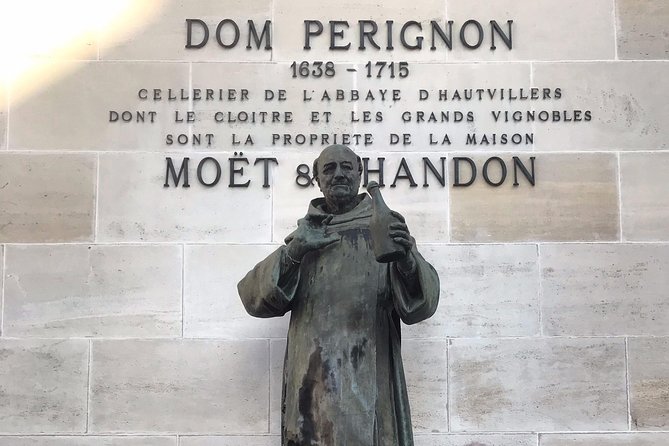
From Epernay, the route continues to Hautvillers, often called the Cradle of Champagne. The village is closely linked with Dom Pérignon, the Benedictine monk associated with important developments in Champagne wine.
Inside Abbaye Saint-Pierre d’Hautvillers, you visit the church and see Dom Pérignon’s grave. The guide explains his work and addresses the familiar question: did he actually invent Champagne?
That question matters because the popular story is much simpler than the truth. The visit gives you room to understand Dom Pérignon as a major figure in the development of wine production, rather than accepting the neat but misleading idea that one person suddenly created the drink we know today.
The church stop lasts about 30 minutes and has no separate admission charge. It is a small, focused visit, not an extended abbey tour. That suits the half-day schedule, though anyone hoping for a long religious or architectural visit may find it brief.
Hautvillers also gives you a sense of place. The village sits above the Marne Valley, surrounded by the historic Champagne hillsides. The setting helps explain why the area is so important: the views connect the person, the vines, and the wine in one stop.
The Hautvillers viewpoint and the family cellar
One of the best parts of the route is the stop in the vineyards above Hautvillers. From here, you look across the Marne Valley and the hillsides where Dom Pérignon carried out his winemaking experiments.
Bring your camera, but give yourself time to listen. The view is not just scenery between tastings. Your guide explains the vineyards, the local terrain, and the place of Hautvillers in Champagne’s story. This is where the region begins to feel like a working wine area rather than a collection of brand names.
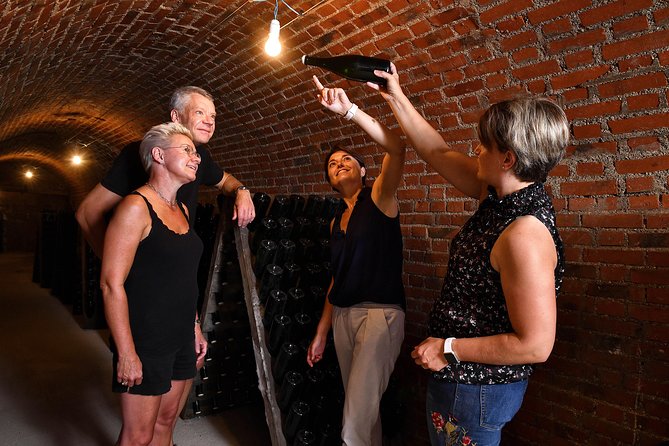
The family producer visit adds the human touch. You visit an independent grower and learn how Champagne is made through the practical parts of production: the press, winery, and cellar. The guide or producer explains the process as you move through the spaces, so you can connect the bottle in your hand with the grapes and equipment behind it.
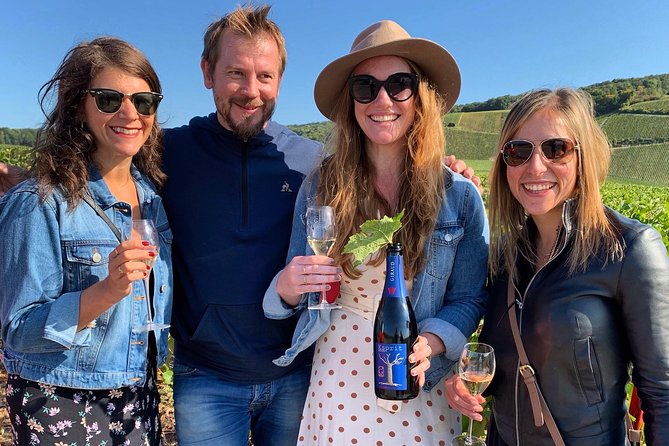
You then taste three Champagnes, generally Grand Cru or Premier Cru, depending on the season and availability. The tasting is commented, so you are not left to guess what distinguishes the wines. You can ask questions about grape varieties, production, and the character of the different bottles.
This is the part I would value most if you have already seen a large Champagne house. A small grower visit feels more personal and gives you a better sense of how families work with their vineyards and cellar space. Past guides such as Charlotte, Lucie, Nina, and Svetlana have been praised for making technical subjects easy to follow.
There is one important qualification. The grower visit and tasting may move to a village in the Côte des Blancs or to Aÿ-Champagne, depending on the season and availability. The core idea remains the same, but the exact producer and village are not fixed.
A different way to spend the day, same corner of France:
- From Epernay : Bubble Champagne Tour 6 tastings
★ 4.7 · 108 reviews - From Epernay: Champagne Small-Group tour with tastings & Lunch
★ 5.0 · 93 reviews - Discovery tour (2 tastings)
★ 5.0 · 77 reviews - The Connoisseurs from Epernay (Private Half day Champagne Tour)
★ 5.0 · 59 reviews
Aÿ-Champagne and the old center of the trade
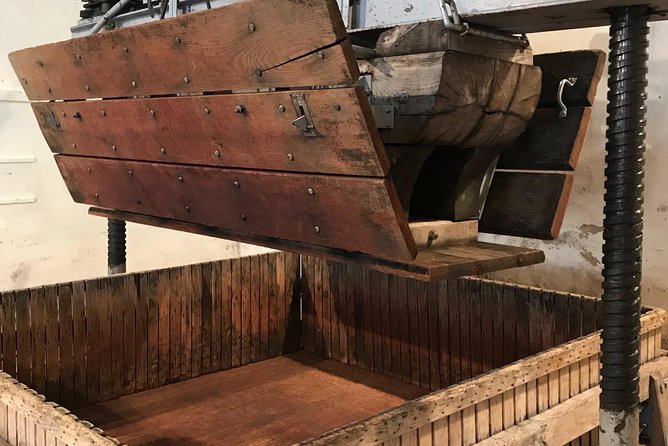
The route continues through Aÿ-Champagne, one of the region’s most important wine villages. Its hillsides are UNESCO-listed, and its vineyards are known mainly for Pinot Noir.
Aÿ held a special place in the Champagne trade as far back as the 16th century. French kings had their own presses here, and Champagne wines were once called Wines of Aÿ. Your guide brings this history to life while pointing out the village, the vines, and the headquarters of famous houses including Bollinger, Deutz, and Ayala.
The stop is useful because it shows you the difference between Champagne as a historic wine region and Champagne as a modern luxury industry. In Aÿ, those two identities sit close together. Family vineyards and major producers share the same hillsides.
You also hear about vine work, grape varieties, the local terroir, and sustainable viticulture. The word terroir can sound vague when used in a tasting room, but here it connects to actual hills, soils, slopes, and vineyard practices. You see where the grapes grow before you taste the finished wine.
Aÿ is also where the tour broadens beyond Champagne itself. You taste three traditional local alcohols and aperitifs:
- Ratafia, a sweet wine-based aperitif
- Fine de la Marne, a regional grape spirit
- Marc de Champagne, made from grape pomace
These come from Goyard Distillery, described as the oldest distillery in Champagne. The tasting gives you a wider view of local drinking traditions, though it also means part of your tasting time goes to spirits rather than more Champagne.
Mareuil-sur-Aÿ and the Mont du Gruguet view
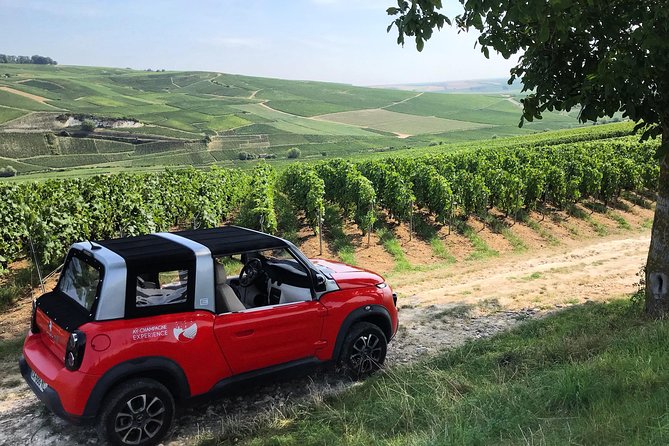
The next stop is Mareuil-sur-Aÿ, a Premier Cru village in the Marne Valley. Its historic hillsides are also UNESCO-listed, and Pinot Noir is the main planting here.
This village is associated with smaller, less widely known Champagne houses, including Billecart-Salmon and Philipponnat. You may not enter those houses, but seeing their home territory adds useful context to the bottles and brands you may encounter elsewhere.
At the Mont du Gruguet viewpoint, you get one of the route’s broadest views. From this high point, you can see toward the Côte des Blancs, the area strongly linked with Grand Cru Chardonnay, as well as the villages and vineyards of the Marne Valley.
The view is especially valuable after the earlier explanations of grape varieties and production. By now, you can see that Champagne is not one uniform wine area. Different villages, slopes, and plantings shape the character and reputation of the wines.
This stop lasts about 30 minutes. That is enough for photos and a short explanation, but weather matters. The activity requires good weather, and poor conditions can lead to a different date or a full refund. Even on a clear day, dress for time outdoors among the vines.
Mutigny and the small villages between the big names
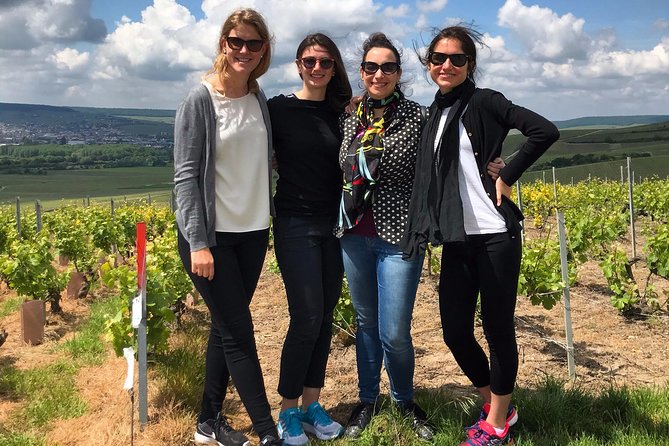
The vehicle also crosses Mutigny, a small wine-growing village above Aÿ-Champagne. An early 16th-century church overlooks the vines, adding another quiet detail to the drive.
Mutigny is not presented as a major stand-alone visit. Its value is in the passing view and the sense of how closely the villages are tied to the vineyards. The route does not keep you only on Epernay’s famous avenue. It takes you into the smaller places that give the region its character.
That is an important reason to choose this outing over a simple town tasting. You see the names on the bottles in their local setting, with the vineyards and village churches nearby.
Guides, vehicles, and the private format
The guide is a major part of the day. Named guides connected with this experience include Philippe, Nina, Victoria, Lucie, Svetlana, Isabella, Carolin, and Charlotte. Their roles vary by departure, but the strongest praise centers on clear explanations, patience, and the ability to answer detailed questions about grapes and winemaking.
A private group also makes the outing easier to shape around your interests. You can ask more questions, spend a little longer at a viewpoint, or keep the conversation focused on history, production, or tasting. The exact flexibility will depend on timing, weather, and the day’s arrangements, but you are not sharing the guide with a large coach group.
Pickup is available within about 6 kilometers, or 3.7 miles, of Epernay. Reims is outside that area and about a 40-minute drive away, so you would need to reach Epernay by taxi, car, or train. Confirm your pickup address before booking.
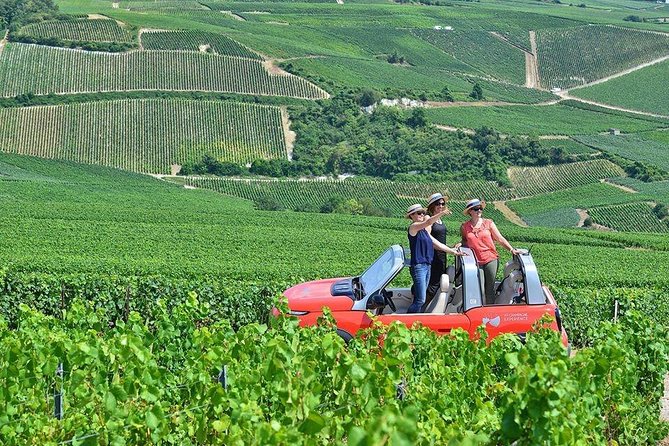
The vehicle depends on the weather, season, and group size. Options include an electric E-Mehari Jeep-style car, a premium van, and minivans. The red electric E-Mehari vehicles are slightly raised, so tell the operator in advance if getting into a higher vehicle may be difficult.
The activity lasts about three and a half hours and ends at the meeting point. Most people can take part, and the location is near public transport, but the tour includes outdoor viewpoints and a church visit, so comfortable shoes and weather-ready clothing make sense.
How much Champagne do you actually taste?
The answer depends on what you count. At the family producer, you taste three Champagnes, generally Grand Cru or Premier Cru. You also taste Ratafia, Fine de la Marne, and Marc de Champagne.
For many people, that is a good range for a half-day tour. You get enough wine to compare styles and enough local spirits to understand another side of the region. The focus is also on the making of Champagne and the vineyards, not just on drinking.
Still, one person found four hours and one producer tasting light on Champagne. That is a fair concern if your priority is a string of cellar visits and generous pours. The operator offers another tour called The Connoisseurs, with two producers and more tastings, which is the better choice for serious tasting.
I would choose this tour for place, history, and personal contact, not for the highest possible number of glasses. The family cellar, scenic stops, and village explanations are the point.
Who should book this tour?
I would recommend it to first-time visitors who want a clear introduction to the Champagne region in a single morning or afternoon. It suits couples, families, and private groups who value a personal guide and do not want to manage several rural appointments themselves.
It is also a strong choice for anyone interested in the story behind the wine. Dom Pérignon’s church, the grand houses of Epernay, Aÿ’s old importance, and the independent producer visit give you a useful sequence of ideas.
The tour may be less suitable if you want a long cellar walk, several major Champagne houses, or a full-day wine program. It is also not the right fit if your accommodation is in Reims and you expect pickup there. You must make your way to Epernay.
Free cancellation is available up to 24 hours before the start time for a full refund. Changes or cancellations inside that window are not accepted, and the weather policy allows a new date or full refund if conditions force cancellation.
Should you book this Epernay Champagne tour?
Book it if you want the best all-around introduction to Epernay and its surrounding villages rather than a tasting marathon. The route covers the Avenue de Champagne, Dom Pérignon, UNESCO-listed vineyard views, Aÿ, Mareuil-sur-Aÿ, and a family grower in only three and a half hours.
At $293.14 per person, it asks you to pay for private transport, a guide, planning, and access to a more personal producer visit. That is fair value for a private group that wants the region explained clearly and efficiently.
Skip it in favor of a longer producer-focused tour if extra Champagne tastings matter more to you than scenery and history. For everyone else, this is a well-shaped half-day that lets you see how Champagne is made, where it comes from, and why Epernay remains its natural starting point.
FAQ
How long does the private Champagne tour last?
The tour lasts approximately 3 hours and 30 minutes and ends back at the meeting point.
Where does pickup take place?
Pickup is available within a 6-kilometer, or 3.7-mile, area around Epernay. Reims is outside the pickup zone, so you need to reach Epernay by taxi, car, or train.
Is the tour conducted in English?
Yes. The experience is offered in English.
Is this a private tour?
Yes. Only your group participates in the private activity.
What Champagne tastings are included?
You taste three different Champagnes during the family producer visit. They are Grand Cru or Premier Cru, depending on the season and availability.
Are other drinks included?
Yes. You taste Ratafia, Fine de la Marne, and Marc de Champagne from the Goyard Distillery.
Will the family producer visit always be in Hautvillers?
Not always. Depending on the season and availability, the visit and tasting may take place in a village of the Côte des Blancs or in Aÿ-Champagne.
What vehicles are used?
The operator may use an electric E-Mehari Jeep-style car, a premium van, or a minivan, depending on weather, season, and group size.
Can I cancel for a full refund?
Yes. You can cancel at least 24 hours before the start time for a full refund. If poor weather causes the operator to cancel the activity, you will be offered another date or a full refund.
Recently reviewed around Epernay
- Champagne experience with a vintage van from Epernay – 3 hours★ 5.0 · 108 reviews
- Food & Champagne Experience from Epernay (Private tour)★ 4.5 · 28 reviews
- Bubble Champagne Tour from Epernay (Small group half day tour)★ 5.0 · 58 reviews
- The Connoisseurs from Epernay (Private Half day Champagne Tour)★ 5.0 · 59 reviews
- From Epernay Full day Electric bike Champagne and lunch★ 5.0 · 36 reviews
- From Epernay: Champagne Small-Group tour with tastings & Lunch★ 5.0 · 93 reviews
- Champagne Munoz Bruneau : Half Day Visit and Tasting★ 5.0 · 50 reviews
- Discovery tour (2 tastings)★ 5.0 · 77 reviews
Champagne Tours, compared.
Reims afternoon tour Champagne and family growers
Read our review →
Aÿ-Champagne: Pressoria Champagne Museum with Tasting
Read our review →
Aÿ-Champagne: Champagne House Tour and Tasting Class
Read our review →
Passy-Grigny: Chocolate and Champagne Tasting Tour
Read our review →
Champagne Day Trip to 3 Family Domains & Lunch
Read our review →Browse the lists this tour appears in