
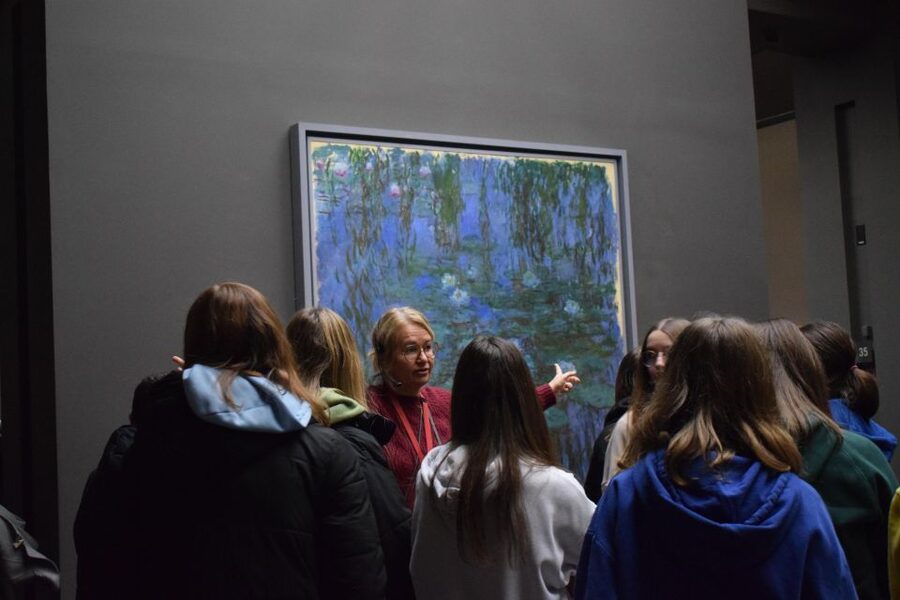
Reviewed · ORSAY MUSEUM TOURS
Paris: Best of Orsay Museum Small Group Tour with Tickets
The best thing about this Musée d’Orsay tour is its clear story. You begin with the old railway station, then follow the jump from strict academic painting to Manet, Monet, Renoir, Degas, Van Gogh, Cézanne, and the artists who pushed painting toward modern art. I like the small groups, often as few as three to six people, and the way guides such as Olga, Blerta, Vanina, Marine, and Patrick connect paintings to social and political change.
I also like that your ticket gets you to the collections quickly, saving precious Paris time when the museum is crowded. The main drawback is the museum itself: busy rooms, heat, and crowd noise can make it hard to hear or get close to every painting. This is a fast-paced highlights tour, not a quiet afternoon spent studying each gallery.
In This Review
- Key points to know before booking
- Why Musée d’Orsay works so well with a guide
- Meeting the guide outside the elephant statue
- The former railway station sets the stage
- From Realism to Manet and the Impressionists
- Van Gogh, Cézanne, Gauguin, and the road to modern art
- Sculpture, Art Nouveau, and a different side of Orsay
- What two hours feels like inside the museum
- Is the $102 price good value?
- Who should book this Orsay tour?
- My verdict: book it for context, not just access
- FAQ
- Where does the Musée d’Orsay tour meet?
- How long does the tour last?
- What languages are available?
- Does the ticket skip the entire entrance line?
- What identification should I bring?
- Can I bring luggage or a backpack?
- Is the tour suitable for wheelchair users?
Key points to know before booking

- Two hours of focused art history: Follow a clear path from Realism and Manet to Impressionism, Post-Impressionism, Art Nouveau, and early modern art.
- Small groups make a real difference: A group of about six is easier to hear, easier to keep together, and better for questions than a large museum walk.
- Meet by the elephant statue: Find the guide in front of Musée d’Orsay at 1 Rue de la Légion d’Honneur, holding a Connecting France sign.
- Major names, useful context: Expect Monet, Renoir, Degas, Van Gogh, Cézanne, Gauguin, Matisse, Rodin, Sisley, Pissarro, and Manet.
- Entry is quicker, not completely line-free: Your ticket helps with access to the collections, but everyone must pass through museum security.
- Best for able walkers: Shared tours cannot slow their pace for mobility needs, and the experience is not suitable for wheelchair users.
Why Musée d’Orsay works so well with a guide
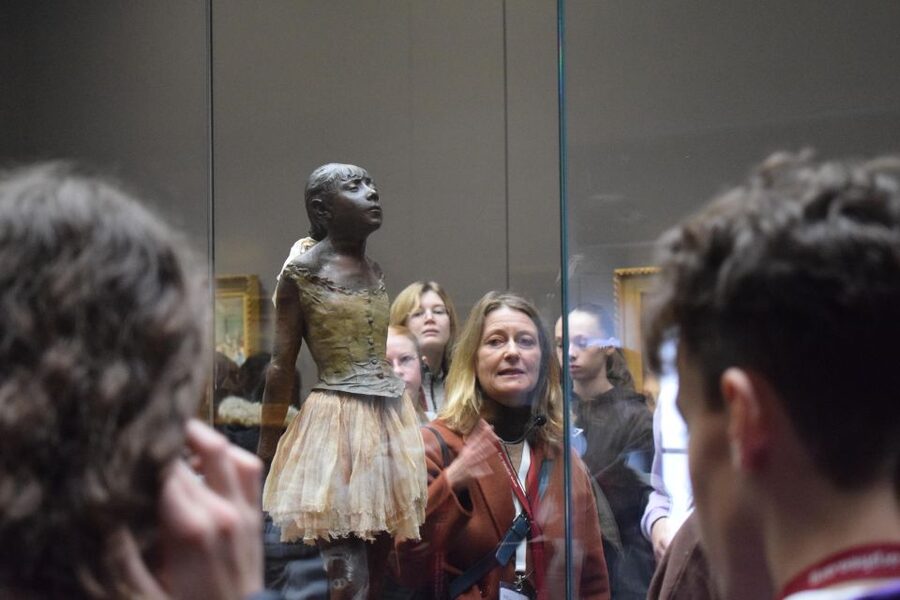
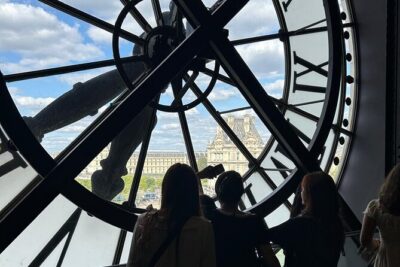
Musée d’Orsay can feel manageable at first. The building is smaller and more inviting than the Louvre, and its clock windows and former railway design give it an immediate sense of place. Then you see the crowds, the long list of famous artists, and the many rooms filled with paintings that deserve your attention.
A guide gives you a route and a reason to care about what you are seeing. Instead of treating the museum as a parade of famous names, the tour explains how one movement reacted to another. You learn why Realist painters challenged official taste, how Manet opened doors for the Impressionists, and why artists began to reject polished studio scenes in favor of modern life, changing light, and visible brushwork.
That context matters. Without it, a Monet can look merely pretty, and a Van Gogh can seem famous simply because it is famous. With a good explanation, you can see the choices behind the paint, the arguments with earlier art, and the social changes reflected in the work.
The guides are the strongest part of the experience. Olga is especially good at linking the practical and political pressures facing artists to the paintings in front of you. Vanina builds a useful path through the periods and brings attention to artists who are often skipped, including Berthe Morisot. Blerta combines art-historical detail with the viewpoint of a working artist, while Marine is good at pointing out symbols and small clues in a painting.
Guides vary, of course, but the tour has a strong pattern: clear explanations, personal enthusiasm, and a willingness to answer questions. Some guides use an iPad to show extra information. That can help when a detail is too small to see or when you need a quick comparison with another work.
More Paris museums and collections:
- Paris: Louvre Museum Timed-Entrance Ticket
★ 4.6 · 71,977 reviews - Louvre Museum Masterpieces Guided Tour with Access
★ 4.5 · 12,023 reviews - Paris: Louvre Museum Entry Ticket With Host and River Cruise
★ 4.6 · 9,926 reviews
Meeting the guide outside the elephant statue
Your starting point is in front of the museum at 1 Rue de la Légion d’Honneur. Look for the large elephant statue and a guide holding a Connecting France sign.
Allow enough time to find the meeting point. The statue is a useful landmark, but the area around a major Paris museum can be busy and confusing, especially if you are arriving by taxi or walking from the river. Your tour begins outside, so do not head straight into the museum entrance and expect to find the group inside.
Bring your passport or another identity card. Museum tickets are personal, and anyone aged 17 or younger needs a photo ID. Large bags, backpacks, luggage, and umbrellas are not allowed, so pack lightly. This is good advice for Paris museums in general: a small purse or compact day bag is much easier than a full sightseeing pack.
The former railway station sets the stage
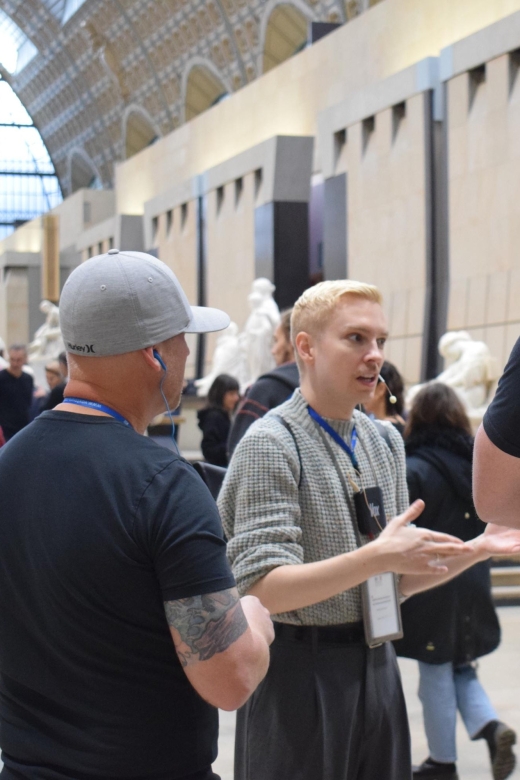
The first stop is not just a quick architectural glance. Your guide explains how the Orsay railway station became a fine-arts museum several decades later. That change gives the building an unusual role in the tour, because the structure itself belongs to the same era of rapid change that shaped the art inside.
Look up and around as you enter. The station setting helps you picture a Paris being reshaped by industry, new transport, expanding city life, and changing public taste. The museum is not a neutral box built only to display art. Its large scale and historic design make the setting part of the experience.
This introduction is especially useful if you are new to 19th-century art. Guides often begin with the academic rules that once governed serious painting, then explain why Realist artists such as Manet caused trouble. That groundwork makes the later Impressionist rooms easier to understand.
The pace here is sensible. You get enough building history to see the museum differently, but the tour does not spend two hours talking about the station while the paintings wait upstairs.
From Realism to Manet and the Impressionists
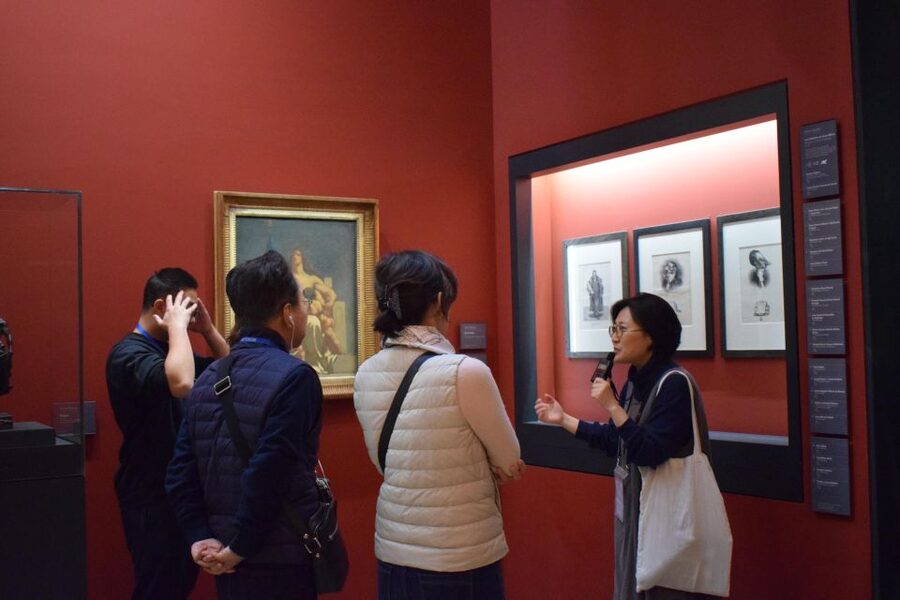
The tour generally builds its story in order, beginning with Realism and the artists who challenged established standards. Manet is an important bridge. He did not simply arrive as a finished Impressionist. His work helped make room for the younger artists who wanted to paint modern people, contemporary leisure, and everyday scenes with a less polished surface.
From there, the guide introduces artists such as Degas, Pissarro, Renoir, Monet, and Sisley. You will hear about the shared ideas that connect them, but also about their different methods. That distinction keeps the tour from flattening all Impressionist art into one style.
Renoir’s Dance at Le Moulin de la Galette is one of the major highlights. The painting rewards a closer look at movement, light, and the crowded pleasure of an afternoon dance. A guide can help you notice how the scene feels alive without presenting every figure as a sharply outlined portrait.
Monet’s paintings offer another lesson in changing light and repeated observation. The point is not simply to admire color. You learn to look at the brushwork and ask how the artist created an impression of weather, time, air, or movement.
Degas gives you a different angle, with interest in bodies, performance, rehearsal, and unexpected viewpoints. Pissarro and Sisley help widen the story beyond the most famous museum names. A good guide keeps returning to the question of how each artist responded to the others.
Crowds can be a problem in these rooms. You may not get a clear view at first, and the sound of nearby groups can compete with your guide. A small group helps, since your guide can position six people more easily than a large crowd and bring you close to the most important works.
More Paris trips worth a second look
- Disneyland® Paris 1-Day Ticket
★ 4.6 · 49,412 reviews - Paris: Versailles Palace and Gardens Full Access Ticket
★ 4.6 · 41,579 reviews - Paris: Eiffel Tower Entry Ticket with Optional Summit Access
★ 4.4 · 20,035 reviews - Paris: Moulin Rouge Cabaret Show Ticket with Champagne
★ 4.7 · 16,088 reviews
Van Gogh, Cézanne, Gauguin, and the road to modern art
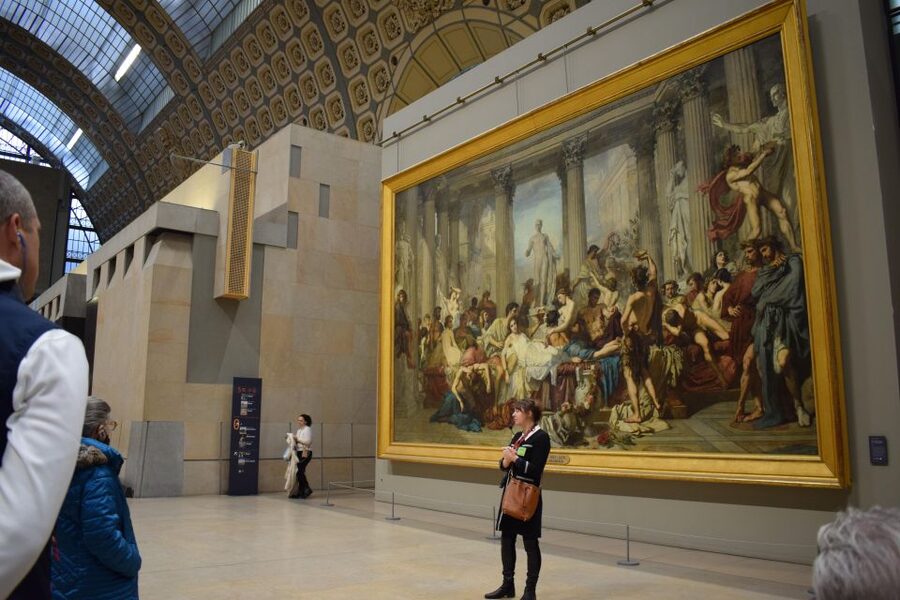
The later part of the tour moves toward Post-Impressionism and artists who took Impressionist ideas in new directions. Expect works connected with Cézanne, Van Gogh, Gauguin, and Matisse, along with explanations of how artists moved from recording visual impressions toward stronger structure, emotion, symbolism, and personal expression.
Van Gogh is often the name many people are waiting for, but the surrounding story matters. His work makes more sense when you have already seen the Impressionist interest in light and color, then understand how he pushed those tools toward a more personal and forceful style.
Cézanne is useful for seeing how a painter could break apart the appearance of a scene while still thinking carefully about shape and structure. Gauguin opens another discussion about symbolism and artistic escape, while Matisse points toward the freer color and form of modern art.
Your guide may also discuss the influence of political and artistic movements on one another. That is one of the tour’s most useful features. You are not asked to memorize dates and labels. You are shown how changes in Parisian life, official taste, public debate, and new ideas about artists affected what appeared on the canvas.
The route can move quickly here. Two hours is enough for a strong overview, but not enough to examine every important painting in the museum. If you already have favorite works, tell your guide early. Some guides, including Emily and Max, have been praised for shaping the visit around the interests of a small group when time and crowd conditions allow.
Sculpture, Art Nouveau, and a different side of Orsay
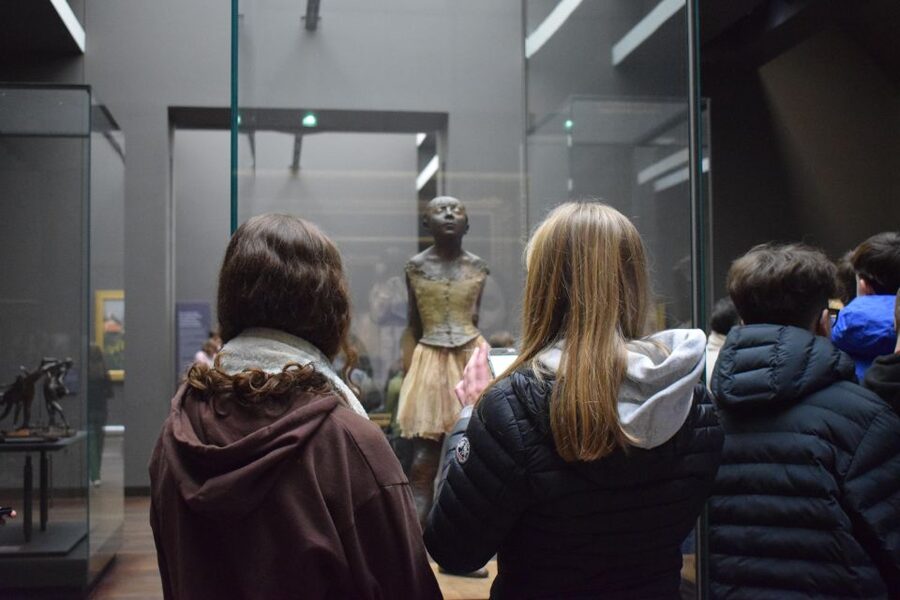
The tour is not limited to paintings. You may also see Art Nouveau features, sculptures by Rodin, and an original Lady Liberty. These additions help show that the museum covers more than the familiar Impressionist postcard images.
Rodin is worth attention because sculpture raises many of the same questions about movement, surface, and unfinished appearance that modern painters explored in two dimensions. Your guide can also point out architectural details that are easy to miss when you are rushing from one famous canvas to the next.
The Art Nouveau material adds another layer. Its curving forms and decorative approach show how the period’s artistic changes reached into design and public spaces, not just easel painting.
Do not expect a full survey of every sculpture or decorative-art room. The tour is built around the museum’s best-known highlights and the connections between them. That is a strength for a first visit, but repeat visitors may want extra time afterward to explore beyond the guided route.
Several tour groups have been allowed to remain in the museum after the formal two-hour visit and look around independently. Treat that as a useful possibility, not a guaranteed extension. The included service is the guided museum tour, and the guide’s main job is to keep the planned route moving.
What two hours feels like inside the museum
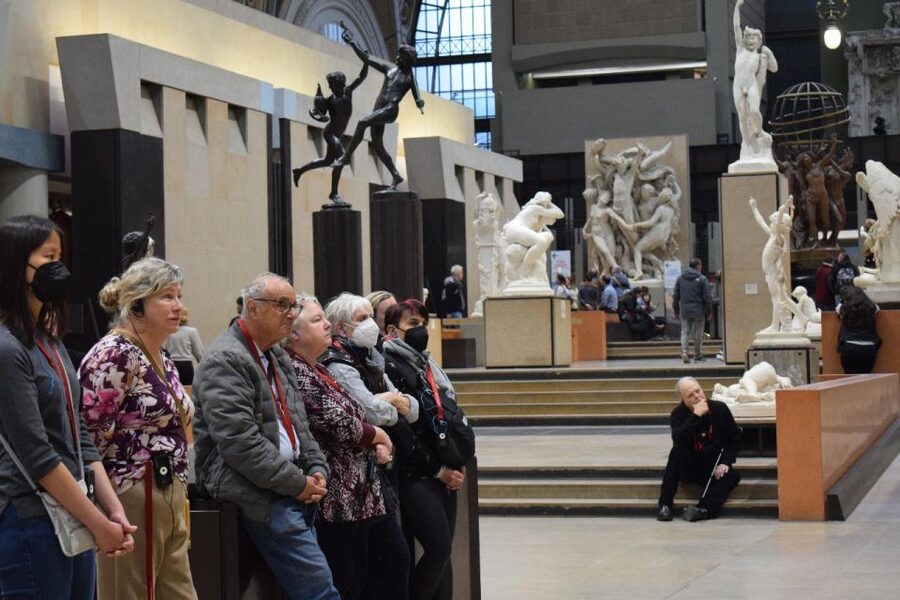
Two hours is about right if you want structure without giving up an entire day. The guide keeps the visit moving through major rooms, giving you enough time to look while preventing you from getting stuck in the first gallery.
The best guides do not lecture without pause. They explain a painting, ask what you notice, answer questions, and move on before the group loses focus. Patrick has been praised for combining humor with solid art history, while Antoine is noted for giving broad context before explaining smaller details.
The small group is important here. Six people can usually stand together, hear the guide, and ask questions without blocking a large section of a gallery. Groups may be even smaller, and on quieter dates the booking can become a private visit if no one else has joined.
Still, the museum may be packed. A Tuesday can be particularly busy when the Louvre is closed, and holidays such as Easter can bring large crowds. The guide can help you reach the main works, but no ticket can guarantee an empty room or a perfect view.
One practical limitation is sound. A few people have found surrounding noise made the guide hard to hear, and this tour information does not promise a listening device. Staying close to the guide is your best strategy. This is another reason the smaller group matters.
Is the $102 price good value?
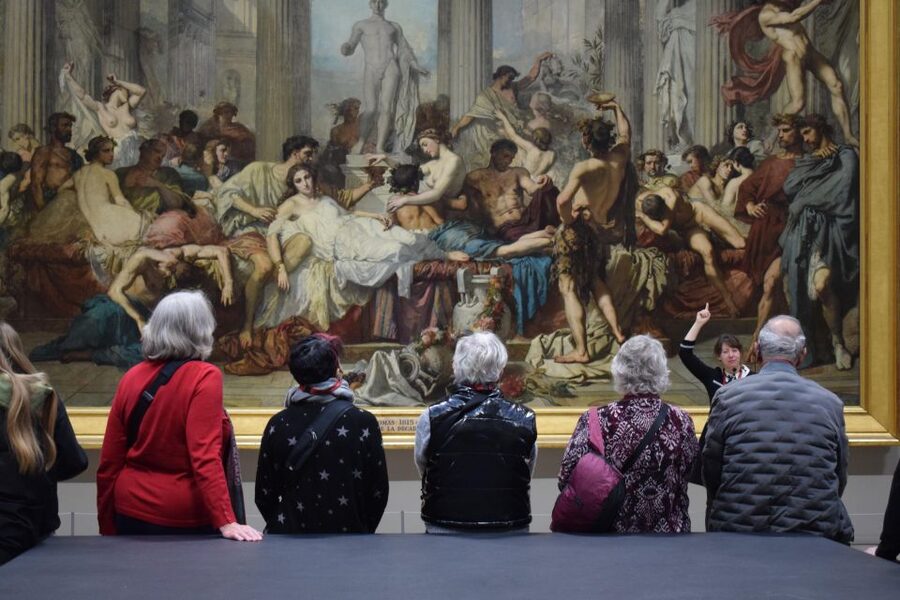
At $102 per person, this is not the cheapest way to enter Musée d’Orsay. You are paying for more than admission: a live guide, a planned two-hour route, and the convenience of arriving with museum entry arranged.
The value depends on how you use museums. If you already know Impressionist art well and enjoy wandering alone, you may prefer a regular museum ticket and several quiet hours at your own pace. If the names Monet, Renoir, and Van Gogh are familiar but the links between them are not, the guide can make the extra cost worthwhile.
I see the strongest value in the time saved and the order of the explanation. Paris museums can swallow hours while you search for the works you came to see. Here, you get the building’s story, the key paintings, the major movements, and a framework for looking at art without having to prepare in advance.
The price also looks better when the museum is busy. Quick collection access does not remove security screening, but it can prevent you from wasting time in the regular ticket process. During holiday periods or on days when nearby museums are closed, that convenience has real value.
The tour has a 4.9 rating from 237 reviews, with repeated praise for the guides’ enthusiasm, clarity, and ability to connect art with social change. The most consistent positive feature is not a particular painting. It is the small-group format and the quality of the explanation.
Who should book this Orsay tour?
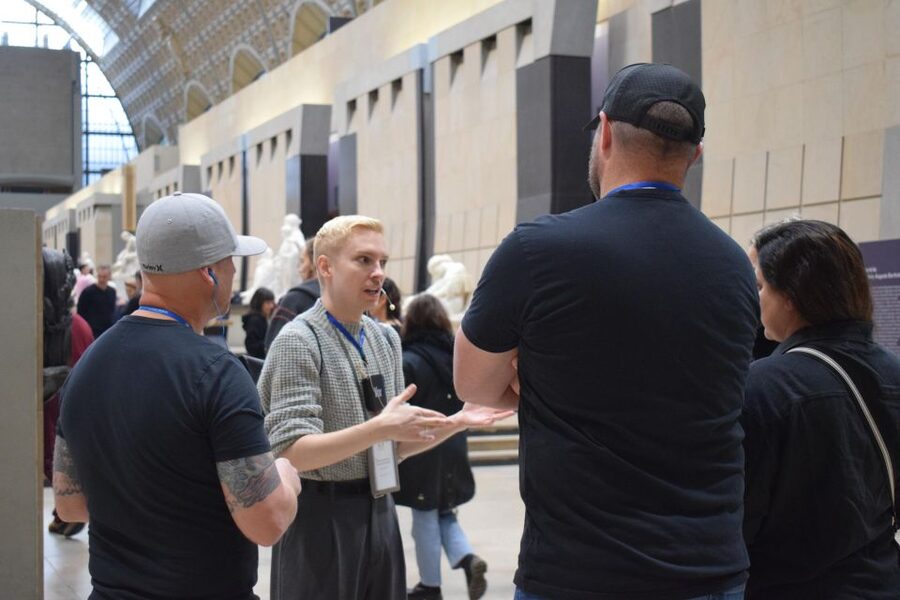
I would choose this tour for a first visit to Musée d’Orsay, especially if you want to understand Impressionism rather than simply photograph the famous pictures. It also suits families with older children, since guides such as Blerta have used stories and questions to keep younger visitors involved.
It works well for couples, solo visitors, and small family groups who want the comfort of a planned route. English, French, Spanish, Italian, and German tours are available, and private or small-group options can be selected.
Art students and repeat visitors may still enjoy it if they want political context, architectural details, or a fresh route through familiar rooms. Tell the guide your interests at the start. In a group of two, three, or six, your questions have a better chance of shaping the visit.
This is not the right pick if you need a slow pace, use a wheelchair, or have significant mobility limitations. Shared semi-private tours cannot change their pace for individual needs, and the experience is listed as unsuitable for wheelchair users. A private tour may be available for some mobility concerns, but confirm that choice before booking.
You can cancel up to 24 hours before the activity for a full refund, and reserve now while paying later. Museum strikes or unexpected closures can occur in France. If that happens, the provider may offer another time, a walking tour, or a refund if the alternatives do not work for you.
My verdict: book it for context, not just access
Book this tour if you want the Orsay’s famous paintings to make sense as part of a story. The guide-led progression from academic art and Manet through Monet, Renoir, Van Gogh, Cézanne, Gauguin, Rodin, and Matisse gives you a useful base for the rest of your Paris art visits.
The small group is the deciding feature for me. It helps you hear, ask questions, stay close, and handle crowded galleries with less frustration. Just remember that quick access is not the same as skipping security, and two hours will cover the highlights rather than every corner.
If you want an informed, lively introduction and value your limited Paris time, $102 is a fair price. If your ideal museum visit means lingering alone for half a day, buy an ordinary ticket and set your own pace instead.
FAQ
Where does the Musée d’Orsay tour meet?
Meet in front of Musée d’Orsay at 1 Rue de la Légion d’Honneur, by the large elephant statue. Your guide will hold a Connecting France sign.
How long does the tour last?
The guided museum visit lasts two hours.
What languages are available?
Live tours are available in English, French, Spanish, Italian, and German.
Does the ticket skip the entire entrance line?
The ticket allows quicker access to the museum collections, but you still must pass through the security line.
What identification should I bring?
Bring a passport or ID card. Tickets are personal, and anyone aged 17 or younger must have a photo ID card.
Can I bring luggage or a backpack?
No. Luggage, large bags, backpacks, and umbrellas are not allowed.
Is the tour suitable for wheelchair users?
No. The activity is not suitable for wheelchair users or people with mobility impairments. A private tour may be available for some mobility needs, while shared tours cannot adjust their pace.
Recently reviewed around Paris
- Louvre Private Tour – The Essentials and More with Expert Guide★ 5.0 · 227 reviews
- 2CV tour by night★ 5.0 · 55 reviews
- Eiffel Tower Second or Summit Floor Access by Elevator with Views★ 3.5 · 161 reviews
- The only Paris Wine Tasting experience you need to do – 2 hours★ 5.0 · 265 reviews
- 2 Hour Street-art Walk and Space Invaders Hunt in Paris★ 5.0 · 27 reviews
- 2 hour outdoor group activity in Paris: SAINT GERMAIN★ 5.0 · 48 reviews
- Sainte-Chapelle, Conciergerie & Palais de Justice Private Tour★ 5.0 · 72 reviews
- Private 2 – Hour Paris Landmarks Tour by Golf Cart Mini Moke★ 5.0 · 38 reviews
Orsay Museum Tours, compared.

Paris in a Day: Louvre or Orsay, Eiffel Tower, City Walk & Cruise
Read our review →
Musée d’Orsay Entry Ticket and Seine River Cruise
Read our review →
Musée d’Orsay Skip-the-Line Tour with Expert Guide
Read our review →
Musée d’Orsay Skip-the-Line Tour with Expert Guide
Read our review →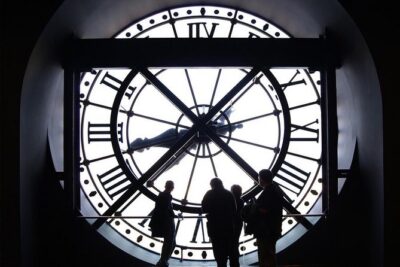
The Musée d’Orsay Guided Tour Orsay Museum Semi-Private 6ppl Max
Read our review →
Louvre & Musée d’Orsay Guided Museum Tour Semi-Private 6ppl Max
Read our review →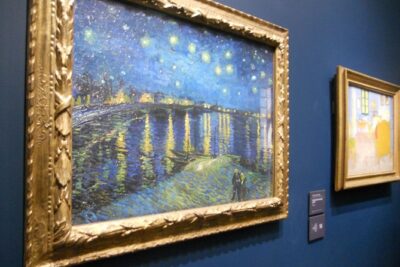
Browse the lists this tour appears in