
Reviewed · NORMANDY TOURS
Private tour: visit Deauville in a sidecar
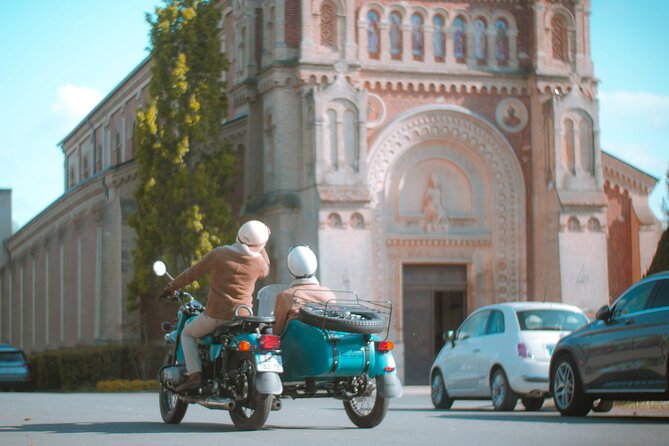
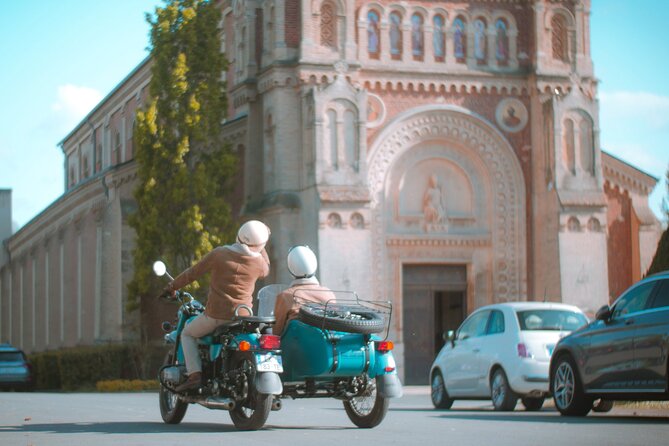
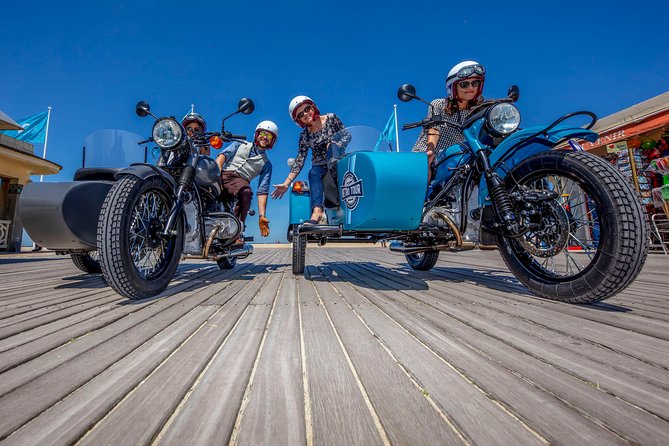
A vintage sidecar is a fine way to see Deauville quickly. You sit low to the road, feel the sea air, and pass from grand hotels to racecourses, churches, hillside viewpoints, and wartime memorials without spending your short visit on foot. Local pilots such as Thomas, Florent, Nico, Rémy, and Thierry add the stories as they drive.
I like the small private format, with no more than six people in one booking and only your group taking part. I also like the practical kit: helmets, gloves, vintage goggles, and rain gear are supplied. The main drawback is time. At about 45 minutes, this is a lively introduction, not a full tour with long visits inside each sight. You will mostly see the landmarks from the road and stop briefly for views and explanations.
In This Review
- Key points to know before you book
- Why a sidecar fits Deauville so well
- Starting beside the harbor and the Hôtel Normandy
- Saint-Augustin and the story of a planned resort
- The Touques racecourse and Deauville’s horse culture
- Villa Strassburger and the town’s racing elite
- Saint-Laurent church and the best high views
- Tourgéville Military Cemetery
- Clairefontaine racecourse and a flower-filled Norman style
- The casino and Deauville’s grand entertainment side
- Trouville views from the Calvaire de la Corniche
- What the equipment and seating are really like
- Price, timing, and who gets good value
- The clearest strengths and limits
- Should you book the Deauville sidecar tour?
- FAQ
- How long does the sidecar tour last?
- How much does the experience cost?
- Where does the tour begin?
- Where does the tour end?
- How many people can take part?
- How many people fit in one sidecar?
- What is the minimum age?
- What equipment is provided?
- What happens if the weather is poor?
Key points to know before you book
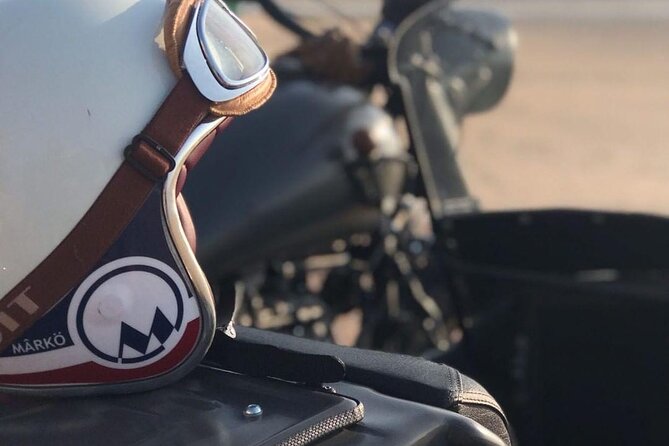
- Ride in a genuine sidecar: One person sits behind the pilot and another rides in the basket, making the vehicle part of the sightseeing.
- See two resort towns in one outing: The route takes in Deauville and reaches viewpoints over Trouville.
- Hear local stories on the move: Pilots explain the town’s past and add anecdotes about figures such as Coco Chanel, Yves Saint Laurent, and Jean Gabin.
- Stop at high viewpoints: Saint-Laurent church and the Calvaire de la Corniche provide some of the best photo opportunities on the route.
- Bring the family: The minimum age is four, and a sidecar can carry up to two adults plus one small child.
- Plan around the weather: The ride needs good conditions, although rain gear is provided and a weather cancellation allows a new date or full refund.
Why a sidecar fits Deauville so well
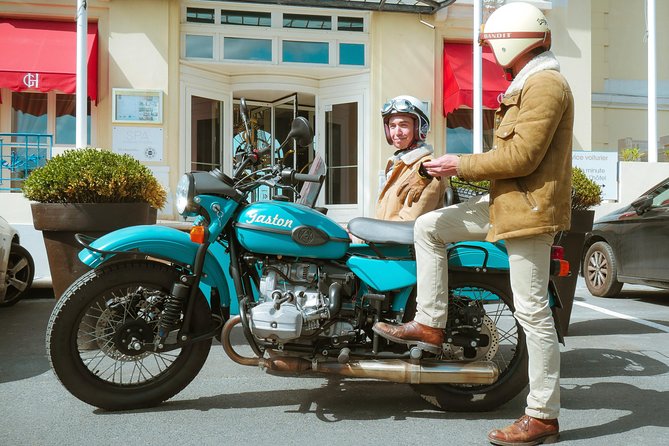
Deauville can look polished and self-contained when you first arrive. Grand villas, striped beach umbrellas, racehorses, casinos, and luxury hotels give it a very particular character. A sidecar lets you see the resort as a connected town rather than a series of isolated sights.
You move between the center and the higher roads above town with little effort. That matters because several of the best views are away from the seafront. On foot, you would need more time and some uphill walking. In the sidecar, you can cover more ground while keeping your eyes open for details.
The ride also gives you a more memorable sense of place than a standard vehicle. You hear the engine, feel the turns, and sit close to the streetscape. That does not make it the best choice for someone who wants a slow, detailed museum-style visit, but it works very well if you have a free hour and want an entertaining orientation.
The tone is informal and personal. Pilots explain what you are seeing rather than delivering a long lecture. Thomas is praised for mixing clear explanations with humor, while Florent is noted for his grasp of Deauville’s past. Nico, Rémy, and Thierry are also named as friendly pilots who add stories and keep the ride relaxed. The exact driver depends on the day.
More Normandy trips worth a second look
- Private D-Day Experience from Bayeux
★ 5.0 · 573 reviews - Private guided American D-Day Tour from Bayeux
★ 5.0 · 255 reviews - Normandy Battlefields D-Day Private Trip with VIP Services from Paris
★ 5.0 · 240 reviews
Starting beside the harbor and the Hôtel Normandy
The meeting point is the Tourist Intercommunal Deauville on Quai de l’Impératrice Eugénie. The experience finishes at this same point, which makes it easy to fit into a day of sightseeing around the center.
One early landmark is the Hôtel Barrière Le Normandy Deauville. Built in 1912 as the Hôtel Normandy, it reflects the grand resort style that helped make Deauville famous. It was commissioned during the town’s period of rapid growth, when visitors came for the races, the casino, the beach, and the social scene.
The hotel also has a screen connection. It was used as a filming location for an Agatha Christie’s Poirot episode, The Murder on the Links. That detail gives the building extra appeal if you enjoy period television or literary mysteries. You may only pause briefly, so have your camera ready before the sidecar pulls away.
Saint-Augustin and the story of a planned resort
Saint-Augustin church shows that Deauville was not simply a collection of hotels and holiday villas. The first stone was laid by the Duke of Morny on August 30, 1864, and the church was blessed less than a year later, on July 30, 1865.
Its construction was part of the planning of the new resort. The church was built by Desle-François Breney and Anatole Jal in the middle of a walled garden. The setting and dates help explain how quickly Deauville developed in the nineteenth century.
You have about five minutes here, with no admission charge. That is enough for a quick look and a few comments, but not enough for a careful examination of every architectural feature. Think of this stop as a useful piece of the town’s story rather than a church visit in the usual sense.
The Touques racecourse and Deauville’s horse culture
The Hippodrome Deauville La Touques is one of the route’s most important stops. Horse racing is not a side note here. It is central to the town’s identity and to the reason many wealthy visitors first came to this part of Normandy.
The racecourse is known as a four-season hippodrome because it hosts racing through much of the year. Its calendar includes 42 days devoted to flat racing, with thoroughbred speed at the center. The grounds also serve as a training center, with about 300 horses in winter and 600 in summer.
A sand-fibre track allows racing during winter, when wet or snowy fields can make turf racing difficult. In warmer months, the turf track returns for major events such as the Prix Rothschild, Maurice de Gheest, Jacques Le Marois, Morny, Jean Romanet, and the Grand Prix de Deauville.
You get around five minutes here. The stop will not replace attending a race or touring the facility, but it gives you a clear reason for Deauville’s refined, sporting image. If you are visiting during a race meeting, ask the pilot whether the schedule may affect what you see around the course.
A different way to spend the day, same corner of France:
- Normandy American D-Day Beaches Full Day Tour from Bayeux
★ 5.0 · 2,103 reviews - Normandy American D-Day Experience – Group tour from Bayeux
★ 5.0 · 1,566 reviews - Normandy Beaches Half-Day Afternoon Trip from Bayeux (A2)
★ 4.5 · 1,116 reviews - Omaha and Band Of Brothers Full Day Tour
★ 5.0 · 1,104 reviews
Villa Strassburger and the town’s racing elite
Villa Strassburger sits near the racecourse and makes the connection between horse racing and grand private houses easy to understand. Baron Henri de Rothschild, a major racing enthusiast, commissioned the villa in 1907 on the site of the Coteau Farm, once owned by the family of Gustave Flaubert.
The house became a protected historical monument in 1975. Its position near the racecourse was practical as well as stylish: a racing patron could stay close to the action while enjoying an impressive country residence.
The tour allows about ten minutes for the stop, but it is an exterior-focused visit. The villa can be visited from June through September by appointment, and it can also be rented for private events. If you want to see inside, arrange that separately. The sidecar tour is better for seeing the setting and understanding its place in Deauville’s social history.
Saint-Laurent church and the best high views
The Church of Saint-Laurent is on the heights above Deauville. Its position matters as much as the building itself, since it looks over the town and gives you a broader view of the resort.
The stop lasts about ten minutes and is one of the better chances to pause, take photographs, and understand Deauville’s layout. From above, the relationship between the town, the coast, and the surrounding roads becomes much clearer.
This is also where the sidecar format earns its keep. You are not spending your limited time climbing between separate viewpoints. The pilot handles the uphill route, then gives you time to look around. If photography matters to you, keep your phone accessible but secure, and use the stops rather than trying to take every picture while moving.
Tourgéville Military Cemetery
The Tourgéville Military Cemetery brings a quieter note to the ride. Created in 1918, it is maintained by the Commonwealth War Graves Commission. France granted the site a permanent concession after the war, and the British cemetery was inaugurated in 1920.
The cemetery was first used for soldiers who died in British Army hospitals established in Trouville and Deauville. Its careful maintenance and formal layout offer a sharp contrast to the resorts’ hotels, casinos, and racing culture.
You have around ten minutes here. This is not a loud or rushed attraction, so listen closely to the pilot’s explanation and give the place the respect it deserves. The stop adds historical weight to a tour that might otherwise focus only on glamour and entertainment.
Clairefontaine racecourse and a flower-filled Norman style
The route also includes the Clairefontaine racecourse, whose design differs from the more urban feel of La Touques. Architects Jean Papet and André Rimbert created a Norman-style course using concrete and half-timbering.
Flowers are a major part of the setting. About 50 years ago, broadcaster Léon Zitrone called it the racecourse with 100,000 flowers, a nickname that captures its decorative character. You may pass by or pause briefly, depending on the route and timing.
For you, the value is in seeing another side of the local racing world. La Touques is closely tied to Deauville’s central resort identity, while Clairefontaine has a more regional look. Together, the two sites show how deeply horse culture is built into the area.
The casino and Deauville’s grand entertainment side
The Deauville casino was built for Eugène Cornuché by architect Georges Wybo in 1912 and opened on July 11 of that year. Cornuché also operated the casino in nearby Trouville-sur-Mer, which opened only a few days earlier.
The building was fully restored in a baroque style by architect and designer Jacques Garcia in 1988. It is another reminder that Deauville was designed for leisure on a large scale, with hotels, racing, gaming, and social events all within easy reach.
The casino also has a darker chapter. On May 26, 1978, it was the scene of an attack carried out by Jacques Mesrine and François Besse. Your pilot may add this detail to the broader story of the building.
As with the other central landmarks, this is a look from outside rather than a gambling visit. Food and drinks are not included, and the tour does not provide time for a casino stop in the normal sense. If you want to enter afterward, you can return on your own.
Trouville views from the Calvaire de la Corniche
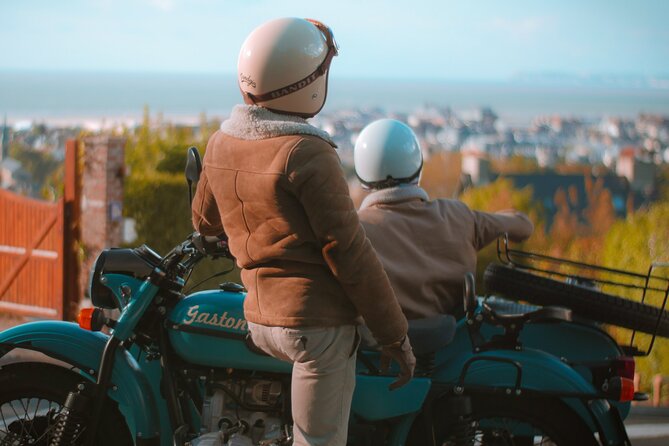
The Calvaire de la Corniche is presented as the finest view of Trouville. It gives the ride a strong finish, moving your attention from Deauville’s planned elegance to the neighboring coastal town.
This viewpoint is especially useful if you are deciding how to spend the rest of your day. You can see the area from above, compare the two resorts, and get a better sense of where Trouville sits in relation to Deauville. The stop lasts about five minutes, so the focus is on the view and a quick photo rather than a long visit.
The route’s viewpoints are one of its strongest features. You see places that are not all clustered around the main streets, but you do not have to organize separate taxi rides or uphill walks. That saves time, especially during a short stay.
What the equipment and seating are really like
Helmets are supplied to every rider. You also get gloves, vintage goggles, and rain gear. These details matter because the sidecar is open to the weather, and coastal conditions can change quickly.
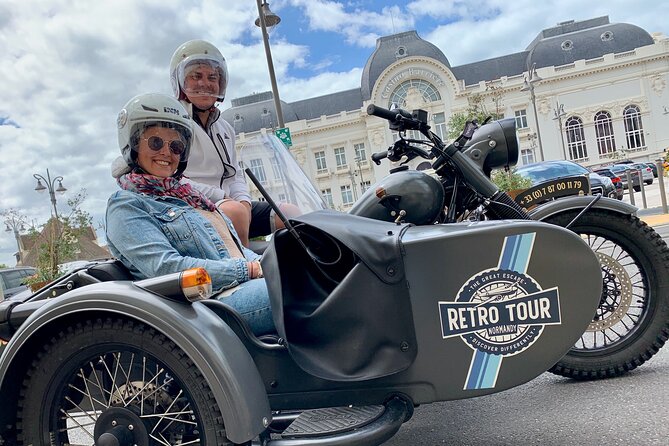
The seating arrangement is specific. One person rides behind the pilot, while one person sits in the basket. A sidecar can carry up to two adults plus one small child, with a minimum age of four years. The booking information says most groups can participate, and service animals are allowed.
For a couple, the basket and rear seat create two different views of the ride. You may want to swap positions if the pilot allows it, though that is not guaranteed by the supplied details. For a family, the small-child option makes this more flexible than many motorbike experiences.
The private setup is limited to six people per booking. That does not mean six people share one sidecar. It means your party takes the tour together, with the vehicles and seating arranged by the operator. The small scale makes it easier to hear the guide and ask a question than on a large coach tour.
Price, timing, and who gets good value
The advertised price is $84.69 per person for about 45 minutes. I see this as a premium orientation ride rather than a low-cost sightseeing transfer. You are paying for the unusual vehicle, the pilot-guide, the supplied safety gear, and access to several outlying viewpoints in a short period.
The value is strongest when you have limited time in Deauville, are celebrating something, or want an activity that feels different from a standard walking tour. It also suits families with children aged four and over, couples, and small groups who want to stay together.
The value is weaker if you prefer to enter buildings, linger at churches, or read every plaque at a cemetery. The route includes many stops, but the visit is brief at each one. You should book it as a moving overview with stories, not as a series of full admissions.
The experience is offered in English. Booking confirmation arrives at the time of booking, and the meeting point is near public transportation. It is booked an average of 18 days ahead, so I would not leave it until the last moment if your schedule is fixed.
The tour requires good weather. Rain gear is supplied, but poor conditions can still lead to cancellation. If the operator cancels for weather, you are offered another date or a full refund. You can also cancel for a full refund up to 24 hours before the start time. A cancellation or change made inside that 24-hour window is not refunded.
The clearest strengths and limits
The strongest part is the combination of movement and explanation. Pilots such as Thomas and Florent are praised for friendly delivery, useful history, and humor. The stories range from the town’s founding and racing culture to personalities linked with Deauville, including Coco Chanel, Yves Saint Laurent, and Jean Gabin.
The second strength is the access to views. Saint-Laurent and the Corniche give you high positions that would take more effort to reach independently. The sidecar also makes the ride feel like an occasion, especially for children or anyone who has only seen these vehicles in films.
The main limit is the short duration. A 45-minute ride passes quickly, and the itinerary includes enough landmarks that some stops must remain concise. You should also be comfortable with an open vehicle and the seating arrangement. Even with protective equipment, this is not the same as sitting inside a warm car.
The experience has a perfect five-star rating from 161 reviews, with 100 percent recommending it. That strong response fits the tour’s clearest qualities: friendly pilots, an unusual way to move around, solid local stories, and memorable photo stops. Still, the high rating should not obscure the basic tradeoff: it is fun and compact, not exhaustive.
Should you book the Deauville sidecar tour?
I would book this if you want a fast, personal introduction to Deauville and Trouville, especially if you have never visited before. It is also a strong pick for a family treat, a birthday surprise, or a couple looking for a more distinctive way to see the coast.
I would skip it if your priority is spending an hour inside Villa Strassburger, Saint-Augustin, the casino, or another attraction. For everyone else, the sidecar gives you a useful first look, local anecdotes, and high viewpoints without demanding a full day. Bring a camera, dress for changing coastal weather, and accept that the best part is the ride itself.
FAQ
How long does the sidecar tour last?
The tour lasts approximately 45 minutes.
How much does the experience cost?
The listed price is $84.69 per person.
Where does the tour begin?
It begins at TOURIST INTERCOMMUNAL DEAUVILLE, Quai de l’Impératrice Eugénie, 14800 Deauville, France.
Where does the tour end?
The activity ends back at the meeting point.
How many people can take part?
The tour is private, and only your group participates. A maximum of six people can be included in one booking.
How many people fit in one sidecar?
A sidecar can carry up to two adults and one small child. One person sits behind the pilot and one sits in the basket.
What is the minimum age?
The minimum age is four years old.
What equipment is provided?
Helmets, gloves, vintage goggles, and rain gear are included.
What happens if the weather is poor?
The experience requires good weather. If it is canceled because of poor conditions, you are offered a different date or a full refund.
Recently reviewed around Normandy
- Découverte Bénédictine★ 4.0 · 138 reviews
- Le Havre Shore Excursion: Private Day Tour with Omaha Beach & American Cemetery★ 5.0 · 57 reviews
- Immersive tour DISTILLERIE PERE MAGLOIRE★ 5.0 · 314 reviews
- From Cherbourg: D-Day Beaches Shore Excursion★ 5.0 · 28 reviews
- Normandy Victory Museum admission ticket★ 5.0 · 58 reviews
- Mt St. Michel Private Tour with Abbey tickets and tour guide★ 5.0 · 45 reviews
- Mont-St-Michel: Private Walking Tour “Abbey Ticket Included”★ 5.0 · 28 reviews
- Airborne Museum Admission Ticket★ 5.0 · 424 reviews
Normandy Tours, compared.
Normandy American D-Day Beaches Full Day Tour from Bayeux
Read our review →
Normandy American D-Day Experience – Group tour from Bayeux
Read our review →
Normandy Beaches Half-Day Afternoon Trip from Bayeux (A2)
Read our review →
Omaha Beach D-Day Experience – Afternoon group tour from Bayeux
Read our review →
Normandy Battlefields Tour – American Sites (A3)
Read our review →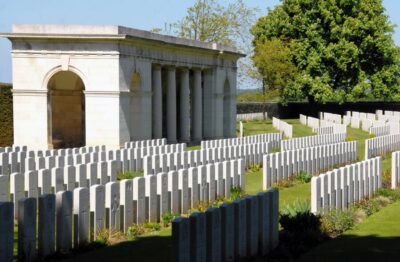
American D-Day Sites in Normandy Half-Day Tour
Read our review →Browse the lists this tour appears in