
Reviewed · WALKING TOURS
Marseille: Half-Day City Highlights Guided Walking Tour
Marseille makes the most sense when you see its sharp contrasts on foot: a working port, old stone lanes, steep hills, seaside paths, and neighborhoods that change character every few minutes. Charles leads this four-hour route from La Major Cathedral through Le Panier, Notre Dame de la Garde, Vallon des Auffes, and the waterfront.
I like the small group capped at eight, because you can ask questions and keep close to the guide in narrow streets. I also like the short ferry ride across the port and Charles’s habit of sharing local restaurant and pastry-shop tips. The main catch is simple: this is a serious 9-kilometer walk with hills, steps, and sun, not a gentle stroll.
In This Review
- Key points to know before booking
- Starting at La Major and entering Le Panier
- From Hôtel de Ville to the Old Port
- The climb through Parc de la Colline Puget
- Notre Dame de la Garde and the best view of Marseille
- Down toward Vallon des Auffes
- The Corniche, Catalans Beach, and Palais du Pharo
- Saint Victor’s Abbey and the final stretch
- Why Charles matters on this route
- Is $58 a fair price?
- How to prepare for nine kilometers
- Who should book this Marseille walk?
- Should you book the Charles tour?
- FAQ
- Where does the tour meet?
- Where does the tour finish?
- How long is the tour?
- How far do you walk?
- What languages does the guide speak?
- Is food included?
- Who may find this tour unsuitable?
Key points to know before booking
- Charles is the central strength: He guides in English or French and brings humor, local insight, and a clear love of Marseille.
- The route covers a lot: Expect La Major, Le Panier, the Old Port, Notre Dame de la Garde, Vallon des Auffes, the Corniche, Palais du Pharo, and Saint Victor’s Abbey.
- The hilltop basilica is the visual payoff: You get broad views across Marseille and the sea, with a 25-minute break to look around.
- The walk is active: Nine kilometers, hills, steps, and uneven city streets call for hiking shoes, water, sun protection, and a decent fitness level.
- The ferry is a clever shortcut: A brief boat crossing breaks up the walking and gives you a different angle on the port.
- It works best early in your stay: The route gives you a useful map of Marseille and ideas for where to eat and what to visit next.
Starting at La Major and entering Le Panier
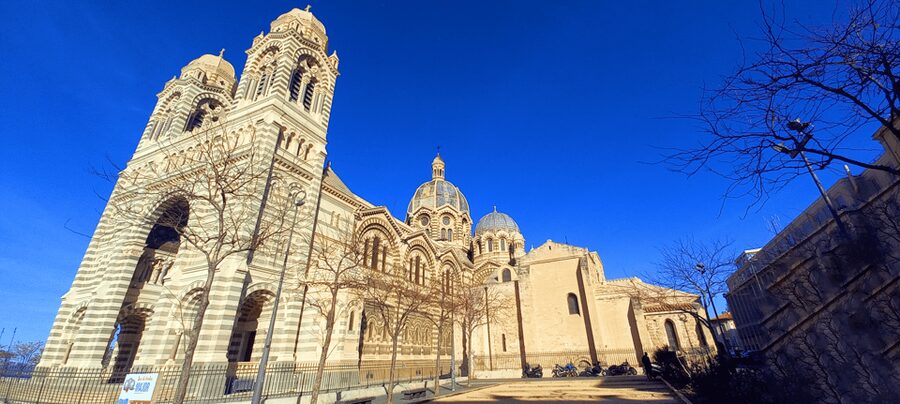
Meet your guide in front of Cathédrale Basilique Sainte-Marie-Majeure, usually called La Major. Look for Charles in a white cap. The cathedral itself gets a short guided visit, about 10 minutes, before the route turns into the lanes of Le Panier.
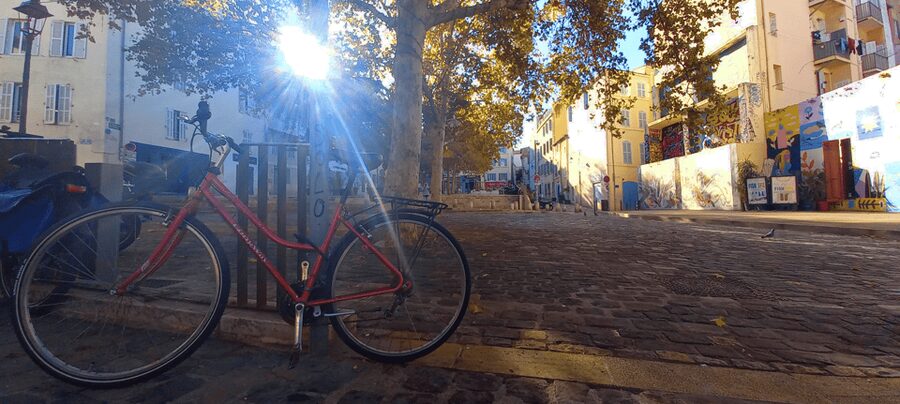
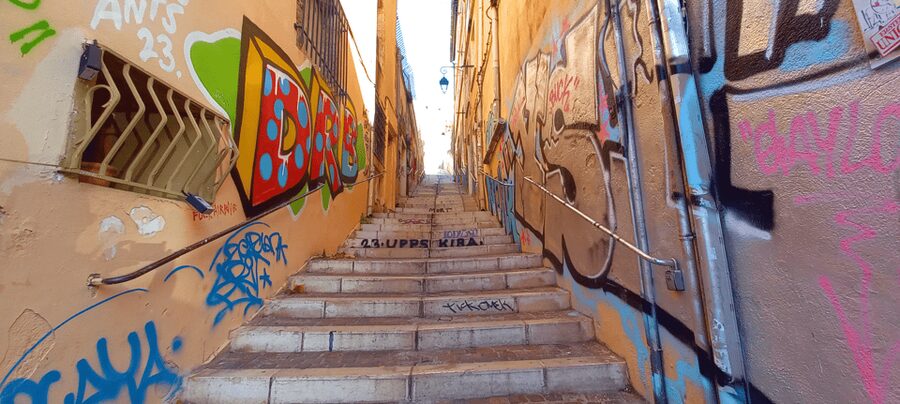
Le Panier is Marseille’s oldest quarter, and its narrow pedestrian streets are exactly where a walking tour earns its keep. Cars cannot follow you into many of these passages. You move through stairways, small lanes, and corners where the city feels much older and more intimate than the broad port nearby.
Allow about 40 minutes here. Charles uses the neighborhood to explain how Marseille developed, not just to point at pretty buildings. That matters because Le Panier can otherwise feel like a maze of façades, staircases, and small squares without much context.
The pace is not rushed, but you should expect frequent changes in level. If you enjoy old quarters and local stories, this will be one of the most rewarding parts. If hills and steps are difficult for you, the day becomes harder almost immediately.
More City Tours in Marseille
- Marseille: City Sightseeing Hop-On Hop-Off Bus Tour
★ 3.8 · 2,820 reviews - Marseille: City Highlights Guided Half-Day E-Bike Tour
★ 4.8 · 325 reviews - Marseille Shore Excursion: City Sightseeing Tour of Marseille
★ 4.0 · 321 reviews
From Hôtel de Ville to the Old Port
The route continues toward Hôtel de Ville, where you get another short guided stop and a chance to take in the city’s civic center. From there, the five-minute ferry ride provides a welcome change from pavement.
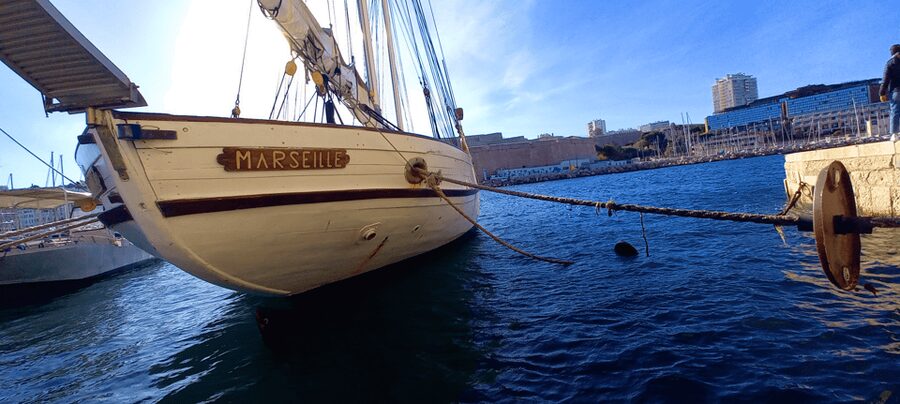
It is a modest boat trip, not a major harbor cruise, but that is part of its appeal. You get a brief look at Marseille from the water, and the crossing saves some walking while keeping the route connected to the port’s history and daily life.
At the Old Port, the tour pauses for a short visit before moving toward Cours Honoré d’Estienne d’Orves. This area helps connect the city’s older maritime identity with its modern public spaces. I like the structure here: you begin with old streets, reach the water, then continue through a series of neighborhoods instead of spending four hours circling one monument.
The Old Port is also a useful orientation point. It is one of the places you may return to for food, ferries, or an evening walk, so seeing it early gives you a practical base for the rest of your stay.
The climb through Parc de la Colline Puget
The next major effort comes at Parc de la Colline Puget. The route spends about 25 minutes walking and sightseeing here as it gains height.
This is where comfortable footwear stops being a suggestion. The tour covers about 9 kilometers, and the climb adds real work after the earlier walking. Bring water in your backpack, wear a sun hat, and apply sunscreen before you start. Sunglasses are also listed as essentials, and Marseille’s exposed hills can feel hot even when the morning begins pleasantly.
The park section gives the group a greener break from stone streets and busy roads. It also prepares you for the climb to Notre Dame de la Garde. Charles is reported to adjust the pace and check on people throughout the walk, and the format allows you to pause and rejoin the group at another location if you need a rest.
That flexibility is useful, but it does not turn this into an easy tour. You still need to be comfortable walking uphill and downhill for several hours. The activity is not designed for wheelchair users, people with a low level of fitness, children under 12, or people over 70. One 74-year-old participant did enjoy the walk, so the age guidance is not a measure of ability, but it does signal the physical demands.
Notre Dame de la Garde and the best view of Marseille
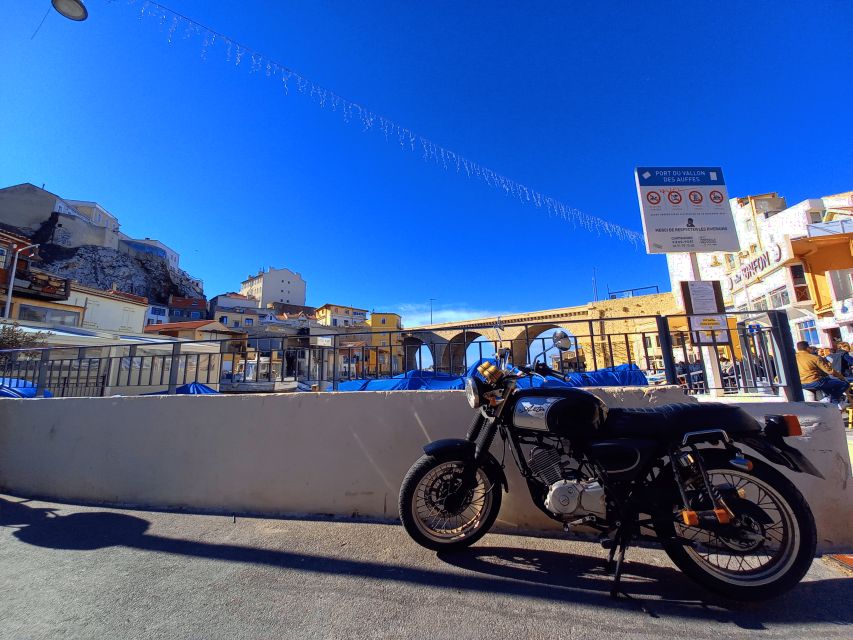
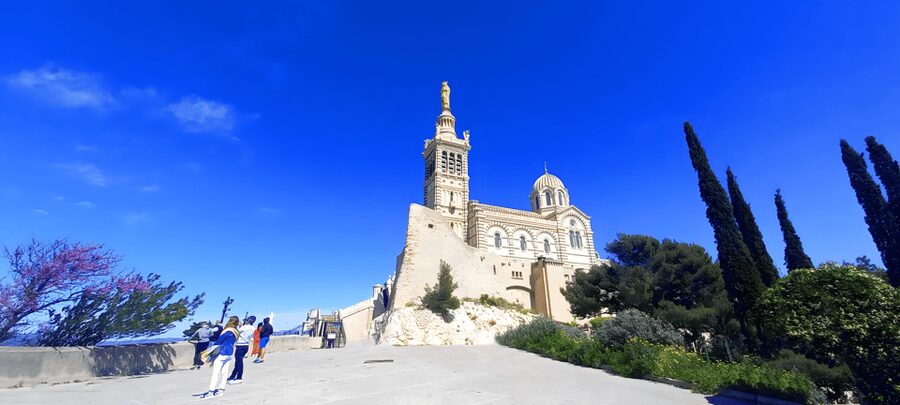
The tour reaches Notre Dame de la Garde for a guided visit and sightseeing stop, followed by a 25-minute break. The basilica sits high above the city, making this the clearest visual reward of the route.
From here, you can look across Marseille, the sea, and the surrounding hills. The view also helps you understand the city’s shape. After walking through the old quarter and around the port, you can finally see how those districts fit together.
The break is long enough to catch your breath and enjoy the setting, but it is not a full meal stop. Food and drinks are not included, and you are expected to carry your own eating and drinking supplies. Pack something practical before meeting the group rather than counting on a café stop during the walk.
Charles’s explanations at the basilica are part of the tour’s strongest mix of place and story. The experience is not just a photo stop at a high point. You learn how the city has changed and how its different districts relate to one another.
More Walking Tours in Marseille
- Boat walk in Sete on the singular island 1 hour
★ 4.8 · 212 reviews - Marseille: No-Diet Club Local Food Tasting and Walking Tour
★ 4.8 · 173 reviews - Marseille: Essential Guided Walking Tour of the City
★ 4.9 · 161 reviews - Marseille: Walking Food Tour with Full Meal
★ 4.7 · 137 reviews
Down toward Vallon des Auffes
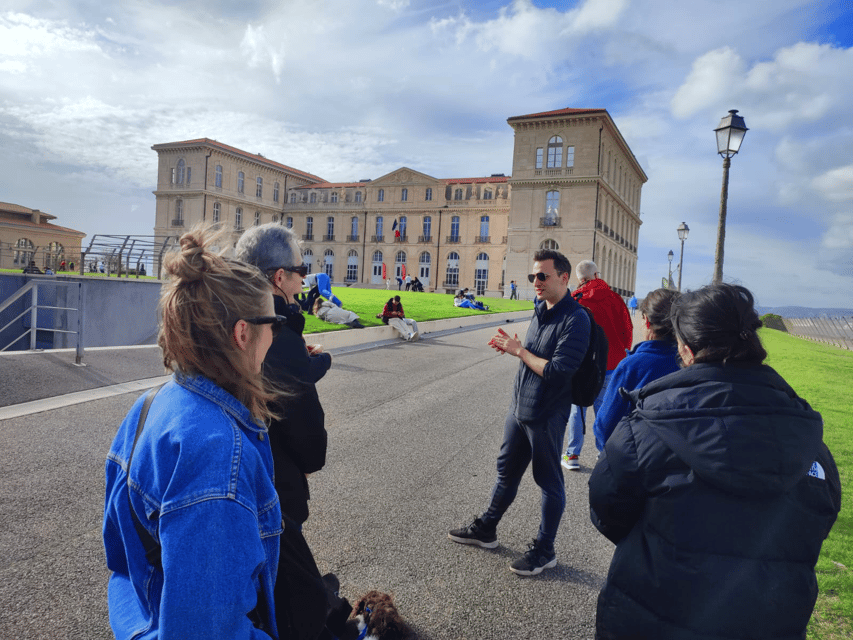
After Notre Dame de la Garde, the route continues for roughly 40 minutes through Marseille before reaching Vallon des Auffes. This stretch brings you from the hilltop back toward the coast and shows how quickly the city’s mood can change.
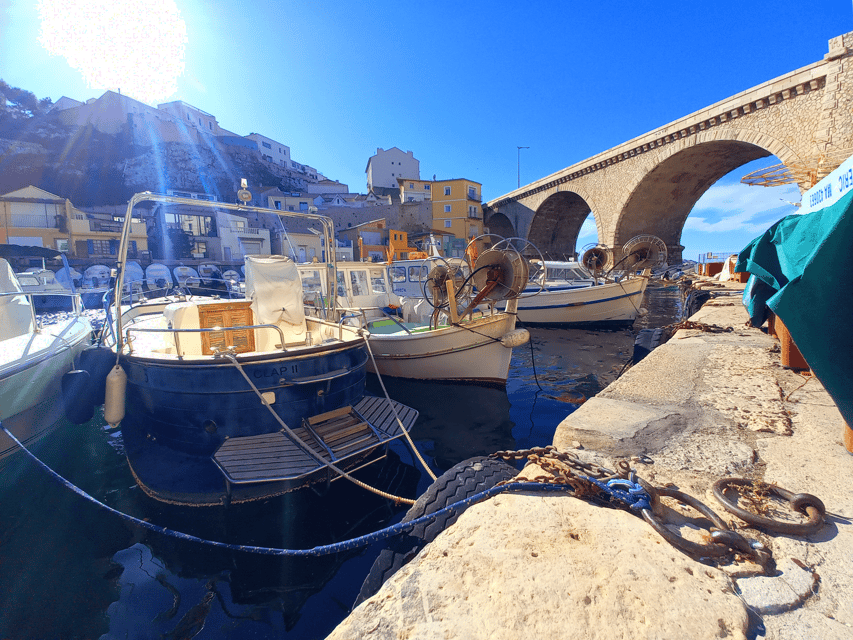
Vallon des Auffes is a small fishing port set in a rocky cove. It feels far removed from the broad openness of the Old Port, even though both are tied to Marseille’s maritime life. The compact harbor, water, and surrounding stone make it one of the most memorable photo stops on the route.
This is also a good example of why the tour covers so much ground. You could visit Notre Dame de la Garde and the Old Port by yourself, but connecting them with smaller coastal districts gives you a fuller sense of Marseille. You see the city not as a checklist of famous sights, but as a collection of neighborhoods with very different personalities.
The descent can be tiring, especially after the earlier climb. Pay attention to your footing and do not save your best shoes for dinner. Hiking shoes or sturdy walking shoes are the sensible choice.
The Corniche, Catalans Beach, and Palais du Pharo
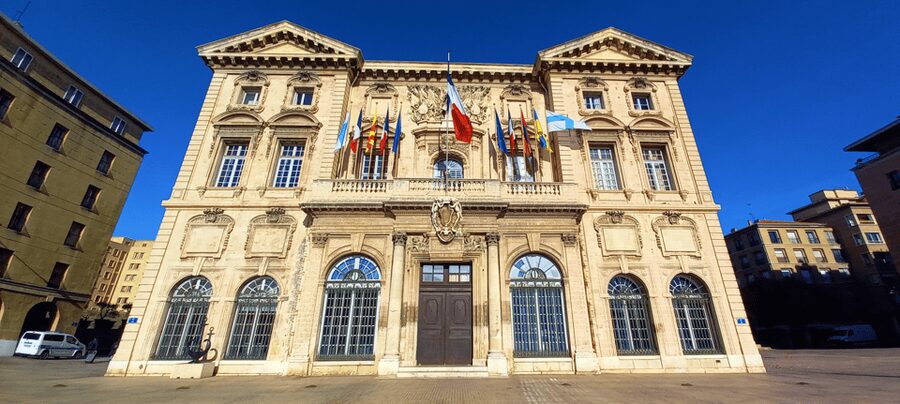
From Vallon des Auffes, the route reaches the Monument aux morts de l’Armée d’Orient et des terres lointaines for a short photo stop. It then follows part of Corniche John Fitzgerald Kennedy, with about 15 minutes set aside for sightseeing.
The Corniche gives you a more open view of the coast. It is a useful counterpoint to Le Panier’s tight lanes and the basilica’s elevated view. Here, the route is about Marseille’s relationship with the sea, not just its buildings.
Plage des Catalans comes next for a brief visit. This is another quick stop rather than a beach afternoon, so keep your expectations in check. You will see the setting and hear about its place in the city, but the schedule is built around covering many districts, not lingering at each one.
The Palais du Pharo follows with about 10 minutes of sightseeing. Its grand architecture and position near the harbor make it one of the route’s more striking landmarks. You get a chance to view the building and its setting without spending a large part of the morning inside one site.
The sequence works well. You move from a working fishing cove to a coastal road, then to a beach and a palace. That variety keeps the tour interesting, but it also explains why the walk can feel long. The route rarely settles into one pace or surface.
Saint Victor’s Abbey and the final stretch
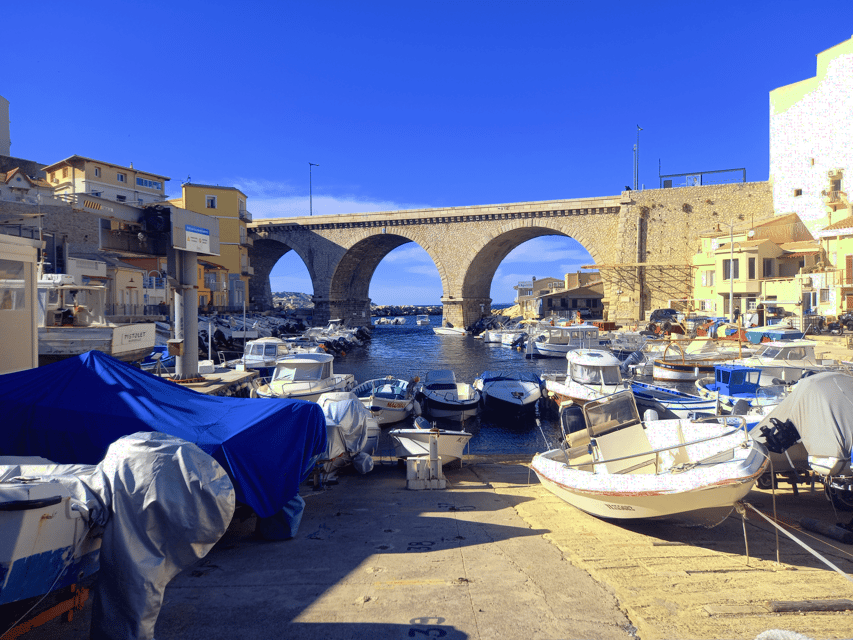
The final major stop is Saint Victor’s Abbey, with about 20 minutes for guided sightseeing. It adds another layer to Marseille’s long story and rounds out the tour with a religious and architectural landmark.
By this point, you have seen old streets, civic buildings, a port, a hilltop basilica, a fishing cove, a coastal road, and a palace. Saint Victor’s gives the ending a quieter historical note before the tour finishes at the Old Port.
There is a small point to clarify here. The detailed route ends at the Old Port, while the broader description also refers to returning to La Major. Use the specific meeting and end-point instructions provided when you book, and allow enough time afterward to get where you need to go. The Old Port is a useful finish because it leaves you near central transport, restaurants, and more waterfront walking.
Why Charles matters on this route
A long city walk rises or falls with its guide. Charles is the guide named for this experience, and the strongest pattern in the feedback is his energy, humor, personal attention, and command of Marseille’s past and present.
He makes an effort to learn names and speak with each person in the group. That is easier with a maximum of eight participants than with a large coach group. You have room to ask questions, and Charles can adjust his explanations to the interests and pace of the people with him.
His bilingual tours run in English or French. One useful feature is his ability to connect history with everyday city life. The route includes old districts and major sights, but the experience also takes you through back streets and offers local suggestions for restaurants and places to visit afterward. A pastry-shop stop has also been part of the day, though you should not treat that as a guaranteed inclusion, since food is not included.
I would book this partly for the route and partly for the guide. The sights are good, but the value comes from understanding how they connect. Charles’s enthusiasm appears to be especially useful in a city that can seem rough-edged, scattered, and hard to read at first.
Is $58 a fair price?
At $58 per person, the tour is not the cheapest way to walk around Marseille. You can visit many public streets and viewpoints without paying anything. The question is what your four hours are worth.
You are paying for a bilingual guide, a small group, a carefully linked route, the Notre Dame de la Garde visit, and the time saved figuring out how to connect distant parts of the city. The short ferry ride adds variety, and the route reaches areas you might not think to combine on your own.
I consider the price fair for a first visit, especially if you have only a day or two in Marseille. It is also useful for a cruise stop, when a single morning needs to provide both orientation and a strong sample of the city.
The value is weaker if you dislike long walks or prefer to explore one district slowly. You may also want a different format if your main goal is extended indoor visits. This tour is about movement, city views, local streets, and explanation on the way.
How to prepare for nine kilometers
Treat the tour as a hike through a city. Wear hiking shoes or sturdy walking shoes, not thin sandals or dress shoes. Bring your own water and food in a backpack, along with sunglasses, a hat, and sunscreen.
Start with enough energy for hills and steps. The tour lasts four hours, and some groups have continued beyond the advertised time when the guide felt there was more to show. That generosity can be welcome, but it means you should avoid scheduling a tight lunch, train, or shore excursion immediately afterward.
The tour is limited to eight people, which helps the group stay together in narrow streets. If you need to stop, you can pause and rejoin the group at another point. Still, you should be able to walk a substantial distance and manage slopes without regular assistance.
Free cancellation is available up to 24 hours before the start for a full refund, and you can reserve without paying immediately. Those terms help if your Marseille plans depend on weather or a changing cruise schedule.
Who should book this Marseille walk?
I would choose this tour for a first-time visitor who wants a broad introduction in one morning. It suits people who like walking tours, local stories, viewpoints, and changing neighborhoods more than people who want a slow museum visit.
It is particularly useful if you are staying only a few days. By the finish, you will have seen enough of Marseille to decide where to return, where to eat, and which areas deserve more time.
Families with older teenagers may enjoy it, but children under 12 are not accepted. Older adults should judge the route by fitness rather than age alone, while remembering that the tour operator specifically excludes people over 70 and those with low fitness.
Should you book the Charles tour?
Book it if you want to understand Marseille through its streets rather than from a bus window. The route is ambitious, the small group is a real advantage, and Charles brings warmth, humor, and strong local knowledge to a city that rewards explanation.
Skip it if 9 kilometers, hills, steps, and sun sound unpleasant. If you can handle the effort, $58 buys a useful first look at Marseille, from La Major and Le Panier to the Old Port, Notre Dame de la Garde, Vallon des Auffes, the Corniche, Palais du Pharo, and Saint Victor’s Abbey.
FAQ
Where does the tour meet?
The meeting point is directly in front of Cathédrale Basilique Sainte-Marie-Majeure, also called La Major. The guide wears a white cap.
Where does the tour finish?
The detailed route finishes at the Old Port of Marseille. The wider description also refers to La Major, so check the final meeting instructions when booking.
How long is the tour?
The tour lasts four hours and is described as a morning experience. Starting times vary, so check availability for the date you want.
How far do you walk?
The route covers about 9 kilometers and includes hills, steps, and walking through narrow streets.
What languages does the guide speak?
The live guide leads tours in English and French.
Is food included?
No. Food and drinks are not included. You need to carry your own eating and drinking supplies in your backpack.
Who may find this tour unsuitable?
The tour is not suitable for children under 12, wheelchair users, people with a low level of fitness, or people over 70. It is also a poor match for anyone uncomfortable with a long walk involving hills and steps.
More Half-Day in Marseille & Provence
- From Arles: Half-Day 4×4 Camargue Safari
★ 4.7 · 1,772 reviews - Marseille: Côte Bleue Calanques Half-Day Kayak Tour
★ 4.7 · 877 reviews - Camargue: Half-Day 4×4 Guided Safari Adventure
★ 4.6 · 846 reviews - Luberon Villages Half-Day Tour from Aix-en-Provence
★ 5.0 · 414 reviews
More Walking Tours in Marseille & Provence
- An Aix-traordinary Walking City Tour of Aix-en-Provence
★ 5.0 · 101 reviews - Marseille: Foodie Walking Tour of the Cours Julien District
★ 4.8 · 97 reviews - Marseille: Guided Off-the-Beaten-Path Neighborhood Walk
★ 4.9 · 63 reviews - Provencal Market Walking Tour with Tastings
★ 4.6 · 50 reviews
Recently reviewed around Marseille & Provence
- Skip the Line: Museum of Romanity Ticket★ 4.5 · 45 reviews
- Guided tour Distillery of Lavender between Nîmes & Arles★ 5.0 · 84 reviews
- A Private Guided Historical and Cultural Tour in Nîmes★ 4.5 · 32 reviews
- Provence Hot-Air Balloon Ride from Forcalquier★ 4.5 · 75 reviews
- Horse ride in Haute Provence Luberon and Forcalquier★ 5.0 · 77 reviews
- Sailing day in the heart of the Calanques★ 4.5 · 61 reviews
- The Urban Hike of Marseille★ 5.0 · 35 reviews
- Sormiou Calanques National Park Electric Bike Tour from Marseille★ 5.0 · 60 reviews
Walking Tours, compared.

Paris Top Sights Half Day Walking Tour with a Fun Guide
Read our review →
Montmartre Hidden Gems and Scenic Highlights Walking Tour
Read our review →
Montmartre Hill French Gourmet Food and Wine Tasting Walking Tour
Read our review →
Paris Île de la Cité and Notre-Dame Walking Tour With Crypt
Read our review →
Montmartre Cheese, Wine & Pastry Guided Walking Tour
Read our review →
Paris in a Day: Louvre or Orsay, Eiffel Tower, City Walk & Cruise
Read our review →
Montmartre Highlights Walking Tour with a Local Guide
Read our review →
Browse the lists this tour appears in