
Reviewed · WALKING TOURS
Paris Marais Quarter 2-Hour Private Walking Tour
The Marais is Paris in several time periods at once. In two hours, this private walk connects a drained medieval marsh to the old Jewish quarter, royal residences, grand civic buildings, and the bold modernism of the Pompidou Centre. The neighborhood’s changing fortunes give the tour a clear story instead of a loose string of monuments.
I like the private format, which lets your guide adjust the pace and explain details to your group. I also like the range of stops, from the market roots of Les Halles to the elegant Place des Vosges. The main drawback is the price: at $176 per person, this is a serious splurge for a two-hour walk, especially for a couple.
In This Review
- Key points at a glance
- Why the Marais makes such a good walking tour
- Starting near Étienne Marcel and old Les Halles
- The Pompidou Centre and the medieval city
- Hôtel de Ville and the civic face of Paris
- Entering the Pletzl and Rue Pavée
- Hôtel de Sully and the road to Place des Vosges
- Finishing at Place de la Bastille
- What the private format changes
- Is $176 per person fair?
- Timing, weather, and who should book
- My verdict on the Marais private walk
- FAQ
- Where does the tour meet?
- How long does the tour last?
- Is the tour private?
- Which languages are available?
- What places are included on the route?
- Will the tour visit a synagogue?
- Are food and drinks included?
- Does the tour operate in bad weather?
- Can I cancel for a refund?
- Do I have to pay at the time of booking?
Key points at a glance
- A neighborhood with many past lives: Learn how the Marais changed from swamp to aristocratic quarter, slum, Jewish center, and fashionable district.
- A useful route through central Paris: The walk links Les Halles, Hôtel de Ville, the Pletzl, Place des Vosges, and Place de la Bastille.
- Private attention: Your group has a live guide rather than joining a large public walk.
- Strong guide team: Alexandre, Caroline, Boris, Fabienne, Anja, Yvana, and other guides have led this experience in English, French, or Serbo-Croatian.
- Good historical range: The tour explains the link between medieval Paris and the Centre Pompidou, not just the buildings themselves.
Why the Marais makes such a good walking tour
The Marais rewards a guide because its most interesting details are easy to miss. The streets do not simply show one polished version of Paris. They reveal layers of settlement, religion, wealth, neglect, civic power, and modern culture.
The district began as wet ground. After the marsh was drained, it became suitable for homes and businesses. The area later grew into an important center for Paris’s Jewish community, and the Pletzl remains closely tied to that story.
Then came a period of aristocratic favor. Wealthy families built grand residences here, and the quarter was linked with the royal court. Later, the Marais lost status and gained a reputation as a rougher district that respectable Parisians avoided.
That rise and fall is what gives the walk its shape. You are not only looking at attractive façades. You are learning why the neighborhood changed, who lived there, and how Paris repeatedly reused the same streets.
The district is now enjoying another period of popularity. That makes it lively and appealing, but it also means the Marais can feel polished and busy. A private guide helps you look past the shops and cafés to the older structure underneath.
More Walking Tours in Paris
- Paris Top Sights Half Day Walking Tour with a Fun Guide
★ 5.0 · 2,893 reviews - Montmartre Hidden Gems and Scenic Highlights Walking Tour
★ 5.0 · 2,684 reviews - Montmartre Hill French Gourmet Food and Wine Tasting Walking Tour
★ 5.0 · 2,588 reviews
Starting near Étienne Marcel and old Les Halles
The meeting point is at Metro Étienne Marcel. Look for a guide carrying a red canvas tote bag, a practical detail that should make the first meeting easier in a crowded central area.
The tour begins near Les Halles, once Paris’s largest open market. The market gave this part of the city an everyday purpose for centuries. Food, trade, workers, and shoppers all shaped the district around it.
Today, the market’s old role is not the first thing you notice. That is why the background matters. A guide can help you picture the commercial life that once filled the area and explain how this part of Paris connected ordinary daily work with the wider city.
The nearby Fontaine des Innocents adds another historic marker. It is one of the stops included on the route, and its presence helps show how public spaces in Paris have changed over time.
I like this opening because it does not begin with the most ornamental square. It starts with work and commerce. That gives you a more grounded introduction to Paris before the walk moves toward city government, religion, and royal architecture.
The Pompidou Centre and the medieval city
The Centre Pompidou is one of the most recognizable modern buildings in Paris. Its strong colors and exposed structural elements can seem far removed from the medieval streets around it.
This tour uses that contrast as a teaching point. You will learn about the connection between the Middle Ages and the Pompidou Centre, rather than treating the modern building as an isolated piece of design.
That is a useful way to understand central Paris. The city did not replace one era with another in a neat line. Older streets, newer public buildings, and changing ideas about art and urban life sit close together.
The Pompidou stop may be especially useful if you are not planning to visit the museum itself. You still get a way to place the building within the quarter. If modern architecture is not your main interest, the guide can connect it back to the older neighborhood instead of leaving it as a visual interruption.
Because the tour lasts only two hours, you should expect an introduction rather than a full architectural study. The value here is the link between periods, not an extended examination of the Centre Pompidou’s collections or design.
Hôtel de Ville and the civic face of Paris
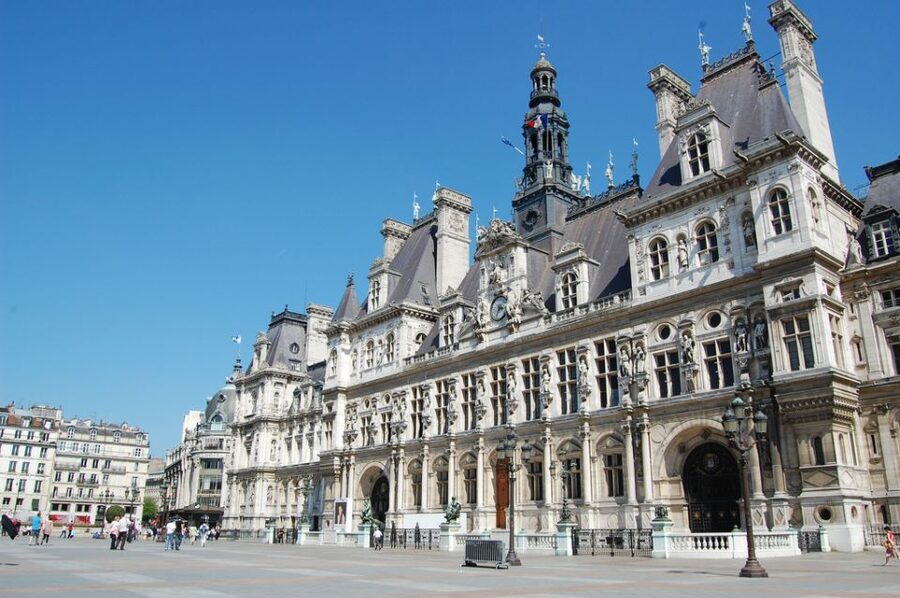
From the older market district, the route continues to Hôtel de Ville, Paris’s opulent Renaissance City Hall. This is one of the tour’s strongest shifts in mood.
Les Halles represents trade and daily life. Hôtel de Ville represents public authority, civic pride, and the official image of the capital. Its scale and decoration show how Paris used architecture to express power.
Your guide can also place the building within the larger story of the city. The Marais was never just a quiet residential quarter. It sat close to the centers of government, wealth, religion, and commerce.
I find this stop valuable because it gives you a pause from small streets and private residences. It shows the Marais in relation to the whole city. You are seeing how a neighborhood can contain both intimate local life and buildings meant to represent Paris itself.
The word opulent sets the expectation here. Do not come looking for a simple medieval town hall. This stop is about grandeur and civic display, and the guide’s explanation helps turn a striking façade into part of the neighborhood’s story.
More Paris walks with a guide:
- Paris Île de la Cité and Notre-Dame Walking Tour With Crypt
★ 5.0 · 2,272 reviews - Paris: Montmartre Cheese, Wine & Pastry Guided Walking Tour
★ 4.8 · 2,255 reviews - Paris in a Day: Louvre or Orsay, Eiffel Tower, City Walk & Cruise
★ 5.0 · 1,956 reviews - Paris: Montmartre Highlights Walking Tour with a Local Guide
★ 4.9 · 1,668 reviews
Entering the Pletzl and Rue Pavée
The Pletzl is the historic center of Paris’s Jewish community. This is among the most important stops on the walk because it gives the Marais a living cultural identity, not just an architectural one.
The route includes Rue Pavée and the synagogue there. The itinerary says you will see the synagogue, so you should think of this as an exterior and neighborhood visit rather than assume an indoor tour.
The Pletzl is worth seeing with a guide because its significance is tied to community, migration, worship, and the survival of a distinct local identity. The guide can explain why this particular part of the Marais became so important and how it remains connected to Jewish life in Paris.
This section also helps correct a common mistake. It is easy to treat the Marais as only a fashionable shopping and dining district. The Pletzl shows that the area has a deeper social story, one that continues beyond attractive streets and restored buildings.
Keep the group’s tone respectful here. This is not simply a photogenic stop. It is a place connected with religious and community history. The private setting may make it easier to ask questions without interrupting a large group.
Hôtel de Sully and the road to Place des Vosges
The Marais’s aristocratic past becomes clearer around Hôtel de Sully. This grand residence represents the period when the district attracted powerful families and was linked with court life.
You will not be touring every interior on this two-hour route. The point is to understand the type of people and institutions that once shaped the quarter. The architecture gives you a visible clue, while the guide supplies the social setting.
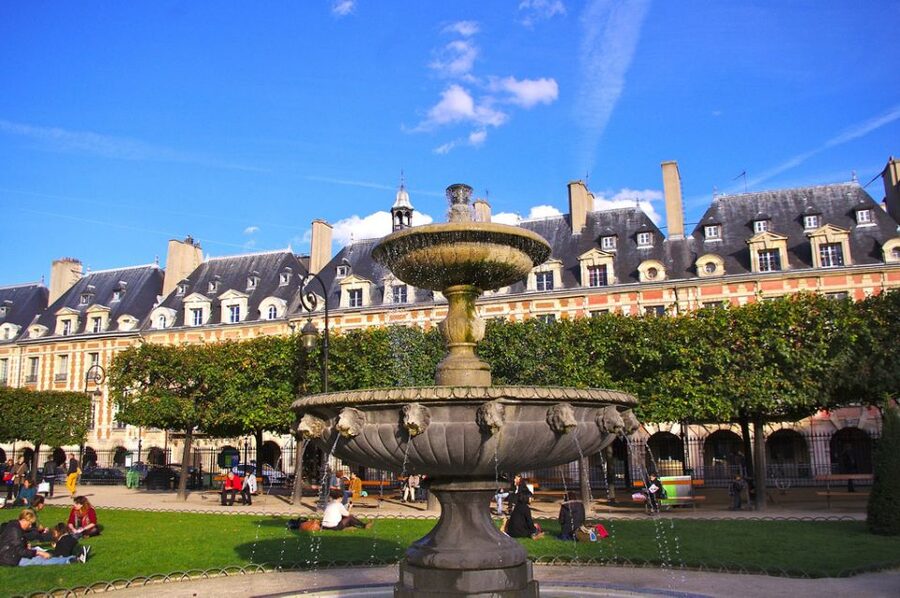
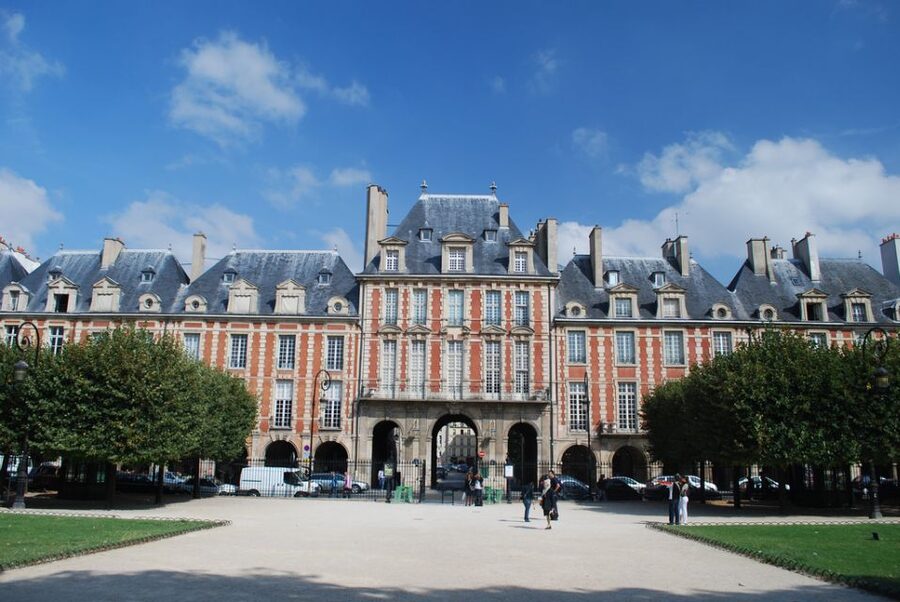
From there, the walk reaches Place des Vosges, often described as one of the most beautiful squares in the world. It is an elegant, carefully planned space with a very different feel from the market streets near Les Halles.
This is likely to be one of the most satisfying visual stops. The regular façades and enclosed layout make the square feel calm and complete. It is also a good place to understand the Marais’s royal and aristocratic era.
I like that Place des Vosges comes after the Pletzl and Hôtel de Sully. You see the neighborhood’s different communities and social levels in sequence. The route does not present the square as the entire Marais. It places the beauty within a more complicated past.
The limitation is time. Two hours does not allow for a long rest in the square or an extended visit to every nearby residence. If you want plenty of time for photographs, shopping, cafés, and museums, plan to return on your own.
Finishing at Place de la Bastille
The listed route ends at Place de la Bastille. The square is tied to one of the best known turning points in French history, and it gives the walk a strong political finish.
After seeing the Marais as a market district, Jewish quarter, royal neighborhood, and civic center, you arrive at a place associated with revolution and public change. That ending reinforces the tour’s larger idea: Paris is shaped by repeated shifts in power and identity.
The tour does not promise a full Bastille history lesson, so keep your expectations in proportion. This is a final landmark within a compact neighborhood walk, not a separate specialist tour of the French Revolution.
Place de la Bastille is also a useful point for continuing your day. The activity ends there, but the tour itself does not provide food, snacks, or beverages. You will need to arrange refreshments separately.
What the private format changes
A private group is the biggest practical advantage of this experience. You are not following a general lecture at a fixed pace. The guide can respond to your questions and shape explanations for the people in your group.
That matters with the Marais because the subject covers several eras and communities. A family with children may need shorter explanations and more visual detail. A group interested in architecture may want more attention on façades and urban planning. A group focused on Jewish Paris may spend more time discussing the Pletzl and Rue Pavée.
The guides have different names and styles. Alexandre is described as passionate and attentive to a group ranging in age from 6 to 75. Fabienne is noted for clear explanations suited to her audience. Anja is described as personable and strong on the history, architecture, and culture of the Marais. Yvana led a playful and well-informed visit, while Caroline was praised for knowing the district’s less obvious places.
You cannot necessarily choose one of these guides when booking, so treat the names as examples of the available team rather than a promise. The important point is that the experience has been led by several guides in a range of styles.
English, French, and Serbo-Croatian are offered. Confirm your preferred language when booking, especially if language choice is central to your decision.
Is $176 per person fair?
At $176 per person, this is not a budget walking tour. For one person, the cost is hard to justify if you only want a quick orientation. You can walk through the Marais without paying for a guide.
The price makes more sense when you value personal attention, historical interpretation, and the ability to ask questions. It may also work better for a small private group that wants one shared experience rather than separate museum tickets or several short activities.
Still, the tour lasts just two hours, and the fee does not include food or drinks. You are paying for the guide and the private format, not for admissions, a meal, or transportation.
I would compare the cost with your group’s interests. If everyone wants to understand Paris through its changing neighborhoods, the price may feel worthwhile. If one person wants architecture, another wants shopping, and another wants only photographs, the group may not get equal value.
The operator, Paris in person private tours, was selected among the top 10 small tour operators in Europe from 26,000 companies in the 2025 Arival TourReview Spotlight Awards. That recognition may provide extra confidence, but it does not change the basic calculation: this is a premium, focused walk.
Timing, weather, and who should book
Two hours is a good length for a first look at the Marais. It is long enough to connect several landmarks without taking over an entire day. You will cover a lot of ground, so comfortable walking shoes are sensible.
Tours operate rain or shine. Paris weather can change quickly, and there is no indoor replacement route promised here. Bring suitable clothing and accept that some explanations will happen outdoors.
I would recommend this experience for:
- First time visitors who want historical context without spending half a day in a museum
- Families who benefit from a private pace
- Small groups with different ages or interests
- People who want to understand the Jewish quarter and royal Marais together
- Repeat visitors who have seen central Paris but have not connected its neighborhoods
I would be more cautious if you dislike walking, want a food tour, or need extensive time inside monuments. Food and drinks are not included, and the information provided does not promise interior visits beyond the outdoor sights and listed locations.
You can cancel up to 24 hours in advance for a full refund, and you can reserve now and pay later. Those terms help if your Paris schedule is still shifting, though they do not make the tour less expensive.
My verdict on the Marais private walk
Book this tour if you want the Marais explained as a changing community rather than presented as a pretty district. The best parts are the clear historical arc, the Pletzl, the contrast between Les Halles and Place des Vosges, and the private guide’s ability to adjust the conversation.
Skip it if your main goal is low cost, long museum time, or a relaxed café stroll. At $176 per person, you should care about the stories behind the streets.
For the right group, this is a smart way to get oriented quickly. You leave with a better sense of how medieval Paris, Jewish Paris, aristocratic Paris, revolutionary Paris, and modern Paris occupy the same compact area.
FAQ
Where does the tour meet?
The meeting point is at Metro Étienne Marcel. Your guide will carry a red canvas tote bag.
How long does the tour last?
The guided walking tour lasts two hours.
Is the tour private?
Yes. The activity is offered for a private group.
Which languages are available?
The live tour guide can conduct the tour in English, French, or Serbo-Croatian.
What places are included on the route?
The route includes Les Halles, Fontaine des Innocents, Centre Pompidou, Hôtel de Ville, the Pletzl area, the synagogue on Rue Pavée, Hôtel de Sully, Place des Vosges, and Place de la Bastille.
Will the tour visit a synagogue?
The route includes seeing the synagogue on Rue Pavée. The provided information does not say that the tour includes entry inside.
Are food and drinks included?
No. Food, snacks, and beverages are not included.
Does the tour operate in bad weather?
Yes. Tours operate rain or shine.
Can I cancel for a refund?
You can cancel up to 24 hours in advance for a full refund.
Do I have to pay at the time of booking?
No. The reserve now and pay later option allows you to book without paying anything today.
More 2-Hour Experiences in Paris
- The Père Lachaise Cemetery: Guided 2-Hour Small-Group Tour
★ 4.7 · 1,065 reviews - Paris: 2-Hour Perfume Creation Workshop
★ 4.8 · 731 reviews - Paris Louvre: 2-Hour Private Tour for Groups or Families
★ 4.6 · 639 reviews - Paris Montmartre: 2-Hour City Tour in German
★ 4.9 · 299 reviews
Recently reviewed around Paris
- Louvre Private Tour – The Essentials and More with Expert Guide★ 5.0 · 227 reviews
- 2CV tour by night★ 5.0 · 55 reviews
- Eiffel Tower Second or Summit Floor Access by Elevator with Views★ 3.5 · 161 reviews
- The only Paris Wine Tasting experience you need to do – 2 hours★ 5.0 · 265 reviews
- 2 Hour Street-art Walk and Space Invaders Hunt in Paris★ 5.0 · 27 reviews
- 2 hour outdoor group activity in Paris: SAINT GERMAIN★ 5.0 · 48 reviews
- Sainte-Chapelle, Conciergerie & Palais de Justice Private Tour★ 5.0 · 72 reviews
- Private 2 – Hour Paris Landmarks Tour by Golf Cart Mini Moke★ 5.0 · 38 reviews
Walking Tours, compared.
Paris Top Sights Half Day Walking Tour with a Fun Guide
Read our review →
Montmartre Hidden Gems and Scenic Highlights Walking Tour
Read our review →
Montmartre Hill French Gourmet Food and Wine Tasting Walking Tour
Read our review →
Paris Île de la Cité and Notre-Dame Walking Tour With Crypt
Read our review →
Montmartre Cheese, Wine & Pastry Guided Walking Tour
Read our review →
Paris in a Day: Louvre or Orsay, Eiffel Tower, City Walk & Cruise
Read our review →
Montmartre Highlights Walking Tour with a Local Guide
Read our review →
Browse the lists this tour appears in