
Reviewed · MONTMARTRE TOURS
Paris: Montmartre Macaron Baking Workshop
Macarons look simple until you try to make them. This two-hour class shows you why the shell texture, piping pressure, and filling all matter. I like the small groups of up to eight and the fact that you make your own batch rather than simply watching a chef work. I also like the choice of fillings and colors, which gives the class more personality than a fixed recipe lesson.
Kanika and Vouthy lead the workshop in English and French, with plenty of hands-on guidance. You learn the Italian meringue method, practice macaronage, use a double nozzle for decorations, and prepare a raspberry or mango-passion ganache. The main consideration is that this is a working kitchen class, not a demonstration you can casually observe. Every person in the room must have a reservation, and the class is not suited to people with food allergies, lactose intolerance, wheelchair users, or children under six.
In This Review
- Key points before you book
- What happens at Maca’Rong on Rue Legendre
- Starting with tant pour tant and Italian meringue
- Macaronage and the glossy batter test
- Piping shells without wasting the batter
- Decorating with a double nozzle
- Ganache, fillings, and the waiting time
- How good is the value at $150?
- Language, instruction, and the pace of the class
- Who will enjoy this Paris baking class?
- Fitting Rue Legendre into a Montmartre day
- Booking details that affect your decision
- Should you book the Montmartre macaron workshop?
- FAQ
- Where does the macaron workshop begin?
- How long does the class last?
- How many people can join the class?
- What languages are spoken?
- How many macarons do I take home?
- What fillings are included?
- Can someone come along just to watch?
- Is the activity suitable for everyone?
Key points before you book
- At least 15 macarons to take home: Each participant receives a special box and a bag, with some people producing more than the promised amount.
- Italian meringue technique: You learn a precise method designed to help shells bake evenly and avoid cracks.
- Creative decoration: A double nozzle lets you add individual designs instead of making every macaron look alike.
- Several filling choices: The workshop includes 10 fillings, with raspberry or mango-passion ganache among the featured options.
- Family-friendly format: Children and adults can work side by side, though all participants must reserve a place.
- Convenient two-hour plan: The class begins and ends at Maca’Rong, at 175 Rue Legendre, with tea and coffee included.
What happens at Maca’Rong on Rue Legendre
You begin at Maca’Rong, a ground-floor shop at 175 Rue Legendre in the 17th arrondissement. Go inside the shop rather than waiting outside for a guide. The same location serves as the ending point, so you do not need to arrange a second meeting spot.
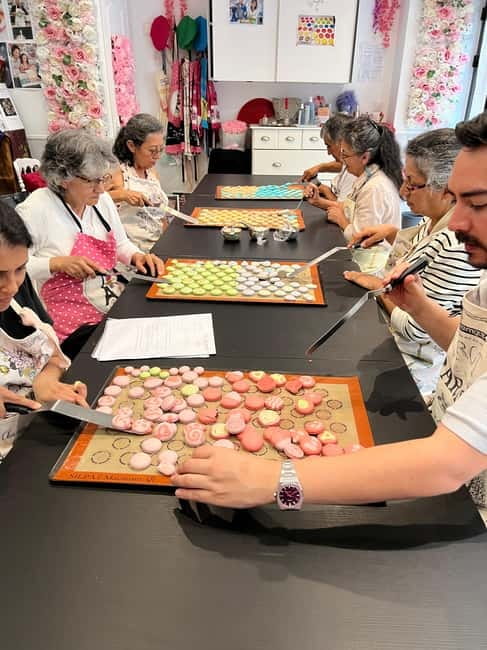
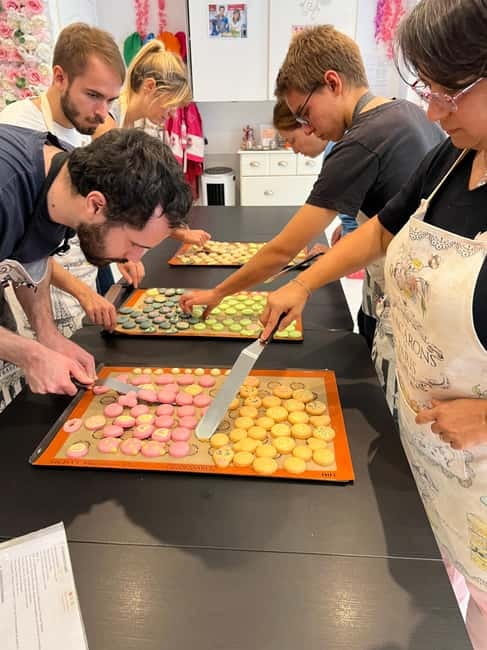
The class is limited to eight people. That number matters here. Macaron making has several moments when a small mistake can affect the final shell, especially while whipping the meringue, folding the batter, or filling the piping bag. In a big group, you might spend more time trying to see the chef than handling the mixture yourself. This setup gives Kanika and Vouthy room to correct your technique as you work.
The atmosphere is friendly and relaxed, but this is still a real practical lesson. You are expected to participate from the start. Parents or companions who have not booked cannot stay simply to watch, so count every person who plans to join the kitchen work when you reserve.
More cooking and pastry classes in Paris:
- Paris Cooking Class and Lunch with Wine plus Market Visit Option
★ 5.0 · 1,024 reviews - Paris: Macaron Class at Galeries Lafayette
★ 4.3 · 905 reviews - Paris Cooking Class: Learn How to Make Macarons
★ 5.0 · 634 reviews
Starting with tant pour tant and Italian meringue
Your ingredients are prepared in bowls before the class begins. The base mixture is known as tant pour tant, a blend of equal parts almond flour and powdered sugar. Having this measured and ready keeps the workshop moving and leaves more time for the parts you actually need to learn.
The key lesson is the Italian meringue method. Instead of relying only on a simpler approach, you work with a technique that uses a cooked sugar syrup and whipped egg whites. It is more technical, but the class presents it as a reliable way to produce smooth macaron shells.
You also hear about other ways to make macarons. That is useful if you plan to continue baking at home, since you can compare methods instead of assuming there is only one correct route. The instructors focus on practical points that affect success, such as avoiding cracked shells and handling the batter at the right stage.
Do not expect to master every detail instantly. Macarons are sensitive, and the method rewards careful timing. The value of having Kanika or Vouthy nearby is that you can ask questions while the mixture is in front of you, rather than discovering a problem later from a recipe book.
Macaronage and the glossy batter test
Once the meringue meets the almond mixture, you work through macaronage, the folding process that turns the stiff mixture into a smooth batter. This is one of the most important parts of the class because the batter must be fluid enough to pipe, but not so loose that the shapes spread across the tray.
The finished mixture should shine. That glossy look is more than a pretty detail. It helps show that the batter has been folded to a usable consistency. Too little folding can leave the mixture thick and lumpy. Too much can make it runny. The instructor demonstrates what to look for, then helps you judge your own bowl.
I find this part especially useful for home bakers because it teaches you to read the mixture rather than follow a rigid clock. Kitchen temperature and ingredient conditions can change, so visual clues are valuable. You leave with a better sense of what the batter should look and feel like before it reaches the oven.
Piping shells without wasting the batter
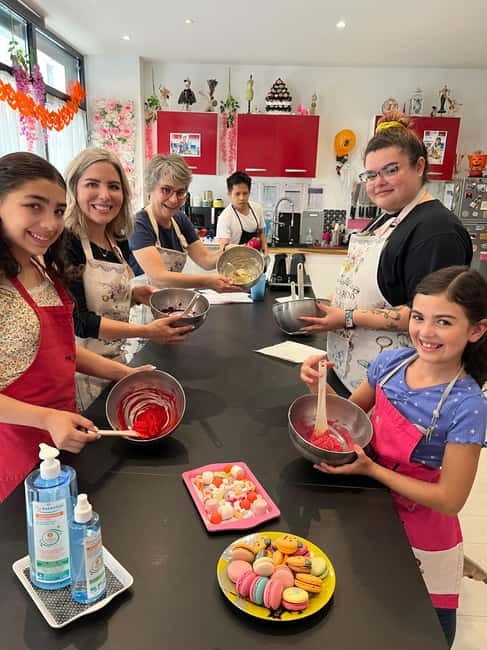
Filling a piping bag sounds easy until batter starts appearing at the wrong end. The class shows you how to load the bag neatly and efficiently, with the aim of reducing waste. That small skill makes the whole process less messy and gives you better control.
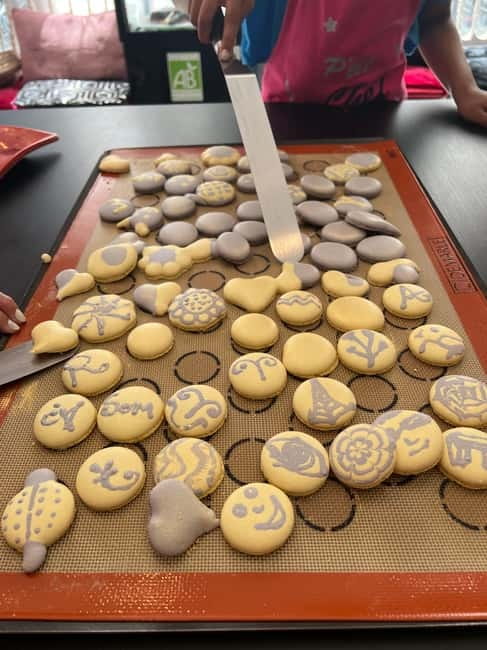
You first pipe onto round templates. This helps you produce shells of roughly equal size, which matters because each finished macaron needs a matching top and bottom. Even shells also make it easier to fill and box your macarons later.
Piping takes practice. You need steady pressure, a consistent angle, and a quick stop at the end of each round. The instructors guide you through the movement rather than leaving you to guess. If your first shells are uneven, you can still learn from the next tray and improve your rhythm.
The class does not treat perfection as the only goal. The creative part comes soon after, and individual designs can make minor differences in shape feel intentional.
More Paris trips worth a second look
- Fragonard Paris: Mini Perfume Workshop
★ 4.5 · 1,924 reviews - Paris Croissant Small-Group Baking Class with a Chef
★ 5.0 · 910 reviews - Paris: 2-Hour Perfume Creation Workshop
★ 4.8 · 731 reviews - Paris: French Croissant Baking Class with a Chef
★ 4.9 · 712 reviews
Decorating with a double nozzle
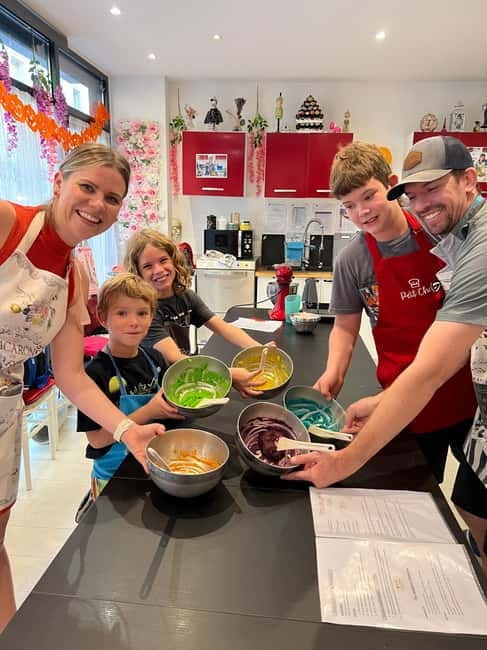
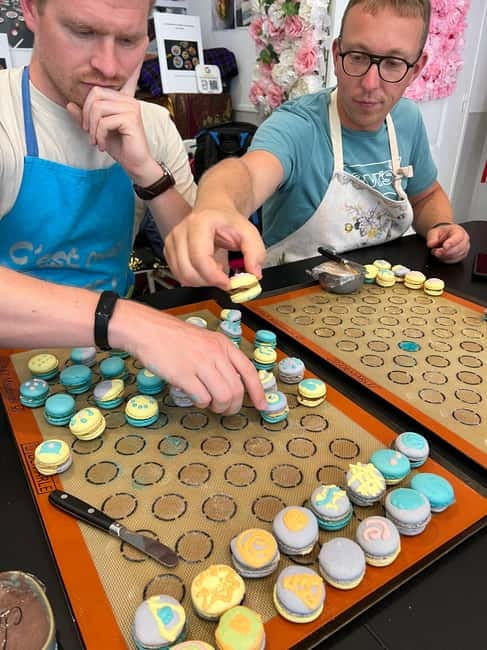
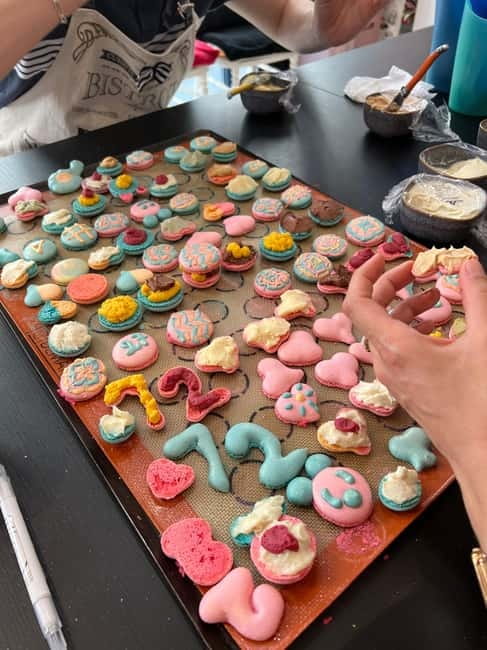
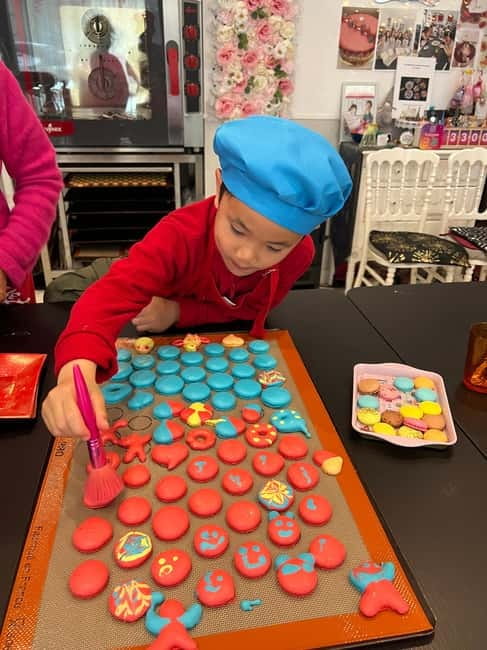
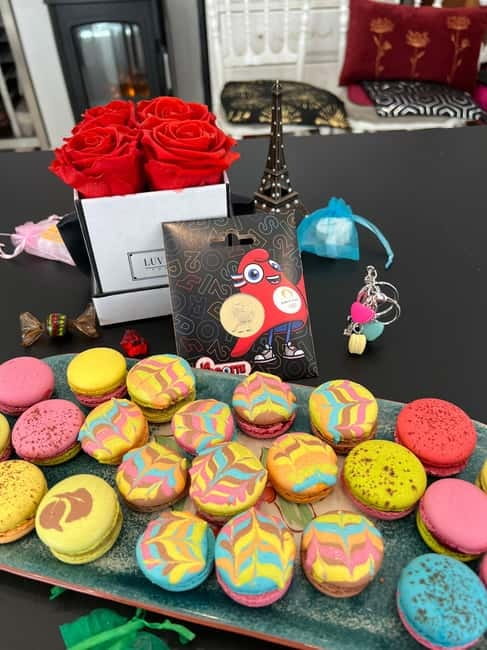
After learning the basic round shape, you use a smaller double nozzle to add designs to the shells. This is one of the workshop’s most enjoyable details because you are not limited to a single uniform style. You can personalize the macarons with different patterns and colors.
The decoration stage suits mixed groups well. A serious home baker can focus on clean lines and technique, while a child or first-time baker can enjoy choosing shapes and colors. It also gives you a chance to make a box that looks like your own work, rather than a set of identical pastries produced by the instructor.
The number you take home depends partly on your piping precision, but the stated amount is at least 15 macarons per person. Some class participants have left with more than 20, and families who booked several places have taken home a large supply. Do not plan to carry them loose in your luggage. Each person receives a special box and a bag for transport.
Ganache, fillings, and the waiting time
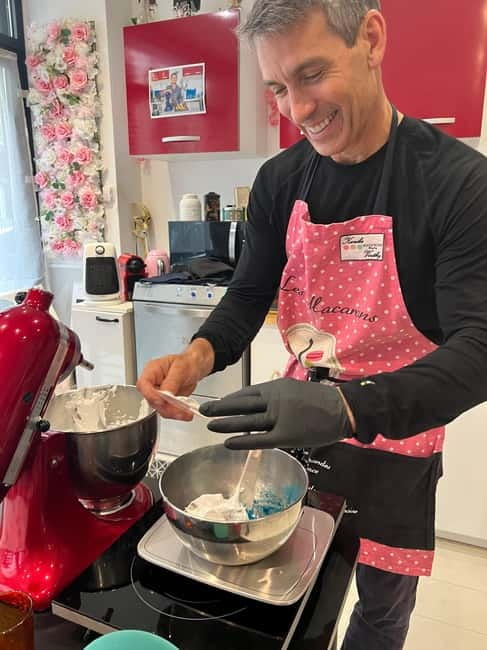
While the shells bake, the class turns to filling. You see how to prepare a raspberry ganache, with mango-passion as another featured flavor. The fruit fillings bring a sharp, fresh note to the sweet shell and show why the filling is not an afterthought.
The workshop includes 10 fillings, giving you more choice than a class that makes one flavor for the whole group. The exact combination available can vary, but the format allows you to personalize the macarons instead of putting the same center in every piece. Some sessions have also included savory options such as a French cheese filling.
This waiting period is used well. You continue learning instead of simply standing around for the oven timer. The instructors share a secret recipe and explain how the filling works with the shell. Tea, coffee, and macarons are included, so there is also time to taste and talk while the baking continues.
Freshly made macarons are delicate. Let them cool before filling, and handle them carefully when placing them in the box. The class gives you the finished pastries to take away, but you should treat the box as a fragile food package rather than something to stuff into an already full day bag.
How good is the value at $150?
At $150 per person, this is not a cheap pastry tasting. You are paying for an instructor-led kitchen session, ingredients, drinks, recipe guidance, a range of fillings, and at least 15 macarons to take home. The value improves if you would otherwise buy several expensive boxes of macarons and want a skill-based activity instead of a purchase.
The price also makes more sense for a family or small private group that values shared time. A family of eight can fill the whole class, and the format allows children, teenagers, parents, and older relatives to work together. Several age groups can take part at once, though young children need to be comfortable with a structured kitchen activity and must be at least six.
I would not book this solely to save money on macarons. The real product is the class. The box of pastries is the tasty result and a useful bonus, but the best reason to pay is that you learn how the shells and fillings come together.
The take-home quantity can be generous. Fifteen macarons per person is already a substantial amount, and some participants have produced around 20 or more. If you attend early in your Paris stay, you can enjoy them over the following days, provided you store and carry them sensibly.
Language, instruction, and the pace of the class
The workshop is offered in English and French. Kanika and Vouthy are the instructors associated with the class, and the teaching style is patient, encouraging, and hands-on. English support is available, though one account of the class found a strong French accent occasionally difficult to follow.
That is worth noting if you need every instruction delivered slowly and perfectly in English. The work is visual, however, and the chef demonstrates each major step. You can watch the consistency of the meringue, the motion used for macaronage, and the pressure needed for piping.
The two-hour duration keeps the activity manageable during a Paris visit. You get enough time to make, decorate, fill, and box your macarons without committing a full morning or afternoon. Check the available starting times when booking, since the schedule is not fixed in the information provided.
Who will enjoy this Paris baking class?
This is a strong choice for families, couples, small groups, and anyone who wants a break from museums and monuments. It works especially well for a mixed-age group because the class combines technical instruction with a playful decorating stage. Children as young as five have taken part with a parent in the same booking, but the formal rule says the activity is not suitable for children under six.
It also suits experienced bakers. One participant already knew French and Swiss macaron methods and still found the Italian approach useful. You can compare methods, ask about consistency, and refine your piping instead of treating the class as a beginner-only lesson.
The workshop is less suitable if you dislike precise baking or want a passive food experience. You will handle the ingredients, follow instructions, and work through a process where small errors matter. It is also not appropriate for people with food allergies or lactose intolerance, and it is not suitable for wheelchair users or babies under one.
Leave oversized luggage behind. The activity does not allow it, and a box of macarons needs careful handling anyway. Plan this as a focused stop, then continue your day without a large suitcase or bulky shopping bag.
Fitting Rue Legendre into a Montmartre day
The class takes place near Montmartre, but the meeting point is not directly at the Sacré-Coeur or the famous hilltop streets. Allow roughly 20 minutes to walk between the class location and Montmartre sights, based on the practical timing shared for the route.
That makes the workshop easy to pair with a Montmartre visit, but do not schedule it as if you are stepping straight from the class into the basilica. Give yourself time for the walk, especially if you are traveling with children or carrying your pastry boxes.
A sensible plan is to visit Montmartre before or after the class, then return to Maca’Rong at the appointed time. The workshop itself ends where it starts, so your onward plan can remain simple. A nearby lunch or neighborhood stop can round out the day, though the class information does not specify particular restaurants.
Booking details that affect your decision
The activity costs $150 per person and lasts two hours. You can cancel up to 24 hours in advance for a full refund, and the reserve-now, pay-later option lets you hold a place without paying immediately.
All participants must reserve. You cannot bring an unbooked friend or family member to observe, even if that person does not plan to bake. This rule is important for families, since the class has only eight spaces and the instructors need to plan ingredients and equipment.
The class begins and ends at Maca’Rong, 175 Rue Legendre. English and French instruction is available, and the small-group format is capped at eight people. Check the starting time and current availability before you commit your Paris itinerary.
Should you book the Montmartre macaron workshop?
I would book this if you want an active Paris experience with something edible to show for it. The class offers real technique, personal decoration, several fillings, and a generous box of macarons. Kanika and Vouthy’s patient approach makes it suitable for beginners, while the Italian meringue method gives experienced bakers something new to compare.
At $150, it is a premium activity, not a bargain pastry stop. You should be ready to participate, follow careful instructions, and accept that macarons can be finicky. If that sounds fun, this is a memorable way to spend two hours near Montmartre, especially for families or small groups who want to make something together rather than simply buy it.
FAQ
Where does the macaron workshop begin?
The workshop begins inside the Maca’Rong shop on the ground floor at 175 Rue Legendre in the Ile-de-France region of Paris.
How long does the class last?
The class lasts two hours. Starting times vary, so check availability when booking.
How many people can join the class?
The workshop is a small-group activity limited to eight participants.
What languages are spoken?
Instruction is available in English and French.
How many macarons do I take home?
Each participant is expected to take home at least 15 handmade macarons in a special box. The number can be higher if your piping is especially precise.
What fillings are included?
The experience includes 10 fillings. The class demonstrates raspberry or mango-passion ganache, and other options may include savory fillings such as French cheese.
Can someone come along just to watch?
No. Everyone at the workshop must have a reservation, so unbooked companions cannot stay just to observe.
Is the activity suitable for everyone?
The class is not suitable for children under six, babies under one year, wheelchair users, people with food allergies, or people with lactose intolerance. Oversized luggage is also not allowed.
Recently reviewed around Paris
- Louvre Private Tour – The Essentials and More with Expert Guide★ 5.0 · 227 reviews
- 2CV tour by night★ 5.0 · 55 reviews
- Eiffel Tower Second or Summit Floor Access by Elevator with Views★ 3.5 · 161 reviews
- The only Paris Wine Tasting experience you need to do – 2 hours★ 5.0 · 265 reviews
- 2 Hour Street-art Walk and Space Invaders Hunt in Paris★ 5.0 · 27 reviews
- 2 hour outdoor group activity in Paris: SAINT GERMAIN★ 5.0 · 48 reviews
- Sainte-Chapelle, Conciergerie & Palais de Justice Private Tour★ 5.0 · 72 reviews
- Private 2 – Hour Paris Landmarks Tour by Golf Cart Mini Moke★ 5.0 · 38 reviews
Montmartre Tours, compared.
Montmartre Hidden Gems and Scenic Highlights Walking Tour
Read our review →
Montmartre Hill French Gourmet Food and Wine Tasting Walking Tour
Read our review →
Montmartre Cheese, Wine & Pastry Guided Walking Tour
Read our review →
Montmartre Highlights Walking Tour with a Local Guide
Read our review →
Sacré-Coeur and Montmartre Tour with Expert Guide
Read our review →
Private Montmartre Food Tour with Wine, Cheese & Pastries
Read our review →
Paris Montmartre Food Tour – A Full French Meal by Do Eat Better
Read our review →
Hidden Montmartre: Paris’ Secret Streets Walking Tour
Read our review →Browse the lists this tour appears in